
Study & Preparation
CCNA 200-301 Security: AAA, TACACS+, RADIUS, and VPNs
About this video
Security is not a single command you enable on a router or switch. It is a system of complementary controls designed to protect confidentiality, integrity, and availability. In this video, we break down the security fundamentals required for CCNA 200-301, including management-plane protection, secure identity methods, centralized AAA, TACACS+, RADIUS, and IPsec VPN architectures. We begin by separating four security terms that candidates frequently confuse: • A threat is a potential cause of harm. • A vulnerability is a weakness in a system or defense. • An exploit is the mechanism used to target that weakness. • A mitigation is a control that reduces the likelihood or impact of an attack. Security also begins beyond the command line. User awareness, organizational policy, physical access controls, secure password handling, and encrypted management all contribute to the overall defense. Next, we examine the management plane—the pathway administrators use to configure, monitor, and maintain network devices. A secure management session depends on: • Routed reachability • Encrypted transport such as SSH • Verified identity • Appropriate privilege limits • Operational logging Local user accounts can provide an important backup access method, but managing separate credentials across a large device estate does not scale safely. We’ll also compare stronger identity methods: • Multi-Factor Authentication • Digital certificates • Biometrics The central section of the video explains the AAA framework: Authentication confirms who you are. Authorization determines what you are permitted to do. Accounting records what you actually did. You’ll then learn the operational differences between TACACS+ and RADIUS. TACACS+ is commonly used for network-device administration. It operates over TCP port 49, encrypts the packet payload, and separates authentication, authorization, and accounting into independent functions. RADIUS is commonly used for network access control such as 802.1X. It uses UDP ports 1812 and 1813, protects the password field, and combines authentication and authorization into one transaction. A critical operational rule is to configure and test a local fallback method before activating centralized AAA. If the central server becomes unreachable and no fallback exists, administrators may lose access to the device completely. The VPN section compares two architectures: • Site-to-Site VPNs protect traffic between network gateways. • Remote-Access VPNs protect individual users connecting from remote locations. Both models can depend on IPsec to provide: • Confidentiality through encryption • Integrity through hashing • Peer authentication using pre-shared keys or certificates • Anti-replay protection The VPN peers must agree on the required cryptographic parameters. A mismatch in one area can prevent the tunnel from forming. For troubleshooting, begin with the underlying dependencies. First, verify physical and Layer 3 reachability to the AAA server or VPN peer. Do not begin by blaming credentials or cryptographic algorithms when the destination is not reachable. Useful Cisco verification commands covered in this lesson include: show aaa method-lists show running-config | section aaa show crypto isakmp sa show crypto ipsec sa Common CCNA security traps include: • Treating threats, vulnerabilities, and exploits as the same concept • Assuming successful authentication guarantees correct authorization • Using Telnet because access has been restricted by source IP • Activating centralized AAA without testing local fallback • Assuming every tunnel provides encryption • Changing AAA or remote-access rules without a recovery session The exam-thinking principle is simple: Verify reachability before cryptography. Verify authorization after authentication. Verify fallback before changing remote access. Use this lesson to build a structured understanding of security controls, device administration, AAA, and VPN protection for both the CCNA exam and real enterprise networks. #CCNA #Cisco #CCNA200301
Keep watching
 7:53
7:53Study & Preparation
CCNA 200-301 v1.1 Study Roadmap Before v2.0
 11:32
11:32Study & Preparation
CCNA 200-301 Network Devices and Topologies Explained
 11:32
11:32Study & Preparation
CCNA 200-301 Ethernet Switching, MAC Learning, and TCP vs UDP
 8:37
8:37Study & Preparation
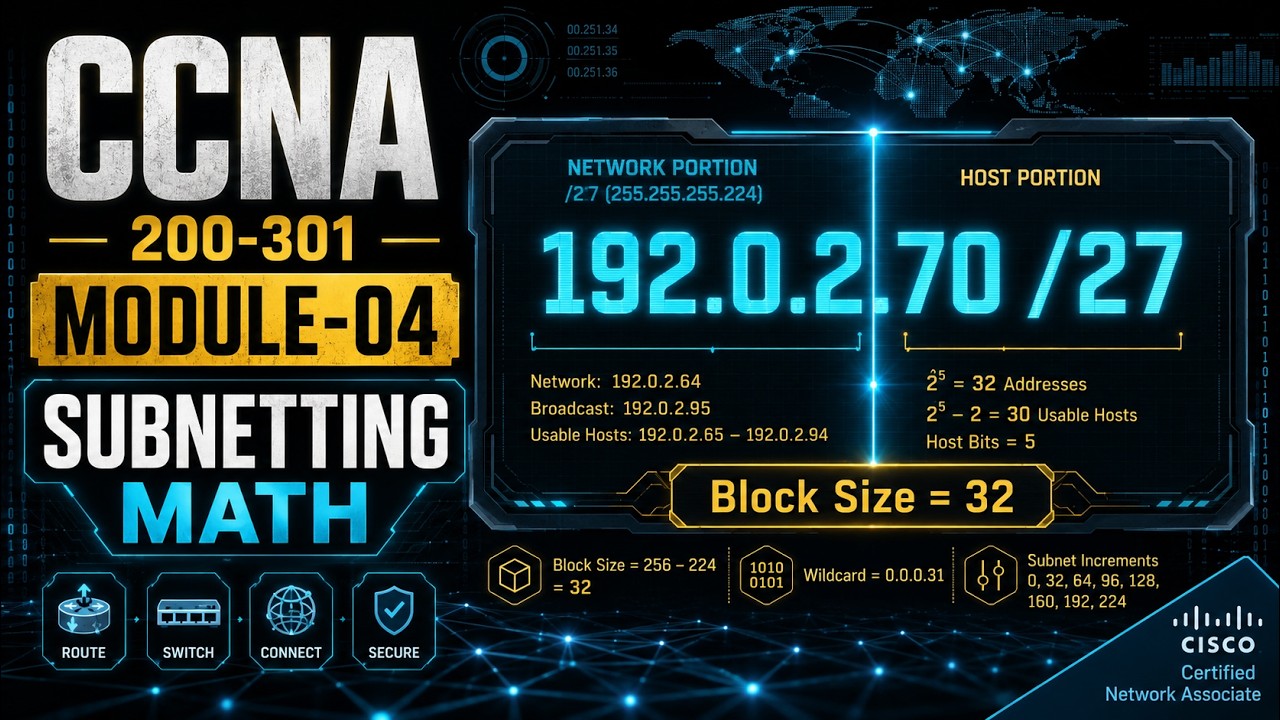
CCNA 200-301 IPv4 Addressing and Subnetting Explained
 8:12
8:12Study & Preparation
CCNA 200-301 IPv6 Addressing and Prefixes Explained
 10:07
10:07Study & Preparation