
Introduction
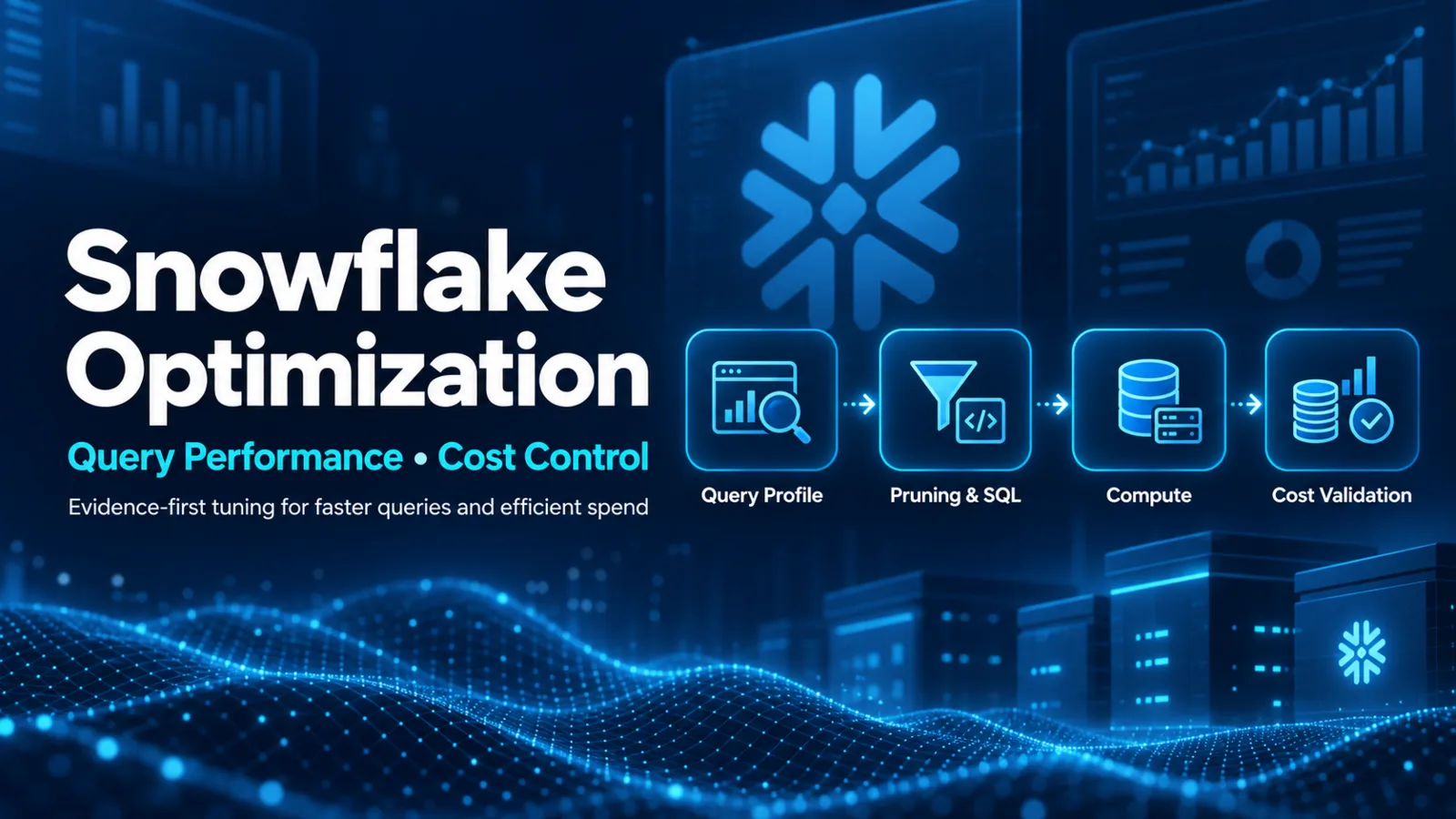
Snowflake optimization should begin with evidence, not a favorite feature. Query latency can come from queueing, compilation, scanning, spill, joins, network transfer, blocking, or an unsuitable compute profile. Cost can come from warehouse runtime, additional clusters, serverless services, storage structures, or repeated inefficient work. The correct change targets the dominant constraint and proves the benefit afterward.
The Optimization Model
Optimization spans four layers:
- SQL and data model: predicates, joins, projections, transformations, and repeated computation.
- Storage organization: micro-partition pruning, clustering, materialized views, and search optimization.
- Compute: warehouse size, type, cluster count, suspension, and workload isolation.
- Scheduling and concurrency: queueing, task timing, overlapping jobs, and resource contention.
A change in one layer can shift cost to another. Automatic Clustering, search optimization, and materialized views can improve selected reads but add compute or storage cost. A larger warehouse may finish a suitable workload faster but consumes credits at a higher rate while active.
Start with Query Profile
Use Query History to locate the query and Query Profile to inspect operators, data flow, scan volume, partitions scanned, spill, and time distribution. Compare a stable query ID and representative parameters rather than relying on a single anecdotal run.
Ask:
- Was the query queued before execution?
- How much data and how many micro-partitions were scanned?
- Did filters remove rows early or late?
- Did joins expand row counts unexpectedly?
- Was data spilled to local or remote storage?
- Did network communication or synchronization dominate?
- Was the result eligible for persisted-result reuse, and is cache reuse relevant to the test?
Improve Pruning and SQL Shape
Snowflake stores metadata for micro-partitions and prunes partitions that cannot match predicates. Use appropriate typed predicates and avoid transformations that prevent useful pruning when an equivalent direct comparison is possible. Select required columns instead of scanning unused wide values.
For repeated transformations, consider whether a curated table, dynamic table, or materialized view is appropriate under current feature rules. This is a design decision with freshness, maintenance, ownership, and cost implications.
Do not add a clustering key merely because a large table exists. Snowflake documentation positions clustering for sufficiently large tables with repeated access patterns that benefit from improved organization. Measure query performance and clustering behavior before and after.
Choose Compute from the Symptom
Scale up when individual queries are compute- or memory-constrained and tests show benefit. Scale out with multi-cluster behavior when concurrent queries queue and edition or cost requirements support it. Separate workloads when independent service levels or chargeback matter.
Warehouse-local disk cache can benefit repeated scans while a warehouse remains running. Suspending the warehouse discards that local cache, although persisted query results and metadata have separate lifecycles. Do not keep a warehouse active solely for cache without measuring whether the saved latency justifies idle cost.
Specialized Optimization Services
Snowflake documents several options:
- Search Optimization Service for supported selective lookup patterns.
- Query Acceleration Service for eligible portions of certain queries.
- Materialized views for precomputed subsets or transformations.
- Clustering to improve organization around selected dimensions.
Eligibility is query- and feature-specific. Search optimization and query acceleration can complement each other for supported queries, but neither is a universal replacement for sound SQL or warehouse design. Verify edition, supported data types, maintenance cost, and query eligibility.
Cost-aware Validation
Use an experiment with a defined baseline:
- Capture query IDs, parameters, warehouse state, runtime, bytes scanned, partitions scanned, queueing, spill, and credits over a representative period.
- Change one controlling variable.
- Repeat with comparable data and concurrency.
- Compare latency percentiles, throughput, and total cost, not only the fastest run.
- Check maintenance or serverless costs introduced by the change.
- Document rollback criteria.
Warning: enabling optimization services or increasing warehouse resources can create ongoing cost. Test in a controlled environment and establish an owner for budget alerts.
Common Mistakes
- Resizing a warehouse before checking whether the query is queued or poorly pruned.
- Comparing a cold run with a cached run and attributing all improvement to code.
- Adding clustering to small or infrequently queried tables.
- Enabling every optimization service without checking eligible query patterns.
- Measuring one query while ignoring concurrent workload and total credits.
- Optimizing runtime at the expense of freshness, correctness, or governance.
Certification Relevance
COF-C03 includes performance monitoring and optimization. The required reasoning is causal: identify the evidence, select the control that owns the constraint, and include cost and verification in the decision.
Authoritative Sources
- Optimizing query performance
- Optimizing storage for performance
- Micro-partitions and data clustering
- Monitor query activity with Query History
Conclusion
Effective Snowflake optimization connects Query Profile evidence to one dominant constraint, tests a targeted change, and validates both performance and cost. This method avoids expensive feature-first tuning and produces decisions that remain explainable.