
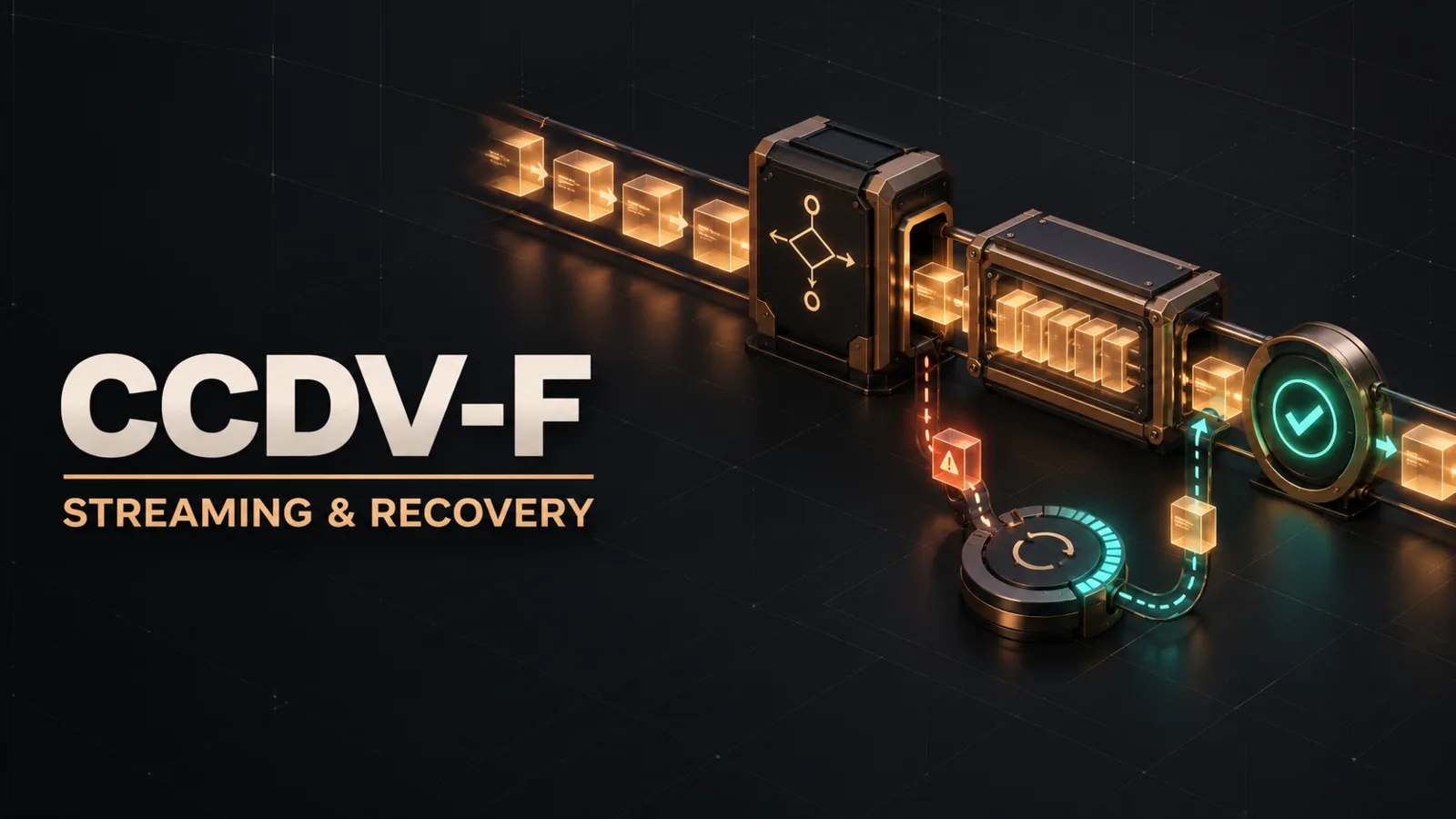
A Claude API client should process a streaming response as a state machine and recover from failure only after identifying the layer, the last confirmed event, and whether another attempt is safe. Consume Server-Sent Events (SSE) in order, assemble content blocks incrementally, apply bounded backpressure, and declare success only after the stream reaches its documented terminal event. Then classify failures as transport, HTTP/API, rate-limit, stream-protocol, or application-consumer problems before choosing retry, backoff, fallback, or escalation.
The central safety rule is not “retry every transient-looking error.” A retry has a new cost and may duplicate work, and a stream that failed after partial output is not equivalent to one that never started. Preserve attempt and request correlation data, respect current server retry signals, use capped exponential backoff with jitter for qualified transient failures, and stop when the error is deterministic, the retry budget is exhausted, or the application cannot safely reconcile partial results.
Troubleshooting Methodology: Find the Failed Boundary
Begin with the first boundary that lacks evidence of successful completion. This keeps a network interruption from being misdiagnosed as weak model output and keeps a blocked consumer from being blamed on the API.
| Failure boundary | Evidence to inspect | Typical ownership |
|---|---|---|
| Request construction | Serialization result, request size policy, authentication configuration | Application and API adapter |
| Transport before response | Name resolution, connection, Transport Layer Security, timeout, cancellation | HTTP client, runtime, network path |
| HTTP/API response | Status, API error type and message, request identifier, response headers | API adapter and recovery policy |
| Streaming protocol | SSE event name, JSON payload, block index, lifecycle phase, terminal event | Stream parser and adapter |
| Async consumer | Queue depth, processing latency, cancellation state, blocked tasks | Application runtime and downstream consumer |
| Application result | Completeness, schema or policy validation, authorization | Application logic |
Use the Claude API errors documentation to interpret current API error shapes and status mappings. Use the streaming documentation for event semantics. Do not infer a model-quality failure until the transport, API, parser, and consumer boundaries have produced a complete response that the application can evaluate.
Process the SSE Lifecycle as a State Machine
With streaming enabled, the Messages API sends a sequence of SSE events rather than one complete response body. A robust client parses the SSE envelope, parses each JSON data payload, and advances explicit message and content-block state.
The current documented lifecycle includes:
- message_start, which initializes the Message-level state;
- content_block_start, which opens a typed block at an index;
- one or more content_block_delta events, which add incremental data to that block;
- content_block_stop, which closes the block;
- message_delta, which updates Message-level fields such as completion and usage information under the current contract; and
- message_stop, which terminates the successful stream.
Ping events can appear during the stream, and an error can arrive as an SSE event after the HTTP response has already begun. The streaming documentation also advises that new event types may be added. Dispatch on the event name, tolerate ignorable events deliberately, and fail visibly on an event that would invalidate application state. Do not assume that HTTP status 200 guarantees a complete streamed Message.
Preserve block identity, order, and type
Maintain a block table keyed by the documented index. Open a block only through its start event, apply compatible deltas to that block, and finalize it only after its stop event. Reject impossible transitions such as a delta for a block that was never opened or a second close for an already closed block.
Do not flatten every delta into one global text buffer. Typed blocks can have different delta shapes, and multiple blocks can appear in one Message. The application adapter should return an ordered, typed result or an explicit unsupported-block outcome.
Define when partial output is usable
Partial display and final acceptance are separate states. A user interface may render text as it arrives, but downstream code should not treat the partial value as a completed business result. Mark partial content as provisional, and release it for validation or side effects only after the terminal event and required block closure have been observed.
If a stream ends early, choose one documented application policy:
- discard the partial result and report a retryable or terminal failure;
- retain it only as visibly incomplete diagnostic or user-facing content;
- offer a user-controlled new attempt; or
- resume through an application-designed continuation flow when current API behavior and the task make that safe.
Do not concatenate a retried response onto partial output as if the two attempts were one authoritative Message. The new request may produce different content.
Control Asynchronous Work and Backpressure
Streaming changes one request into a producer-consumer pipeline. The HTTP reader produces events; parsing and validation transform them; rendering, storage, or another consumer processes the result. If the consumer is slower than the producer, an unbounded queue turns latency into memory growth and eventual failure.
Use bounded flow control:
- cap the event or byte buffer;
- process events in order with one owner of the assembly state;
- pause or naturally await further reads when the runtime supports it;
- cancel the upstream request when the consumer is gone or the budget is exceeded;
- keep slow logging, persistence, or user-interface work outside the parser's critical section; and
- measure queue depth, processing delay, and total stream duration.
Backpressure policy is application engineering, not an API limit. Choose the bound from workload tests and memory budgets, and make overflow behavior explicit. Dropping arbitrary deltas corrupts the result; cancellation with a clear incomplete-state outcome is safer than silently losing events.
Propagate cancellation and deadlines
One operation should have a coherent cancellation path from caller to HTTP request to parser to downstream consumer. When a user leaves a page, a job deadline expires, or a service shuts down, cancel outstanding reads, release resources, and record that the stream ended by client decision rather than server completion.
Separate connection, first-event, idle, and total-operation deadlines when the client stack supports them. These protect different failure modes. Values should come from application service objectives and observed latency, not from invented universal constants.
Avoid detached retry work
The component that owns the request should also own its retry task and retry budget. Detached background retries can outlive the caller, continue spending after cancellation, or deliver a late result into a new session. Use structured concurrency or an equivalent ownership pattern so cancellation, error propagation, and cleanup remain visible.
Classify API Errors Before Retrying
The current API errors reference documents HTTP statuses and API error types. Treat the exact mapping as version-sensitive, but preserve the durable recovery distinction between invalid requests, access failures, size failures, rate limits, server failures, and overload.
| Failure class | Recovery direction | Why |
|---|---|---|
| Invalid request | Do not retry unchanged; correct fields, types, or supported options | Repetition does not repair a deterministic contract error |
| Authentication or permission failure | Stop and repair credentials, identity, or access policy | Backoff cannot grant access |
| Not found or unsupported resource | Recheck the endpoint, model, identifier, and current availability | The selected target may be wrong or no longer available |
| Request too large | Reduce or redesign the request before retrying | Waiting does not change payload size |
| Rate limit | Wait according to current server signals and the client's budget | Immediate retries add pressure and usually repeat the failure |
| Server or overloaded response | Retry a safe operation with bounded backoff and jitter; consider a qualified fallback | The condition may be transient but can persist |
| Connection loss or timeout | Decide from operation safety and observed progress; retry only within budget | The client may not know how far the request progressed |
| Stream error after partial output | Finalize the attempt as incomplete before any new request | The first attempt has already exposed provisional content and consumed work |
SDKs can translate these responses into language-specific exceptions. Keep recovery policy based on normalized status, error type, headers, and stream phase rather than spreading SDK exception subclasses through business code.
Respect Rate-Limit Signals
Rate limits protect different resource dimensions and can vary by account tier, model, and current platform policy. Consult the current rate-limit documentation rather than embedding permanent request or token limits.
When a rate-limited response provides retry-after, do not retry earlier than that signal. Current rate-limit headers can also expose limit, remaining-capacity, and reset information for documented dimensions. Treat header names and semantics as a versioned adapter concern; parse them centrally and retain raw values for diagnosis.
A client-side limiter should reduce collisions before the service rejects work. Coordinate concurrent requests, request rate, and token demand at the scope where limits actually apply. If several processes share the same quota, an isolated per-process counter can still create a distributed retry storm.
Use bounded exponential backoff with jitter
For a qualified retryable failure:
- honor a valid server-provided delay when present;
- otherwise calculate an exponentially increasing client delay;
- add jitter so many workers do not retry together;
- cap both the delay and the number or elapsed duration of attempts; and
- stop immediately if the caller cancels or the operation deadline expires.
The retry budget should be smaller than the caller's total deadline and should reserve time to return a controlled failure. Infinite retries convert a transient dependency problem into resource exhaustion and unpredictable cost.
Decide Whether a Retry Is Safe
A Messages API generation request does not authorize downstream application actions, but another attempt can still produce another charge, another output, and another set of logs. Retry safety therefore depends on the whole workflow, not only the HTTP method.
Ask four questions before retrying:
- Did the client receive any response or stream event from the prior attempt?
- Has partial content been displayed, persisted, or passed to another component?
- Can the application distinguish attempts and discard duplicate or stale results?
- Could another generated result cause a downstream operation to execute twice?
Assign an application operation identifier and a unique attempt identifier. Preserve the API request identifier when available. This creates a trace from the user operation through multiple service attempts without pretending the API request itself is a business transaction.
Choose retry, fallback, or escalation deliberately
- Retry when the failure class is transient, the operation is safe to repeat, and budget remains.
- Fallback only to a model or path already evaluated for the same content, safety, schema, and compatibility requirements. A cheaper or more available model is not automatically equivalent.
- Escalate when credentials or permissions need intervention, a deterministic request defect needs code or configuration change, repeated service failures exceed policy, partial output cannot be reconciled, or the application cannot meet its objective safely.
Expose a controlled failure rather than masking a persistent problem with an unverified fallback. Record which path produced the final result so later evaluation and incident review can separate primary and fallback behavior.
Troubleshooting Workflow
Use this order during an incident or test failure:
- Capture the operation ID, attempt ID, time, environment, model configuration, transport outcome, API request ID, and last valid stream phase without logging secrets or unnecessary content.
- Confirm whether the request was rejected before streaming, failed at the transport boundary, emitted an SSE error, ended without message_stop, or completed but failed application validation.
- Reconstruct the event-state transition from sanitized logs and verify block indexes, delta types, and closure.
- Check for cancellation, deadline expiry, blocked consumers, queue saturation, or resource exhaustion in the application runtime.
- Normalize the API status, error type, server retry signal, and rate-limit state.
- Apply the recovery matrix and the operation's remaining retry budget.
- If retrying, finalize the prior attempt as failed or incomplete, wait through the approved backoff, and create a separately identifiable attempt.
- Escalate persistent or deterministic failures with the evidence needed by the owning team.
This workflow stops once a complete response reaches application validation. Determining why a structurally complete answer is low quality belongs to the broader evaluation and debugging discipline.
Common Reliability Mistakes
- Declaring success on HTTP 200. A stream can still emit an error or terminate before message_stop.
- Treating each delta as a complete answer. Deltas are provisional state transitions inside a typed block.
- Appending a retry to partial output. Separate attempts can diverge and must remain distinguishable.
- Retrying invalid or unauthorized requests. Contract and access failures require correction, not delay.
- Ignoring server delay signals. Immediate retries amplify rate-limit and overload conditions.
- Using unbounded buffers. A slow consumer can turn a healthy stream into memory pressure and failure.
- Swallowing cancellation. Work can continue after the caller no longer needs it, consuming quota and delivering stale results.
- Falling back without compatibility evidence. A different model or path can violate quality, schema, latency, or safety assumptions.
- Logging raw prompts and credentials for diagnosis. Operational evidence should be minimized, access-controlled, and sanitized.
Certification Relevance
The Claude Certified Developer – Foundations Exam Guide v1.0 connects Claude API Mechanics, Software Engineering Foundations, and Debugging and Error Handling. The practical skill is to understand the streaming event lifecycle, implement asynchronous control flow, classify API and rate-limit failures, and distinguish integration faults from model-output problems.
That skill is durable because it is based on boundaries and evidence rather than memorized numeric limits. Current event names, error mappings, and headers come from live product documentation; the troubleshooting method remains to preserve state, identify ownership, retry only safe transient work, and escalate with useful diagnostics.
Conclusion
Reliable Claude API streaming depends on an explicit event state machine, bounded asynchronous flow, and failure-aware ownership. A complete response requires the documented terminal event and closed blocks; a partial stream requires an explicit incomplete-result policy. Transport, HTTP/API, rate-limit, stream, and consumer failures need different recovery actions.
Use current server signals, capped backoff with jitter, application-level attempt identity, evaluated fallbacks, and finite retry budgets. When evidence is incomplete or repetition is unsafe, fail visibly and escalate rather than turning uncertainty into duplicated work, higher cost, or an unauthorized downstream action.