
Introduction
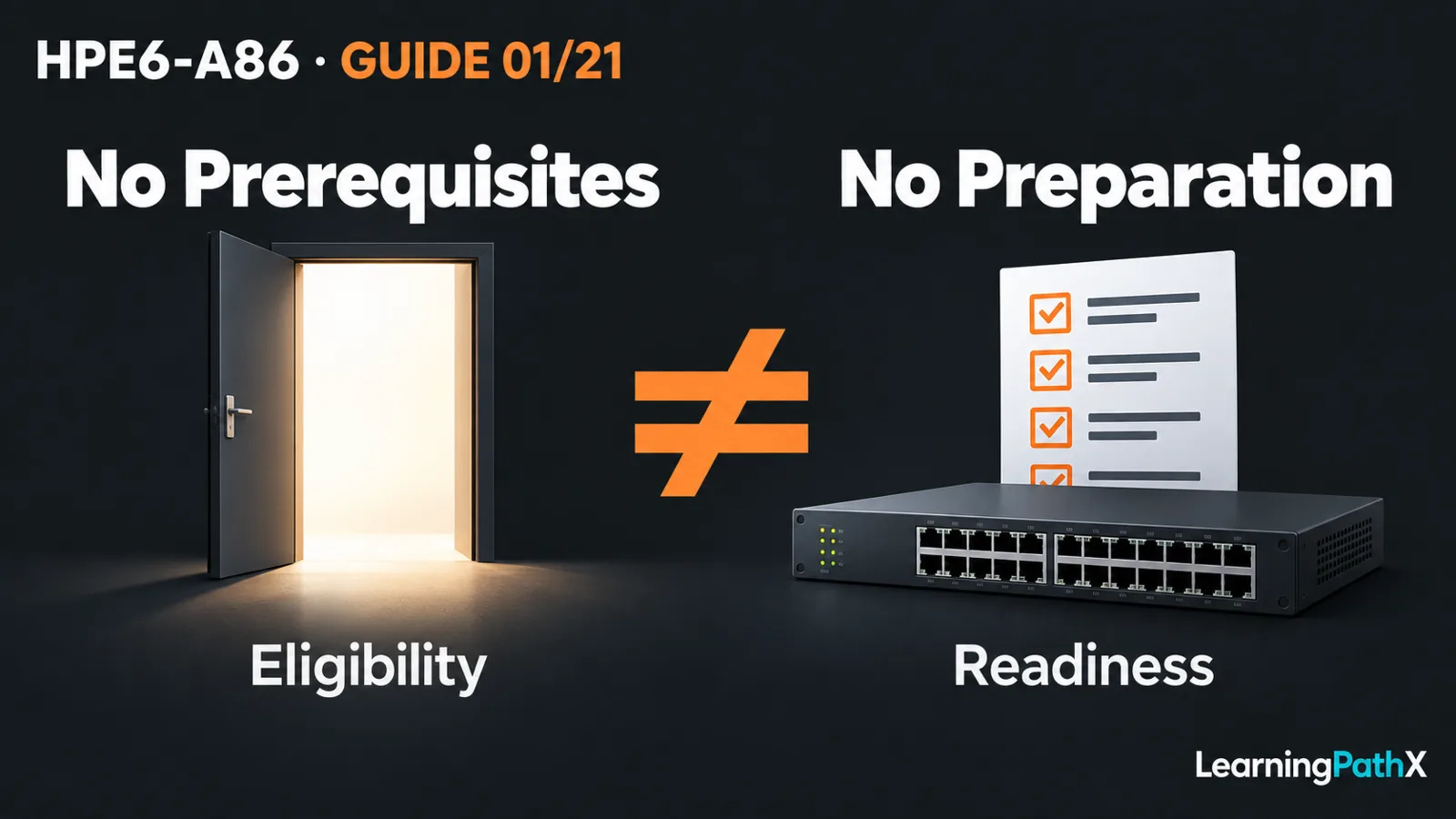
HPE6-A86 is the HPE Network Switching Associate Exam required for the HPE Aruba Networking Certified Associate - Switching credential. It is aimed at people who support wired networks and need associate-level knowledge of networking foundations, HPE Aruba Networking switching products, configuration, troubleshooting and management. The certification path states that there are no prerequisites; the exam's recommended preparation and experience guidance help judge readiness rather than create additional eligibility requirements.
Choosing this certification therefore involves two separate decisions: whether its wired switching scope matches your work, and whether you can demonstrate the underlying skills before attempting the exam. The official certification path and exam listing were checked on October 16, 2026. They identify the current path and registration access, but candidates should recheck the official details before booking.
Distinguish the Credential from the Exam
The credential describes the certification earned through HPE's published path. HPE6-A86 identifies the examination used by that path. Keeping those identities separate prevents a course completion, product training activity or similarly named certification from being mistaken for the required assessment.
The public material places the technology in small to medium enterprise wired networks. A useful fit is a junior networking role involving limited-scope installation, support or maintenance, where the operator needs to explain both how traffic moves and how to validate the switch's behavior. This is narrower than assuming that an associate credential establishes expertise in every campus, data center or cloud networking architecture.
The official path is currently listed. The consulted material does not state a retirement date; that absence should not be interpreted as a promise of indefinite availability. Use the current exam and certification pages together when confirming that the intended assessment still belongs to the desired credential.
What the Public Objectives Cover
The exam distributes its scope across five domains. The table summarizes their learning emphasis; the percentages are the published domain weights, not a recommended allocation of every reader's study hours.
| Published share | Learning emphasis |
|---|---|
| 24% | Networking foundations: architecture, media, Ethernet, addressing, transport, management protocols and basic switching concepts. |
| 21% | HPE Aruba Networking product and solution functions, including hardware, software and management-tool distinctions. |
| 22% | Installing, configuring and validating a wired solution. |
| 17% | Troubleshooting, operation and maintenance. |
| 16% | Management and monitoring practices. |
Those categories connect rather than stand alone. For example, understanding a virtual local area network (VLAN) helps explain a forwarding boundary; configuring membership establishes that boundary; validation and troubleshooting then determine whether traffic follows the intended path. Similarly, selecting a management method requires both product knowledge and a clear understanding of reachability and administrative control.
Use the detailed public subobjectives to identify learning gaps. A reader who recognizes protocol names but cannot explain an observed forwarding failure needs more than a vocabulary review. A reader who already operates switches may instead need to revisit foundational addressing, media or product distinctions. Domain weighting identifies emphasis, while the individual's evidence determines what to repair first.
Eligibility, Recommended Experience and Preparation
The certification datasheet's no-prerequisites statement is the eligibility anchor. The exam page describes an ideal candidate with at least six months supporting or maintaining wired networks, either as a junior team member or independently on projects with limited scope. That describes the intended experience profile; it must not be rewritten as a mandatory employment-duration rule.
The exam also recommends Aruba Certified Network Technician preparation as a foundation. This recommendation does not override the certification path's prerequisite statement. A candidate should distinguish a useful preparatory route from a requirement to earn another credential first.
As an editorial readiness check, consider whether you can explain a simple switched and routed path, interpret an address plan, identify the role of VLANs and loop prevention, and describe how you would collect evidence before changing a configuration. These are examples of observable learning outcomes, not confidential exam tasks or an alternative eligibility policy. The full technical lessons and learning roadmap address how to develop those skills.
Keep Training and Product Versions Separate
AOS-CX Switching Fundamentals, Rev. 24.31 is the official course offering identified in the consulted preparation material. Its public scope includes VLANs, Multiple Spanning Tree Protocol (MSTP), Link Aggregation Control Protocol (LACP), Virtual Switching Framework (VSF), static routing and Open Shortest Path First (OSPF).
The course description helps a reader evaluate structured instruction. It does not establish every implementation detail or turn every listed course topic into a separately weighted exam objective. OSPF is a useful example of why the course scope and public exam blueprint should be read together without treating them as identical documents.
Rev. 24.31 is a course revision. AOS-CX 10.13 is the product-documentation baseline selected for this technical article series, with CX 6300 as the worked platform. Neither value is a published numbered revision of HPE6-A86. HPE does not identify the exam as being tied to that operating-system release in the consulted exam overview. For an actual switch procedure, the exact platform and release still need their own product documentation.
Confirm Administration Before Booking
The current public exam listing describes a proctored exam with 60 questions, a duration of 1 hour 30 minutes and a passing score of 73%. The listed languages are English, Japanese and Latin American Spanish. These are administrative facts to confirm again when arranging an appointment, since an article is not the booking system.
Treat the published passing percentage as the vendor's reported score threshold. Do not infer a required number of correct answers from it or assume an unpublished scoring method. Likewise, confirm the applicable registration and delivery instructions through the official process rather than assuming that a proctored listing establishes one particular delivery location or procedure.
Common Learning Challenges
The main scope mistakes come from combining facts that answer different questions: prerequisites versus recommendations, certification versus exam, course revision versus software release, and conceptual familiarity versus operational evidence. Keep a separate note for each question and use its appropriate official source.
Avoid treating an official course as a pass guarantee or an associate credential as proof of competence in every advanced technology. The useful technical outcome is the ability to explain and validate the wired switching tasks within the published scope. Preparation should build that capability using original exercises and authoritative documentation.
Conclusion
HPE6-A86 fits readers developing practical wired switching support skills around HPE Aruba Networking solutions. Confirm the required exam through the certification path, use the detailed objectives to judge scope, and distinguish recommended foundations from mandatory prerequisites. Then make the booking decision using current official administration details and evidence of your own technical readiness.