
Introduction
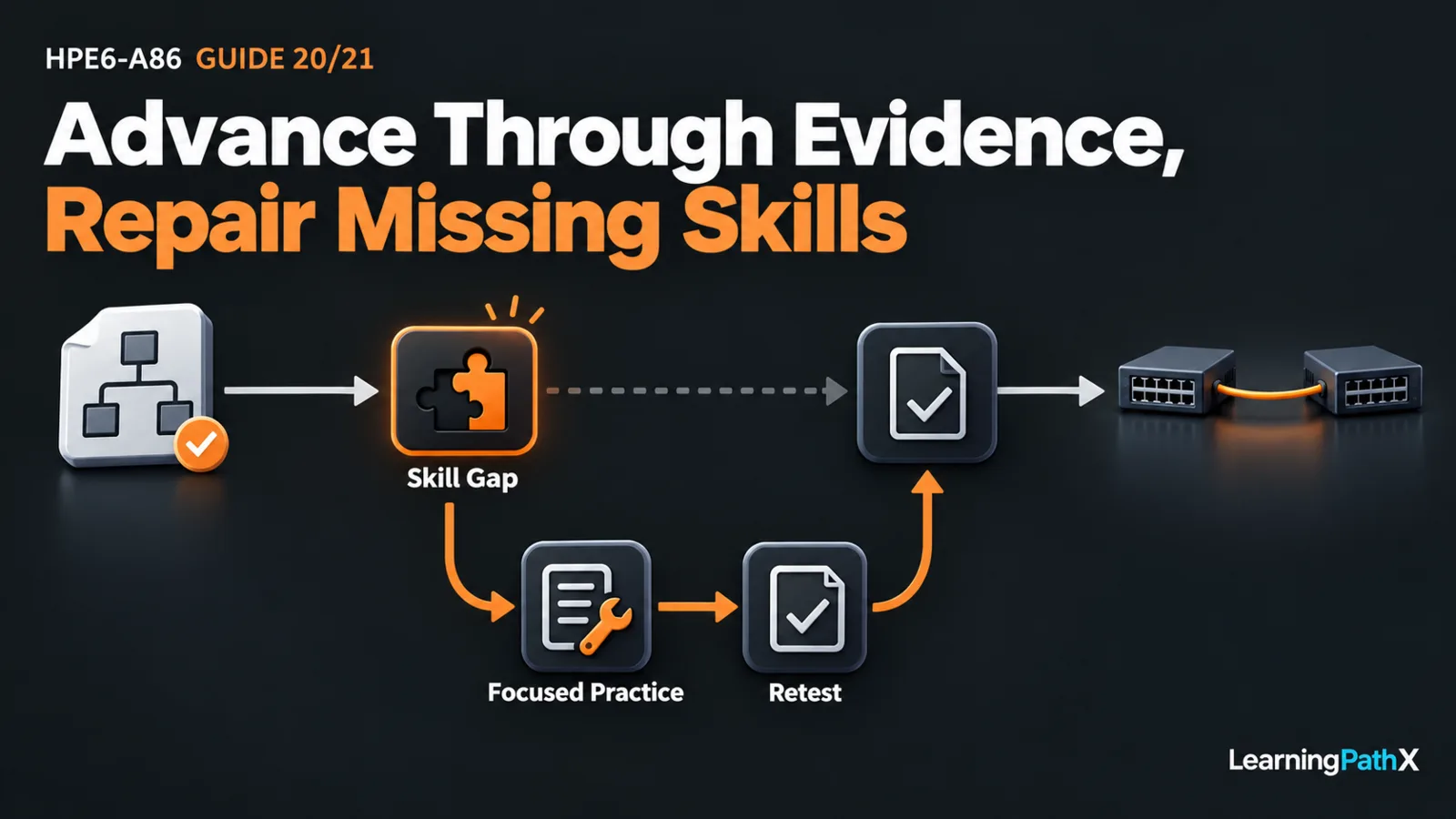
Build an HPE6-A86 learning roadmap by moving from packet and addressing foundations to platform choices, controlled configuration, operations and integrated validation. Advance when you can explain the expected behavior, obtain appropriate evidence and recover the prior state where a change is involved. When a task fails, return to its missing prerequisite skill and repeat a focused test before attempting the integrated task again. Pages read and commands entered are activity records, not proof of understanding.
Use this roadmap before completing the lab. First read HPE6-A86: Validating a Small Campus Switching Lab to understand the eventual topology and acceptance record; perform it after the relevant skills are ready. HPE6-A86: Choosing Official Study and Product Documentation establishes how to select evidence. Here the task is sequencing learning and repairing weaknesses, rather than choosing another collection of resources. The proposed stages are a learning method, not an official required timetable or an exam-pass prediction.
Establish a Coverage and Evidence Record
Start with the current public exam's detailed subobjectives. Keep their coverage visible while grouping related skills into the stages below; these teaching groups do not replace the official domains or their weights. Include product and management choices as well as configuration, troubleshooting and operations. A successful lab alone cannot establish coverage of every objective.
Use one small record per skill: the intended outcome, prerequisite, platform/release, predicted observation, actual evidence and remaining explanation. Record whether you explained, practiced or independently repeated the task. Mark unsupported or untested claims explicitly. This separates a conceptual gap from missing equipment and from a documented platform limitation.
The series uses AOS-CX 10.13 on CX 6300 for operational examples. HPE6-A86 and the training course's Rev. 24.31 are different identifiers from that software baseline. Match each exercise to its documented hardware and release; do not turn a command remembered from another switch family into assumed support.
Build Foundations Before Forwarding Changes
Begin with physical media and link behavior, Ethernet forwarding, network layers and transport purpose. Then work Internet Protocol version 4 (IPv4) address plans and explain whether a destination is local or requires a gateway. Trace how Address Resolution Protocol (ARP) supplies the local next-hop mapping rather than the address of a remote server.
For an exit check, draw a small original host-and-gateway topology, calculate its subnet boundaries and predict the local versus remote forwarding decision. Explain which addresses and frame fields matter at each step and how a wrong mask or gateway would change the result. Check the arithmetic separately from the explanation. A correct number without the packet-path reasoning leaves a prerequisite unfinished.
Add Platform and Management Judgment
Next translate a small network's requirements into a platform choice: port media, endpoint power, uplinks, form factor and supported software features. Record a supported capability and the model/release evidence behind it. Treat a current portfolio description and a historical platform support guide as answering different questions.
Choose a management method for the task and identify its authority, reachability and recovery path. Explain when local console access, the command-line interface (CLI), a web interface, Central or an automation interface would fit. Your exit evidence should be a justified choice with its limitation, not a list of tool names. Before operational changes, demonstrate authorized access and a recovery login in an isolated environment.
Progress Through Controlled Configuration
Establish secure management, time and configuration persistence before changing forwarding. Then learn virtual local area network (VLAN) access/native/allowed membership and neighbor observations. Add loop prevention and Link Aggregation Control Protocol (LACP) as distinct mechanisms. Study Virtual Switching Framework (VSF) roles and failure boundaries separately; recognizing one logical switch does not prove every failure is harmless.
After addressing and Layer 2 membership are reliable, work inter-VLAN gateways, connected routes, explicit static routes and return paths. Follow with single-area Open Shortest Path First (OSPF), distinguishing neighbor state from advertised topology and selected routes. Keep administrator authorization, endpoint admission, traffic filtering and quality of service (QoS) in the sequence rather than postponing them until an unexplained failure.
For each bounded exercise, predict the state, preserve recovery, make the documented change, inspect the relevant evidence and test the intended traffic. Include a negative or limiting case where appropriate: an allowed traffic test does not establish that unwanted traffic is denied. Exit when you can explain the component relationships and repeat acceptance after recovery, rather than merely reproduce a saved configuration.
Develop Operations and Diagnostic Discipline
Use stable configurations to practice synchronized timestamps, counter differences, events and independent collector receipt. Compare management protocols by purpose and security, including legacy file-transfer, terminal and monitoring methods. A working administrative session is not proof that monitoring works or that every transfer method protects secrets.
Practice distinguishing running configuration, startup state, checkpoints and protected off-device backups. Write a small software-change plan with exact compatibility checks, acceptance and separate software/configuration recovery. A checkpoint is not an operating-system backup.
For troubleshooting, define one failing source-to-destination exchange. Gather physical, VLAN, learned forwarding, neighbor, route, return-path and policy evidence before changing a cause. The exit record should identify what each observation proves, what remains uncertain and how the repeated original test closes the diagnosis. Preserve evidence instead of clearing state to make the symptom disappear.
Integrate Skills in the Isolated Lab
Return to the small-campus lab after its prerequisites are ready. Predict same-VLAN and routed host paths, verify the healthy baseline, introduce only the documented reversible member failure, restore it and repeat acceptance. Record actual interruption and limitations rather than inventing successful output or a convergence time. Finish cleanup and verify management recovery.
That lab integrates selected skills; it does not exercise every product, security, routing or operations outcome. Keep separate evidence for the remaining subobjectives. If eligible equipment is unavailable, label diagrams and predicted results as reasoning exercises and retain hands-on validation as an open task; do not claim simulator or hardware equivalence without evidence.
Repair a Weak Skill and Recheck Dependencies
Suppose the lab's same-VLAN test works but a client's routed service test fails. Avoid restarting the entire learning sequence. Write the failed expectation, inspect the host mask/gateway and selected forward/return decisions, and identify the first unsupported relationship. If gateway reasoning is weak, return to the addressing exercise; if the design is understood but membership is wrong, revisit the bounded VLAN task.
After focused practice, predict a slightly changed example without copying the earlier result. Repeat that skill's acceptance, then rerun the dependent lab exchange and an unaffected comparison. Keep the failure, correction and new evidence together so familiarity with the original example does not masquerade as transfer.
Periodically compare the record with all public objectives and revisit stale or weak evidence. A later concise review can reveal recall gaps, but it should not replace unfinished explanations or recovery practice. Your next task is the smallest missing dependency with a clear observable outcome, not a fixed number of pages or an arbitrary calendar deadline.
Authoritative Sources
- HPE Network Switching Associate Exam
- AOS-CX Switching Fundamentals, Rev. 24.31
- AOS-CX 10.13 Fundamentals Guide
- AOS-CX 10.13 Layer-2 Bridging Guide
- AOS-CX 10.13 Link Aggregation Guide
- AOS-CX 10.13 Virtual Switching Framework Guide
- AOS-CX 10.13 IP Routing Guide
- AOS-CX 10.13 IP Services Guide
- AOS-CX 10.13 Security Guide
- AOS-CX 10.13 Quality of Service Guide
- AOS-CX 10.13 Monitoring Guide
- AOS-CX 10.13 Diagnostics and Supportability Guide