
Introduction
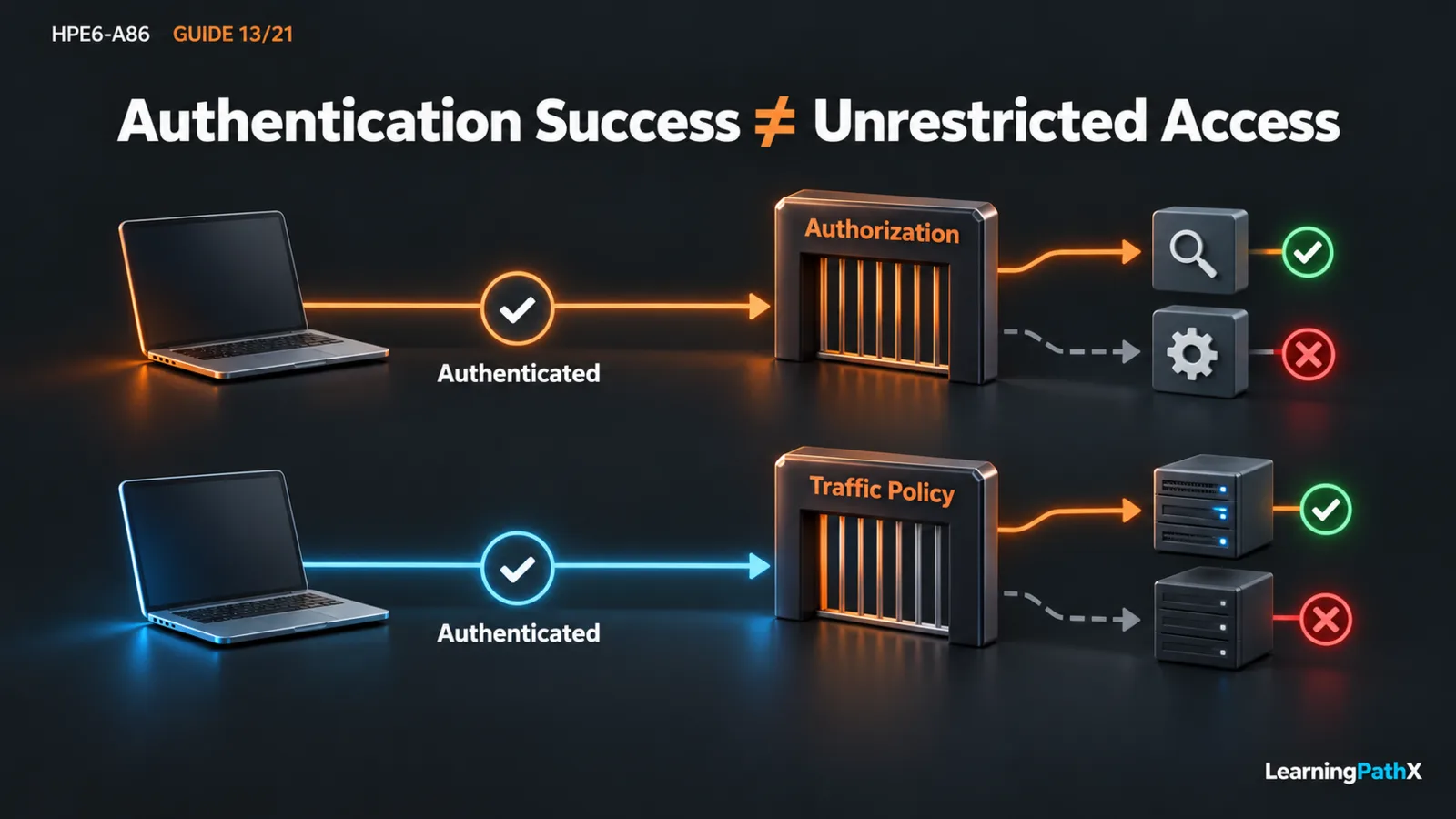
Protect administrator access with Secure Shell (SSH) and deliberate authentication, authorization and accounting (AAA); control endpoint attachment with the appropriate port-access method; and constrain traffic with access control lists (ACLs) applied at the intended location and direction. Validate each outcome separately. An encrypted login does not establish least-privilege command rights, and an authenticated endpoint does not automatically gain permission to reach every destination.
Separating management security from traffic access controls starts with identifying what is being protected, who or what is requesting access, and where the decision is enforced. This framework uses AOS-CX 10.13 on CX 6300. It provides original selection and acceptance reasoning, not a production configuration recipe or an executed security test. Confirm the exact platform, release and existing policy before adopting any feature.
Architecture Overview: Identify the Protected Path
The management plane concerns administration of the switch. The control plane handles traffic and protocol processing addressed to the device itself. The data plane forwards transit traffic through it. Management access can depend on control-plane packet delivery, but filtering those packets and authorizing commands within a session are different decisions.
For example, a control-plane ACL can restrict traffic addressed to the switch in its documented scope. It does not assign an administrator's command privileges. A transit ACL controls matching traffic on a forwarding path; it should not be assumed to protect every management path. Check the actual attachment and context instead of relying on a policy's name.
| Decision | Relevant control | Evidence needed |
|---|---|---|
| Who can administer the device, and with which rights? | SSH, administrator authentication and authorization | Trusted device identity, separate successful login and permitted/denied operations |
| Which endpoint may attach through this port? | Port-access authentication and assigned access policy | Correct client identity, authentication outcome and effective access assignment |
| Which traffic may cross this boundary or reach the switch? | Appropriately scoped ACL | Applied location/direction, ordered matches and allowed/denied test traffic |
These controls can cooperate. None substitutes for all the others, and a virtual local area network (VLAN) boundary alone is not a complete traffic security policy.
Secure Administrator Access and Limit Authority
SSH encrypts the administration session, while authentication establishes the identity presented at login. Authorization determines what that identity may do, and accounting records relevant activity. AOS-CX supports local users/groups and remote AAA arrangements; select the intended method and role policy deliberately rather than assuming that successful authentication implies full administration rights.
As a least-privilege recommendation, distinguish an operator who needs status inspection from an administrator authorized to change configuration. Review the actual group or authorization rules for the selected release. Test both an allowed observation and an operation that should be denied, using an isolated or approved validation context. A login success alone cannot establish either result.
Preserve authorized console recovery before changing authentication methods or filtering management traffic. Confirm the service's management context, the authentication service's reachability and the documented behavior when that service is unavailable. Do not assume that a fallback account will work without checking the actual method order and failure behavior. Protect credentials and shared secrets; no acceptance record should expose real passwords.
Decide How Endpoints Gain Network Access
The Institute of Electrical and Electronics Engineers (IEEE) 802.1X standard provides port-based authentication. Its participants include the endpoint supplicant, the switch authenticator and an authentication server. In the documented design, Remote Authentication Dial-In User Service (RADIUS) provides the server interaction. This decides endpoint access, rather than authenticating a person to the switch's administration interface.
Media Access Control (MAC) authentication supports endpoints that do not run the required supplicant software, such as a suitable legacy device. It uses the endpoint's MAC identity through the documented authentication arrangement. That identifier is not equivalent to a user proving possession of an individual secret. Select it with an explicit device policy and risk assessment, rather than treating it as interchangeable with every 802.1X method.
Verify the resulting access assignment, not just the authentication event. If an endpoint is placed in a VLAN or receives another supported policy, confirm that the effective result matches its intended service. Test approved and unapproved clients in an authorized lab, and check the planned response when the authentication service is unavailable. Do not invent a universal failure policy or client limit.
Dynamic Host Configuration Protocol (DHCP) snooping addresses a different edge risk: unauthorized address-configuration service. It distinguishes trusted server-facing paths and collects client bindings containing VLAN, Internet Protocol (IP) address, MAC address and interface information. Source lockdown can use bindings for its separate enforcement purpose. Verify the server path and binding assumptions first; the 10.13 IP Services guide does not allow the local DHCP server to be configured with snooping. Neither function grants administrator privileges.
Reason About ACL Matching and Scope
An ACL contains access control entries (ACEs) processed from lower to higher sequence numbers. Matching stops at the first successful entry, which supplies the action. If no entry matches, the documented ACL behavior is implicit denial. A broad early permit can therefore prevent a later restrictive entry from ever matching the same traffic.
Defining a list is not the same as applying it. Identify its type, supported attachment, direction and traffic path. Interface, VLAN and control-plane applications answer different questions, and their platform restrictions matter. Do not transfer a rule intended for transit traffic to a control-plane attachment without analyzing the resulting scope.
Include required service dependencies and return traffic in the intended policy. Before an authorized change, review what the implicit denial will affect and preserve recovery access. The safe outcome is an explicit permitted-flow and denied-flow specification, not an unexplained list of permit statements or a copied production mutation sequence.
Apply the Framework to a Small Office
Consider an illustrative office with a support operator, an administrator, employee endpoints and a legacy printer. The operator needs status inspection; only the administrator should make approved changes. Employees need authenticated access, while the printer needs a documented attachment decision. User traffic should reach designated services without gaining unrestricted switch administration access.
Choose and validate these outcomes separately: an encrypted administrator session, correct account rights, the expected endpoint access assignment, and permitted/denied traffic at the intended boundary. A printer's successful attachment is not evidence that its traffic restrictions work. Conversely, a transit rule blocking one server does not prove that administrator privileges are correctly limited.
Acceptance, Recovery and Conclusion
Record the baseline, authorized test identities, expected permissions and required services before testing. Correlate authentication events, effective roles or access assignments, applied ACL entries and available counters with the same test flow. A counter increment identifies a match; it does not prove that the entire application exchange succeeded.
If expectations fail, retain recovery access and investigate the relevant control instead of disabling several protections. Restore the approved prior state through the established recovery process when necessary, then repeat the same acceptance checks. Keep these changes within an isolated lab or an authorized change plan.
The useful security decision names the protected subject, enforcement location, least required permission and observable result. That makes management security, endpoint admission and traffic control distinct, testable parts of one design.
Authoritative Sources
- AOS-CX 10.13 Security Guide
- AOS-CX 10.13 ACLs and Classifier Policies Guide
- AOS-CX 10.13 IP Services Guide
- HPE Network Switching Associate Exam