
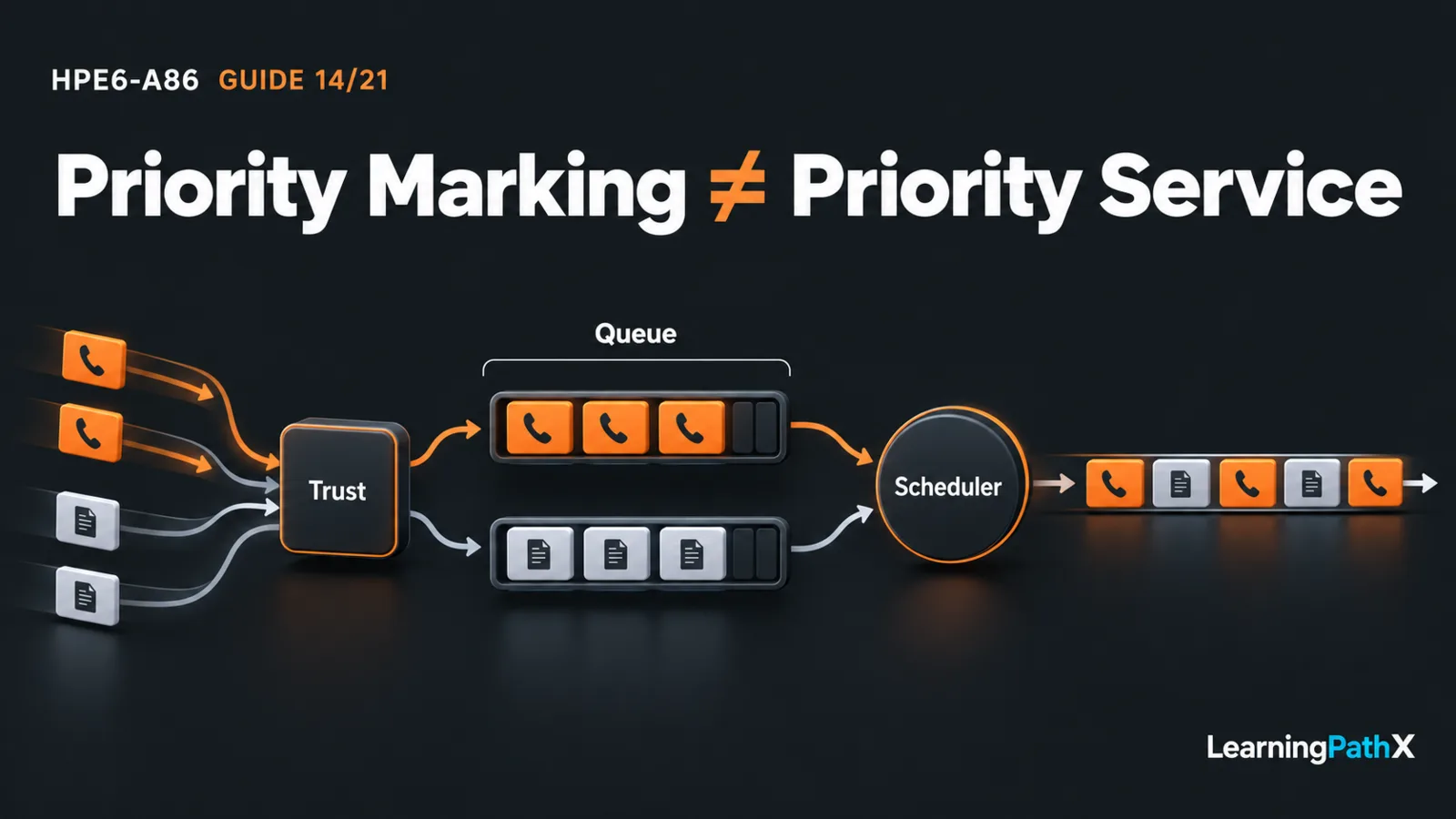
Quality of Service (QoS) protects delay-sensitive traffic by identifying its intended treatment, deciding which markings to trust, assigning an internal priority and egress queue, and scheduling that queue when traffic competes for transmission. It changes how limited capacity is shared; it does not create additional link capacity. A voice packet's priority marking alone does not establish that it will receive different service.
Applying QoS reasoning to converged networks means following this complete chain rather than enabling a feature by name. This explanation uses AOS-CX 10.13 on CX 6300 and an original voice-and-bulk-data example. It is a conceptual design discussion, not an executed test or a configuration recipe. Queue capabilities and supported profile behavior must be checked for the actual switch and release.
Architecture Overview: Find the Congested Egress
A converged network carries different applications over shared infrastructure. Consider several access ports sending voice and file-transfer traffic toward one uplink. If the combined arrival rate exceeds what the uplink can transmit, packets must wait; sustained excess can eventually result in drops. Spare capacity on a different link does not remove this particular bottleneck.
Voice is sensitive to delay and variation in delay, called jitter. Bulk transfer generally has a different service objective: completing a volume of data rather than delivering each packet within a short interactive interval. The design question is how to protect the delay-sensitive class while retaining useful service for other traffic. It is not whether every packet can be declared equally urgent.
Locate the actual competing traffic and outgoing interface before choosing a policy. A high-priority designation on an uncongested access link does not resolve queuing on a later congested uplink. End-to-end behavior also requires compatible treatment at subsequent devices.
Follow the QoS Components in Order
Classification and Marking Describe Intended Treatment
Classification places traffic into a service class according to policy. Marking records a class indication in a frame or packet header. These are related actions, but the recorded label and the actual forwarding treatment are different facts.
A Differentiated Services Code Point (DSCP) is carried in an Internet Protocol (IP) header. At Layer 2, Class of Service (CoS) uses priority information in tagged Ethernet frames. This is the priority concept associated with Institute of Electrical and Electronics Engineers (IEEE) 802.1p; it is separate from the virtual local area network (VLAN) identifier that defines membership.
For the example, define a voice service class and a bulk-data class. Do not infer voice solely from a device's claim of high priority. The policy needs an accountable basis for identifying the intended traffic, and the operator must know where its marking originated.
Trust Determines How Received Labels Are Used
In AOS-CX, CoS or DSCP trust maps received values into local priority through the corresponding map. Trust is therefore a policy boundary: it determines whether an external label influences local treatment.
An unmanaged endpoint could mark ordinary traffic as important. Accepting that label without evaluating the source would allow the endpoint to compete for service intended for another class. Conversely, ignoring a deliberately controlled upstream marking can prevent a valid class distinction from reaching the queue decision. Decide where markings become authoritative rather than making every access port a trust boundary by default.
The documented factory trust mode is none. Do not assume a received DSCP value is being used merely because it appears in a packet. Existing interface-specific or dynamic behavior also needs inspection before drawing a conclusion from a global setting.
Local Priority Selects a Queue; a Schedule Selects Service
Local priority is internal switch metadata. A queue profile maps it to an egress queue; a schedule profile controls transmission service for those queues. Keep that distinction explicit when tracing a packet.
Changing a packet's outgoing marking does not necessarily change the local queue already selected for it. The documented port DSCP-remark processing illustrates this separation. Verify the actual classification, priority and queue path instead of assuming that a rewritten header proves preferential service.
Deficit weighted round robin (DWRR) shares available service among nonempty queues according to relative weights. Strict scheduling favors the highest-priority queue first and can starve lower queues under sustained demand. The documented factory schedule uses DWRR with weight 1 for its configured queues; a higher-looking label is not a substitute for inspecting the applied schedule.
Trace Voice and Bulk Data Through the Uplink
Assume the intended voice class is correctly identified, its markings are accepted at a deliberate boundary, and its local priority maps to a different queue from bulk data. These are example assumptions to validate, not observed switch results.
When both queues contain traffic, the scheduler determines their relative opportunities to transmit. A design favoring timely voice service can reduce its wait behind competing bulk traffic. Bulk service must still satisfy the organization's requirements. If voice and bulk unexpectedly map to the same queue, the planned class separation has been lost before scheduling can deliver it.
Now change one assumption: a bulk sender marks all its traffic as voice and that marking is trusted. Separating queues no longer separates the intended applications. The scheduling policy can be internally consistent while protecting the wrong traffic. This is why the trust decision belongs in the explanation rather than being treated as an automatic prerequisite.
Finally, suppose the offered load remains above the uplink's capacity for a sustained period. Prioritization cannot make every flow meet its objective. The design may need reduced demand or more capacity as well as a differentiated service policy. QoS decides how contention is handled; capacity planning determines whether the overall demand is feasible.
Validate the Chain Rather Than One Setting
For an isolated, authorized evaluation, use evidence that answers each part of the model:
- Establish where congestion occurs and what traffic competes there.
- Confirm the received markings, their source and the effective trust behavior.
- Follow the applicable priority map into the applied queue profile and schedule.
- Observe per-queue forwarding and drops alongside application delay, jitter and useful bulk throughput under comparable load.
These are reasoning checks, not claimed test results. A quiet test cannot demonstrate behavior during contention, and a marking visible in a capture cannot establish which queue received the traffic. Record a baseline and a recoverable prior policy before any authorized change; avoid using a production congestion event as an uncontrolled experiment.
Common Mistakes and Conclusion
The common mistakes are equating marking with treatment, trusting every endpoint, assuming queue numbers imply a universal scheduling policy, and evaluating only the switch where the policy was first applied. Keep platform-specific queue capabilities and profile compatibility in the matching guide rather than copying another model's design.
For HPE6-A86, the useful outcome is to explain why the voice packet receives its service at the actual bottleneck. Name the class, trust decision, local priority, queue and schedule, then identify the evidence that would confirm the intended effect. That connects QoS terminology to a defensible congestion-management design.