
Introduction
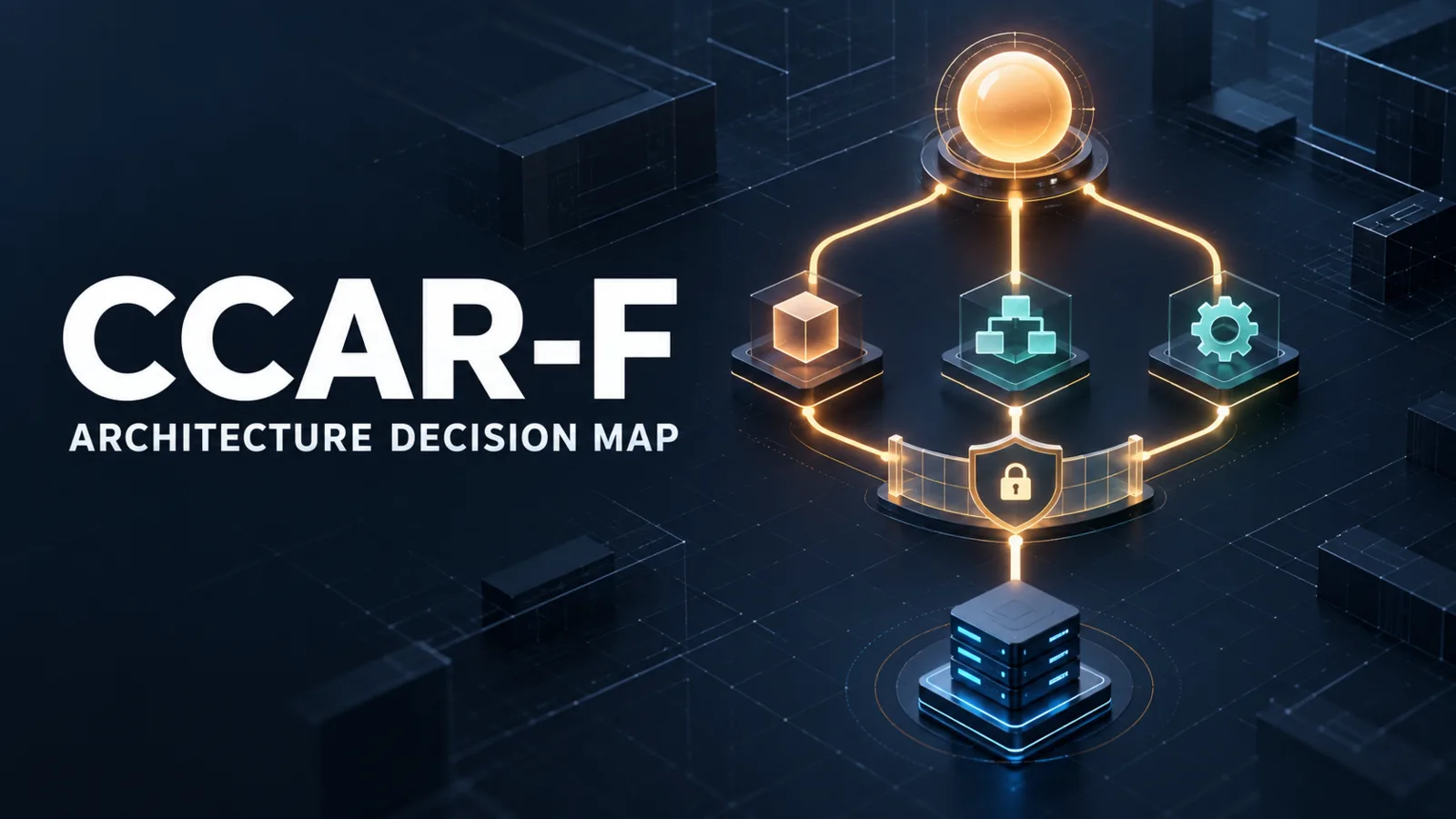
The public scope of Claude Certified Architect - Foundations (CCAR-F) is best understood as an architecture map, not as a collection of isolated product features. The map starts with the outcome a system must achieve, then connects architecture choice, tool and integration boundaries, development workflow, prompt and output contracts, and operational reliability. Anthropic describes CCAR-F as a current public certification for eligible partner organizations on its certification page; this article uses only that public scope and public product documentation, not confidential assessment content.
What CCAR-F Scope Covers
The published CCAR-F coverage groups the architect's work into five connected areas: agentic architecture and orchestration; tool design and Model Context Protocol (MCP) integration; Claude Code configuration and workflows; prompt engineering and structured output; and context management and reliability. The useful interpretation is that an architect must make decisions across a system's whole lifecycle rather than optimize a prompt or a tool in isolation.
Claude is the model platform at the center of that lifecycle. The Claude API is appropriate when an application needs direct model interaction and owns its surrounding control flow. The Claude Agent SDK overview describes a different option: a Python or TypeScript library that brings the Claude Code agent loop, tools, and context management into an application. Claude Code is the interactive development environment, while the Model Context Protocol architecture defines MCP as an open protocol for connecting AI applications with external tools and context. Those names identify different roles; they are not interchangeable deployment modes.
Why the Architecture Decision Map Matters
An architecture decision map makes dependencies visible before implementation begins. A tool is useful only when its caller has the right authorization and its result can inform the next decision. A long-running agent needs a context strategy and stopping rules. A structured response is useful only when the consumer validates and safely handles it. The result is a sequence of decisions, not a vendor checklist.
For an architect, the central question is: what is the smallest controllable system that can satisfy the user outcome? Starting from that question discourages unnecessary autonomy, excessive tool access, and an overly broad context surface.
Core Concepts
Begin with the outcome and risk boundary
Define the job in observable terms before selecting a Claude integration. Identify the requested result, the systems the solution may read or change, the human approval points, and the consequences of an incorrect action. A summarization feature with no side effects has a different risk boundary from an assistant that can modify a customer record or run a deployment command.
This first step also identifies what must be deterministic. Validation, authorization, data retention, and irreversible actions normally belong in application controls rather than in a model instruction alone. Model reasoning can help choose or explain an action; it should not be the only safeguard for a high-impact operation.
Choose the execution shape
Next, decide whether the outcome needs one model response, an application-controlled workflow, or a tool-using agent. The Agent SDK overview distinguishes using the SDK to run an agent loop in an application from calling the API directly and implementing the loop yourself. That distinction is architectural: it determines who owns iteration, tool execution, session continuity, and runtime controls.
At this level, do not yet design the loop. Record why the selected execution shape is sufficient, what event ends the work, and which decisions remain in application code. Detailed pattern selection belongs in the next article.
Design the capability boundary
Capabilities include model access, tools, MCP connections, files, and services. Treat every capability as an interface with an owner, an authorization decision, an input contract, an output contract, and an audit need. The tool use overview explains that tool use extends Claude with application-defined tools, but the application remains responsible for the surrounding execution and safety design.
Use least privilege as the default design posture. A system that only needs retrieval should not receive write-capable tools. Where changes are allowed, retain a separate approval or policy check before the external side effect. This is an architecture recommendation, not a claim that one model setting can replace organizational controls.
Carry decisions through the production lifecycle
The lifecycle continues after the first successful response. Prompt contracts define the task and expected output; context management keeps necessary information available without allowing history and tool results to dominate the request; evaluation checks whether outcomes meet the success criteria; and operational controls detect cost, latency, safety, and quality regressions.
The Claude Agent SDK overview lists permissions, sessions, MCP, subagents, hooks, and cost and usage tracking among the available capabilities. An architecture map uses these as decision areas: select only the capabilities that advance the stated outcome, and define how they will be observed and constrained in production.
Target Audience
This map is for solution architects, AI architects, platform architects, and technical leads who need to connect Claude capabilities to a production design. It assumes familiarity with APIs, service boundaries, and software delivery practices. It does not assume access to CCAR-F assessment materials.
Career or Technical Value
The value of a decision map is traceability. It lets a team explain why a design uses a direct call, a workflow, or an agent; why a tool is present; where an approval occurs; and how a quality issue will be detected. That traceability makes later design reviews and operational changes more defensible.
It also prevents a common failure mode: choosing a sophisticated orchestration pattern before verifying that the user outcome requires it. The next articles narrow the map into specific choices without treating the public certification scope as a hidden implementation specification.
Common Learning Challenges
One challenge is conflating a public certification domain with a detailed product procedure. The public scope tells readers what areas are relevant; it does not substitute for the current documentation needed to implement a feature.
Another challenge is treating every Claude solution as an agent. A model call, a workflow, and an agentic loop have different control surfaces and operational costs. Start with the outcome and risk boundary, then add autonomy only when it solves a real coordination problem.
Conclusion
CCAR-F's public scope becomes more practical when viewed as one architecture lifecycle: define the outcome and risk boundary, choose an execution shape, constrain capabilities, and operate the resulting system with explicit quality and reliability controls. That lifecycle is the foundation for selecting the simplest appropriate Claude architecture pattern.
Authoritative Sources
- Claude Certified Architect - Foundations
- Agent SDK overview
- Tool use with Claude
- Model Context Protocol architecture