
Introduction
Machine learning adds more value than rules when a business needs a prediction, classification, ranking, or forecast; historical data contains repeatable signals; and the decision pattern is too complex or changeable to express reliably as fixed logic. Rules remain preferable when conditions are explicit and stable and the same input must always produce the same action. Generative artificial intelligence (AI) is a better fit when the primary output is newly created content or a conversational response rather than a predictive score or category.
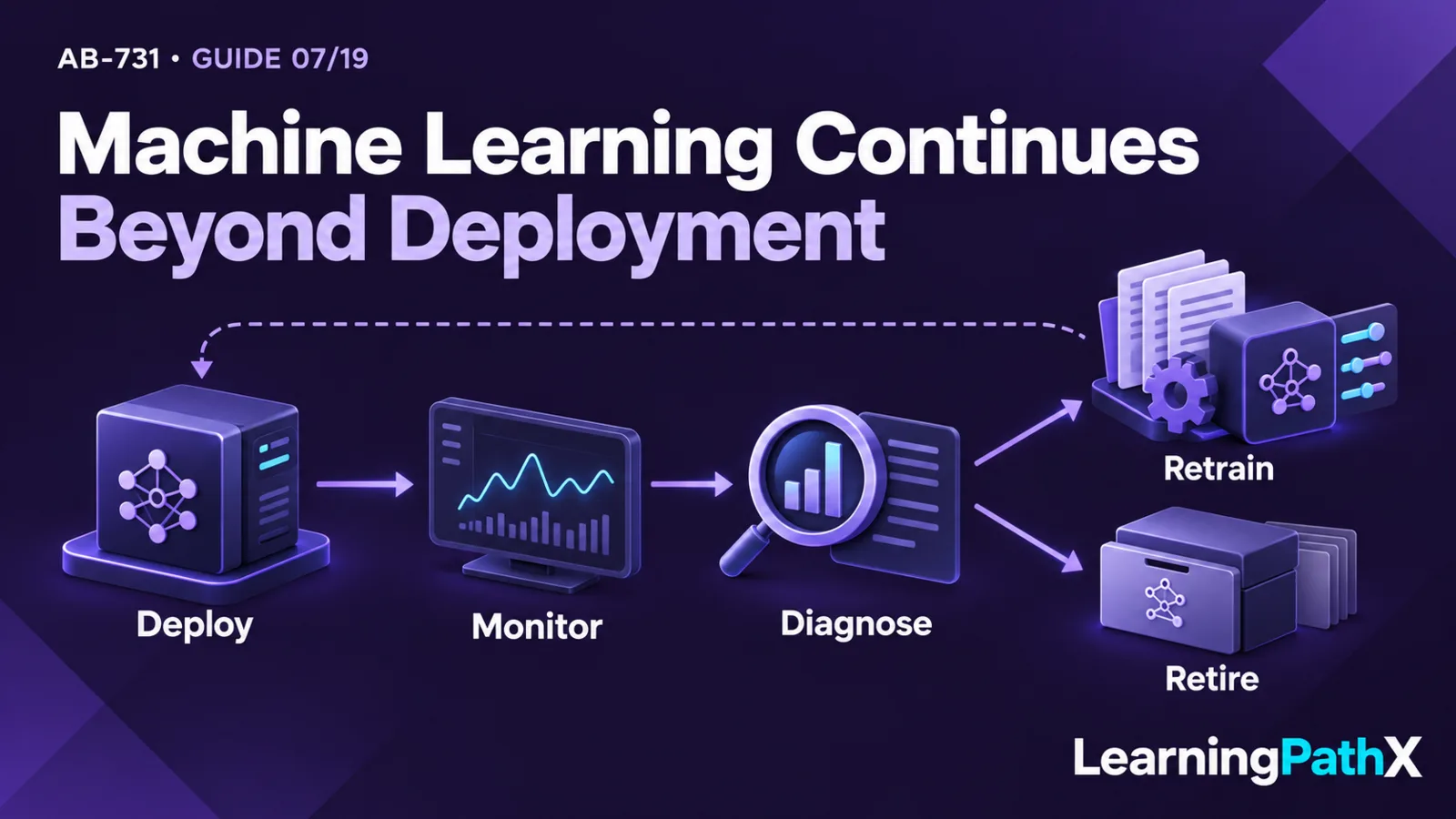
A useful predictive model also requires an ongoing lifecycle, not a one-time build. Leaders must define the outcome and decision, prepare representative training data, train and evaluate candidate models, validate business and risk thresholds, deploy the model into a controlled process, monitor data and outcome quality, and retrain or retire it when performance or business conditions change. The lifecycle creates value only when a named owner connects model performance to a measurable business result.
Architecture Overview
Predictive machine learning learns statistical patterns from historical data and applies those patterns to new observations. The output might be a probability that a customer will leave, a forecast of demand, a classification of a transaction, or a ranking of cases for review. The output supports a business decision; it does not define the entire process or remove accountability from the decision owner.
Three layers work together:
- Business decision layer: Defines the outcome, acceptable tradeoffs, intervention, and measure of value.
- Model lifecycle layer: Turns data into a trained and evaluated predictive model, then maintains it over time.
- Operational process layer: Delivers model outputs to people or systems with controls, monitoring, feedback, and fallback behavior.
This architecture explains why an accurate experiment is not yet a valuable production capability. A model can perform well on historical test data but fail to change a business outcome if its score arrives too late, no useful action follows, users do not trust it, or the operating environment changes.
When Predictive Machine Learning Is the Right Fit
Choose rules for explicit, stable logic
Rules are usually the best starting point when experts can state the conditions clearly, exceptions are limited, and auditability requires deterministic behavior. Eligibility thresholds, required-field checks, approval limits, and policy-based routing often fit this pattern.
Rules can also establish a baseline for a potential machine learning use case. If a small, understandable rule set already meets the business requirement, a predictive model may add complexity without enough incremental value.
Choose predictive machine learning for patterns in historical outcomes
Predictive machine learning is a strong candidate when the organization can identify a past outcome and assemble data that existed before that outcome. Common outcome types include:
- Classification: Assign a category, such as likely escalation or normal handling.
- Regression: Estimate a continuous value, such as delivery time or demand.
- Ranking: Order cases by relevance, urgency, or likelihood.
- Forecasting: Estimate a future quantity over time.
The strongest use cases also connect the prediction to an action. A risk score has little standalone value. Its value comes from enabling an appropriate intervention, prioritizing scarce attention, or improving a planning decision.
Predictive machine learning is not justified merely because historical data exists. Leaders should confirm that the target outcome is meaningful, the available data is sufficiently representative, the prediction arrives in time to influence the decision, and the organization can tolerate and manage probabilistic errors.
Choose generative AI for content and interaction
Generative AI produces new content in response to input and learned patterns. It is suited to tasks such as drafting, summarization, transformation, question answering, and conversational assistance. Microsoft's business-leader foundation module treats generative AI as a distinct capability category with its own opportunities, costs, and challenges.
The distinction is the primary outcome, not whether the technologies can coexist. A predictive model might identify cases likely to escalate, while a generative system summarizes each case for an agent. The predictive component estimates an outcome; the generative component creates a useful artifact.
A Business Decision Framework
| Decision question | Rules are favored when | Predictive machine learning is favored when | Generative AI is favored when |
|---|---|---|---|
| What output is needed? | A deterministic action or validation | A score, category, ranking, or forecast | New content or a conversational response |
| Where does the logic come from? | Experts can state stable conditions | Historical examples contain useful patterns | A model can generate from instructions and context |
| How should variation be handled? | Identical inputs require identical actions | Probabilistic error can be measured and managed | Output variability is acceptable with evaluation and oversight |
| What sustains the solution? | Policy and rule maintenance | Data, evaluation, monitoring, and retraining | Prompt, context, model, evaluation, and safety controls |
Use the table to identify a starting point, then test five business conditions:
- Decision value: Would a better prediction change an action or allocation of resources?
- Data suitability: Is there representative historical data with a usable outcome label and appropriate permissions?
- Error tolerance: Are false positives, false negatives, and uncertain cases understood well enough to set thresholds and escalation paths?
- Operational fit: Can the prediction reach the right person or system at the right time?
- Lifecycle ownership: Can the organization monitor the model and respond when data, behavior, policy, or performance changes?
If the first four conditions pass but lifecycle ownership is missing, the use case is not ready to scale.
The Machine Learning Lifecycle
Microsoft's machine learning lifecycle guidance presents machine learning as an iterative process that continues through monitoring and retraining. The seven stages below are this article's business-level grouping, not an exam-mandated sequence or stage count. Microsoft's current guidance separates registration, staging, and testing from production deployment; those activities are grouped together here under controlled deployment.
1. Scope the problem and decision
Define the business outcome, decision owner, user, intervention, baseline, and constraints. Specify when the prediction is needed and what action it can change. Translate broad goals such as “reduce churn” into a bounded decision, such as identifying accounts for a retention review early enough for an intervention.
Set both value and guardrail measures. A useful model must improve an outcome without creating unacceptable unfairness, privacy exposure, operational burden, or customer harm.
2. Acquire and understand the data
Identify data that would have been available at prediction time and determine how the target outcome will be represented. Examine data origin, meaning, ownership, quality, permissions, time coverage, and population coverage.
Historical data reflects the process that produced it. Missing records, inconsistent definitions, past policy, and unequal service can become model inputs or labels. A large dataset is not automatically representative or appropriate.
3. Prepare data and candidate features
Clean and transform the data into consistent inputs, resolve missing or invalid values, and create candidate features that represent useful signals. Keep data from future events out of training inputs; otherwise evaluation can appear strong while the deployed model lacks the same information.
Business experts are essential at this stage because they understand how fields were created, when they become available, and which apparent correlations may reflect process artifacts rather than a durable signal.
4. Train and compare candidate models
Training adjusts a model using historical examples. The team compares candidate approaches against a simple baseline and selects evaluation measures that match the business decision. The most complex model is not automatically the best choice; interpretability, latency, maintainability, and operational constraints may favor a simpler candidate.
Leaders do not need to write training code, but they should ask whether the comparison used representative data, whether candidates were tested consistently, and whether the improvement over the baseline is material.
5. Validate technical and business performance
Validation helps compare candidates and tune choices using data that was not used to fit them. Keep a separate final test set held out from those choices so repeated tuning does not turn the final check into another development exercise. Overall accuracy alone may hide the errors that matter most. Review false positives and false negatives, performance across relevant groups and conditions, threshold choices, uncertain cases, and the downstream effect of the proposed intervention.
The release decision should require evidence that the model meets defined technical, business, and risk thresholds. It should also specify human review, fallback, or escalation when confidence or consequences demand it.
6. Deploy into a controlled process
Deployment makes the model available within a real workflow. The production design must deliver inputs and outputs reliably, enforce access controls, record the model and configuration used, and make the prediction understandable enough for its intended user.
Before release, register the model version and test its integration in staging under realistic conditions. Confirm that inputs and outputs are valid, response time meets the requirement, and the accountable stakeholders approve the evidence. Retain a tested fallback or rollback path so an unsuitable release can be withdrawn without improvising a response.
Rollout can begin with a limited population or decision-support mode. This allows the organization to compare model recommendations with actual outcomes and user behavior before increasing automation or reach.
7. Monitor, retrain, and retire
Monitor more than service availability. Track input-data changes, missing or delayed data, output distributions, predictive performance when outcomes become available, business impact, error patterns, user overrides, and operational incidents.
Performance can degrade when customer behavior, products, policies, markets, or data pipelines change. Define thresholds and decision rights for investigation, retraining, rollback, recalibration, or retirement. Retraining should repeat applicable data, evaluation, approval, and deployment controls; it is not an automatic cure for every performance problem.
How Lifecycle Components Work Together
The lifecycle is iterative because evidence from later stages changes earlier assumptions. Monitoring may reveal that a feature is no longer reliable. User overrides may show that the predicted outcome does not fit the operational decision. A pilot may demonstrate technical accuracy but no measurable business benefit.
Traceability connects the stages. A leader should be able to follow a line from the business objective to the dataset, evaluation criteria, release decision, deployed model, monitoring measures, and response plan. This makes changes reviewable and helps distinguish a model problem from a data, workflow, adoption, or policy problem.
Feedback also has to be designed. Outcome data may arrive days or months after a prediction, and user overrides are not automatically correct labels. The operating team should define which observations become trusted evaluation evidence and who approves their use in retraining.
Design Considerations for Leaders
Define the intervention before optimizing the prediction
A prediction has value only when it supports an action. Identify the eligible intervention, its cost, its capacity, and the consequence of acting incorrectly. This prevents teams from maximizing a model metric that does not improve the business process.
Evaluate against a meaningful baseline
Compare machine learning with the current process, a simple rule, or a basic statistical approach. Incremental value should justify the added data and operational responsibility.
Match metrics to consequences
Different errors carry different costs. For a limited review queue, precision among the highest-ranked cases may matter more than overall accuracy. For a safety-sensitive detection task, missed cases may dominate. Business owners should help set thresholds rather than delegating the choice entirely to model builders.
Assign durable ownership
Name owners for the business outcome, data, model performance, production service, control decisions, and adoption. Clarify who can approve release, change thresholds, trigger retraining, pause use, or retire the model.
Common Mistakes
Using machine learning when rules are sufficient
A model is harder to explain, monitor, and maintain than a stable rule set. Require evidence that learned patterns produce a worthwhile improvement over the simpler baseline.
Choosing generative AI for a predictive outcome
Fluent language generation does not replace a properly framed prediction and evaluation process. Begin with the needed output and decision, then choose the capability category.
Treating deployment as completion
Production use introduces real data changes, user behavior, latency, failures, and delayed outcomes. Monitoring and response ownership are part of the original business case.
Optimizing one aggregate metric
An average can conceal costly error types or weak performance for important segments. Examine the measures and slices that reflect the actual decision and its consequences.
Retraining without diagnosing the cause
Degradation may come from a broken data pipeline, changed policy, altered user behavior, or a no-longer-valid use case. Identify the cause before collecting new data or fitting another model.
Certification Relevance
Microsoft Certified: AI Transformation Leader expects business leaders to recognize where machine learning adds value and understand its lifecycle without requiring them to implement algorithms. The durable skill is asking whether the output, data, decision, error tradeoffs, and ownership support a predictive approach.
The distinction builds on AB-731: Generative AI Foundations and Business Value for Leaders and complements AB-731: Choosing Generative AI Solutions and Model Strategies. Leaders can use the AB-731: Study Roadmap for AI Transformation Leaders to practice these decisions alongside the wider certification scope.
Conclusion
Predictive machine learning is valuable when historical data can support a measurable score, category, ranking, or forecast that changes a business decision. Rules remain stronger for explicit deterministic logic, while generative AI fits content creation and interaction. A justified use case must also have representative data, manageable error consequences, operational fit, and durable ownership.
That ownership spans problem scoping, data preparation, training, validation, deployment, monitoring, retraining, and retirement. Treating those stages as one business lifecycle keeps model performance connected to real outcomes and gives leaders clear points to continue, correct, or stop the investment.
Authoritative Sources
- Machine learning lifecycle
- Understand the foundations of generative AI for business leaders
- Study guide for Exam AB-731