
Introduction
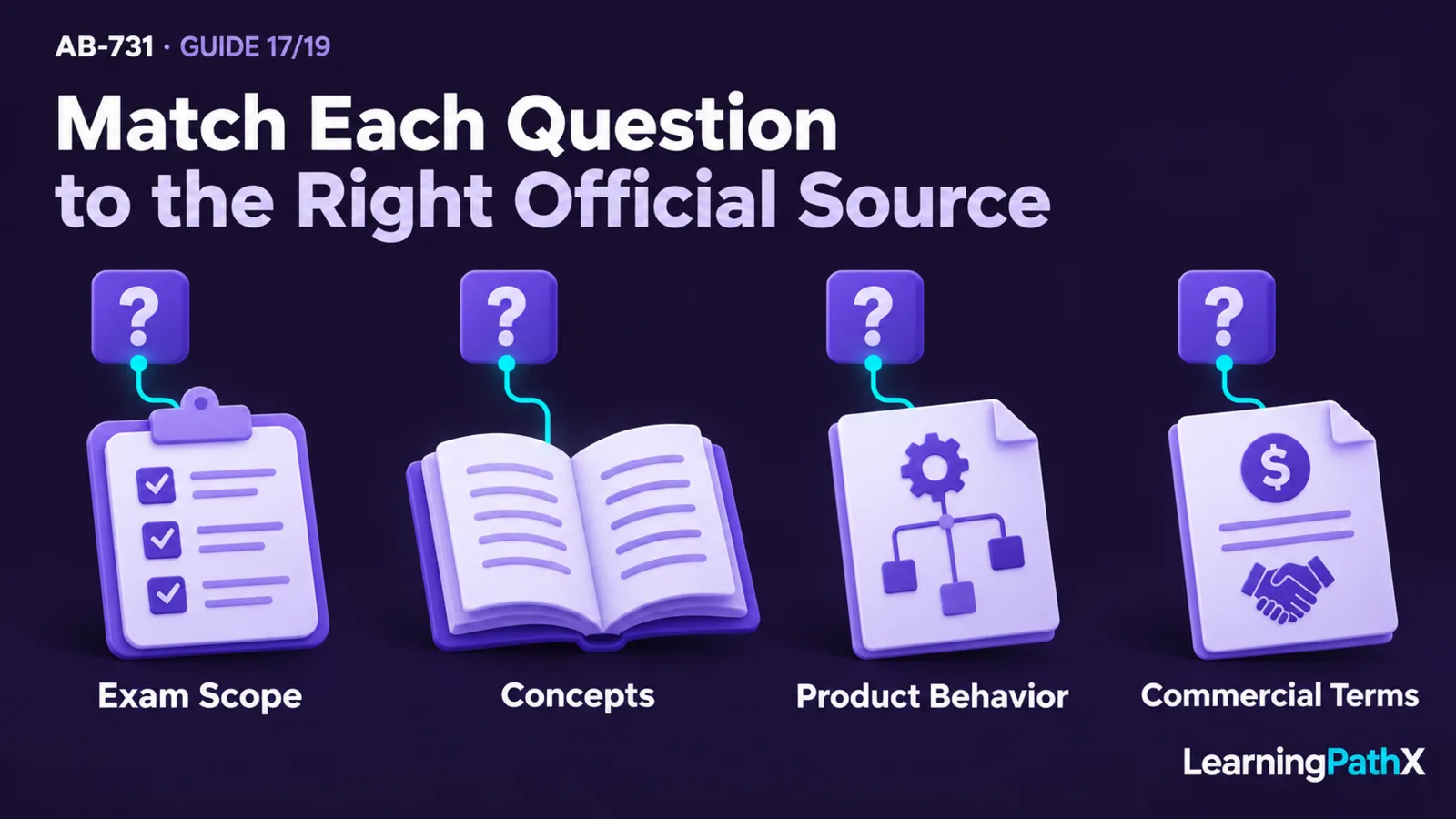
Choose official AB-731 resources by the question you need to answer. Use the study guide to establish assessed skills and their effective date, the certification page for credential positioning and current exam arrangements, and the official course and learning paths to build understanding. Use product documentation to verify how a capability works and the applicable security boundary. For commercial decisions, check licensing eligibility and the selected service's consumption guidance separately.
Then check whether the evidence applies to your exam version, product experience, account, deployment and decision date. An official page can be authoritative for one purpose without answering another: a course teaches concepts, a product overview introduces choices, and a billing page defines a particular commercial scope. The useful result is a small, traceable set of sources that answers your question with its conditions intact.
What Official AB-731 Resource Selection Means
Resource selection is the task of matching a claim to evidence that can support it. Before searching, write the uncertainty as a concrete question: “Is this skill in the public scope?”, “What does this capability access?”, or “Which users and services does this billing model cover?” These questions require different documents even when they mention the same product.
This guide is for candidates, business owners and transformation leaders who need to choose and interpret sources. It assumes you have the credential orientation in AB-731: Certification Guide: AI Transformation Leader Skills and Scope. Detailed technology explanations remain in the core lessons; a staged preparation sequence belongs to AB-731: Study Roadmap for AI Transformation Leaders.
Choose the Source That Fits the Question
| Your immediate need | Start with | What to extract | Boundary to retain |
|---|---|---|---|
| Confirm the credential, intended audience or exam arrangements | Microsoft Certified: AI Transformation Leader certification page | Credential identity, audience, current scheduling and preparation options | Confirm arrangements again when booking; they are not a technical capability specification |
| Determine what to learn for the selected exam version | Study guide for Exam AB-731 | Skills-measured effective date, detailed objectives and change log | Objectives define assessment scope, not complete product behavior |
| Learn unfamiliar concepts in an instructional order | AB-731T00-A course and the relevant official learning path | Audience, prerequisites, objectives and module sequence | A course's duration or completion does not establish readiness or replace scope checking |
| Understand a platform or extension choice | Microsoft Foundry overview or Copilot extensibility overview | Supported paths, component responsibilities and links to narrower guidance | An overview does not establish every method's availability or licensing |
| Verify how organizational information is handled | Microsoft Copilot data, privacy and security documentation | Applicable experience, permission model, data handling and stated exceptions | A service protection does not prove that an organization's existing permissions are appropriate |
| Determine whether a user is eligible for a capability | Microsoft Copilot licensing documentation | Required plans, license family, account and experience | Eligibility and usage charges are separate questions |
| Determine the relevant consumption and management model | Copilot Credits usage-based billing guidance, then the selected service's guidance | Covered services, billing path and management scope | A common credit currency does not make all services share the same terms |
Use this table as a routing aid. After selecting a starting page, inspect the section that actually supports the claim rather than treating the page title as sufficient evidence.
Understand the Roles of the Main Resources
The study guide defines scope; the certification page establishes context
The AB-731 study guide currently identifies skills measured as of July 22, 2026. Its detailed objectives let you determine whether a learning question belongs within the selected scope. Its change log helps you identify which portions changed between versions. Keep the objective wording when recording scope rather than replacing it with a product marketing summary.
The certification page answers a different set of questions: what credential the exam supports, who it targets, and how to access preparation and scheduling. It describes a business-leader audience without a coding expectation. Its practice assessment and exam sandbox serve different purposes: one supports knowledge-gap assessment, while the other familiarizes you with the exam interface. Neither should be treated as a substitute for learning the published skills.
The course and learning paths teach concepts
Course AB-731T00-A, Drive AI transformation in your organization, provides an official entry point for business leaders. The Explore the business value of generative AI solutions learning path introduces foundations before effective solution design, including prompts, grounding, data quality, security and machine learning considerations.
Read a module's stated objectives and prerequisites before deciding how deeply to use it. A candidate who cannot explain a concept should start with its teaching material; a leader checking one current feature should move to the relevant product documentation. Completing a path shows that you worked through that material, but it does not establish that you can justify a decision in a new business situation.
Product documentation verifies behavior and boundaries
Use an overview to locate the right product path, then move to the documentation for the capability in question. The Microsoft Foundry overview introduces its agents, models and tools and distinguishes current and classic experiences. It helps you locate the relevant platform context; a particular region, model or deployment claim requires its more specific evidence.
The Copilot extensibility overview starts with where people use the experience: inside Copilot, or in applications and custom agents that an organization operates. Use that distinction to select the appropriate follow-on documentation. Reading about one path does not establish the deployment, identity or distribution requirements of another.
For a claim about organizational information, the Copilot privacy and security page is more useful than a general training summary. It describes access through existing permissions and explains data handling. Read applicable notes and exceptions alongside the main statement. The next practical question is whether the actual organization's access model and intended experience satisfy those conditions; a general page cannot certify that configuration.
Commercial documents answer different parts of the cost question
Use the licensing page to check the prerequisite subscription and license family for the intended user and experience. Use consumption guidance to determine what can incur usage charges and how that service is managed. Preserve both answers in a proposal rather than allowing “included access” or “uses Copilot Credits” to stand for the whole commercial model.
The Copilot Credits overview explicitly routes some products to separate pay-as-you-go or Microsoft Copilot Studio guidance. Follow the route for the selected service and check its stated scope before relying on it. This guide does not reproduce current prices, eligible-plan lists or procurement terms; those details belong in a dated check for the actual purchasing decision.
Check Dates, Names and Applicability
Keep three dates separate
The exam's skills-measured effective date tells you which assessment scope you are studying. A document's update date describes that page's revision history. Your verification date records when you actually checked the claim. These dates answer different questions.
The sources used here were checked on October 16, 2026, and the exam guide still specifies the July 22, 2026 scope. A later product update can change available capabilities without changing that exam scope. Conversely, a new exam effective date would require checking the objectives even if your product notes remain technically accurate. When a page exposes no update date, record that it is not stated rather than inventing one.
Preserve the relevant naming context
Current Microsoft product documentation states that Microsoft 365 Copilot is now named Microsoft Copilot, while transitional experiences and exact feature names may retain the earlier wording. The AB-731 study guide still uses Microsoft 365 Copilot. Recognize the naming boundary so the old and new enterprise product names do not become two invented solution alternatives.
Likewise, the current Foundry overview identifies Azure AI Studio and Azure AI Foundry as earlier brands. An older name or redirected official address can still lead to relevant material. Check the destination, current title and documented experience before deciding that two pages describe the same version or that an old procedure remains applicable.
Record the conditions that change the answer
For each material claim, retain the source title and address, the supporting section, the date checked, and the applicable product or exam context. Add conditions such as account type, license, cloud environment, region, preview status, portal experience or deployment model when they affect the answer. Record unresolved conditions explicitly.
A landing-page check establishes only the claims actually read on that page. Linked licensing guides, implementation procedures and feature specifications need their own checks before their details can support a decision. This makes a resource record useful even when another person must continue the research.
Use a Purposeful Reading Order
Begin with the certification page to confirm that the credential fits your role, then read the study guide to turn a broad interest into a defined scope. Capture unfamiliar objectives as learning questions rather than immediately opening every linked document.
Use the official course or relevant learning path to build the concepts needed for those questions. Once you can explain the concept, select product documentation for the capability, data flow or control boundary that remains uncertain. This order avoids getting lost in implementation details before you understand why they matter.
Check licensing and usage-based billing when your learning question becomes an adoption or investment decision. Those sources constrain a proposed experience; they do not replace the conceptual explanation that makes the choice understandable. Return to the study guide afterward to confirm that the answer addresses the original learning need.
This is an order for using evidence, not a calendar or a required reading volume. Move directly to a narrower source when you already have the necessary background. Use the study roadmap to organize stage outcomes and review weak areas across the full series.
Resolve Apparent Conflicts Before Reusing a Claim
First determine whether two sources are answering the same question. Exam wording and current product naming may differ deliberately. An overview and a feature-specific page may also have different scope or update dates. Compare their applicability statements, effective dates, exceptions and linked context before treating the difference as a contradiction.
For exam scope, use the current official study guide and its stated effective version. For a feature or commercial claim, use the current applicable product or billing documentation. Do not let a newer broad overview silently erase a condition in a specific document, or let an older training example establish a present-day entitlement.
Consider a hypothetical proposal that says a Copilot-based assistant can answer from any company file and that all usage is included. Select the privacy page to test the access claim, the licensing page to check user eligibility, and the relevant usage guidance to establish the service's billing scope. The result should state the verified access and commercial conditions separately. A product name alone supports neither assertion.
If equally applicable current official sources still disagree, keep both statements and their context in your notes, mark the affected claim unresolved, and seek authoritative clarification before using it to approve a decision. Do not select whichever statement makes the proposal easier to justify.
Common Resource-Selection Mistakes
- Collecting many official links without recording which question each answers.
- Using exam objectives as proof of detailed product behavior, or a product release as proof of changed exam scope.
- Reading a training example as a current licensing or availability commitment.
- Treating a former name, current name and transitional feature label as interchangeable evidence of separate products.
- Ignoring account, deployment, region, preview or entitlement conditions because the headline sounds relevant.
- Assuming every linked child document was verified when only the parent page was read.
- Reusing an old commercial summary without checking the actual service and decision date.
Conclusion
Effective official AB-731 resource selection starts with the reader's uncertainty. The study guide establishes scope, the certification page provides credential and exam context, teaching resources build understanding, and product and commercial documents verify the conditions of a proposed solution.
Keep the exam effective date, document context and actual verification date distinct. A useful source record explains both what the evidence supports and where another check is needed. That makes your learning and leadership decisions easier to defend as terminology and cloud services change.
Authoritative Sources
- Microsoft Certified: AI Transformation Leader
- Study guide for Exam AB-731
- Course AB-731T00-A: Drive AI transformation in your organization
- Explore the business value of generative AI solutions
- What is Microsoft Foundry?
- Data, privacy, and security for Microsoft Copilot
- License options for Microsoft Copilot
- Ways to extend Microsoft 365 Copilot
- Understand usage-based billing and cost management for Copilot Credits