
Introduction
The best AB-731 preparation sequence starts with the current official scope, builds a common generative AI vocabulary, practices matching business needs to Microsoft capabilities, and then turns those decisions into governance, adoption, security, and commercial-readiness artifacts. Finish by integrating the artifacts into one transformation proposal and using the official study guide to find weak objectives. This order matters: a leader cannot make a defensible product or adoption decision before defining the business outcome, risk boundary, and evidence of value.
Use documentation review and business exercises together. Reading establishes accurate terminology and current product boundaries; creating decision artifacts proves that you can apply them. A complete preparation portfolio should include a value hypothesis, use-case scorecard, solution decision record, responsible AI risk register, adoption operating model, security and data checklist, licensing assumptions log, and measurement plan. The roadmap below is no-code and does not use real, recalled, or reconstructed exam questions.
Architecture Overview
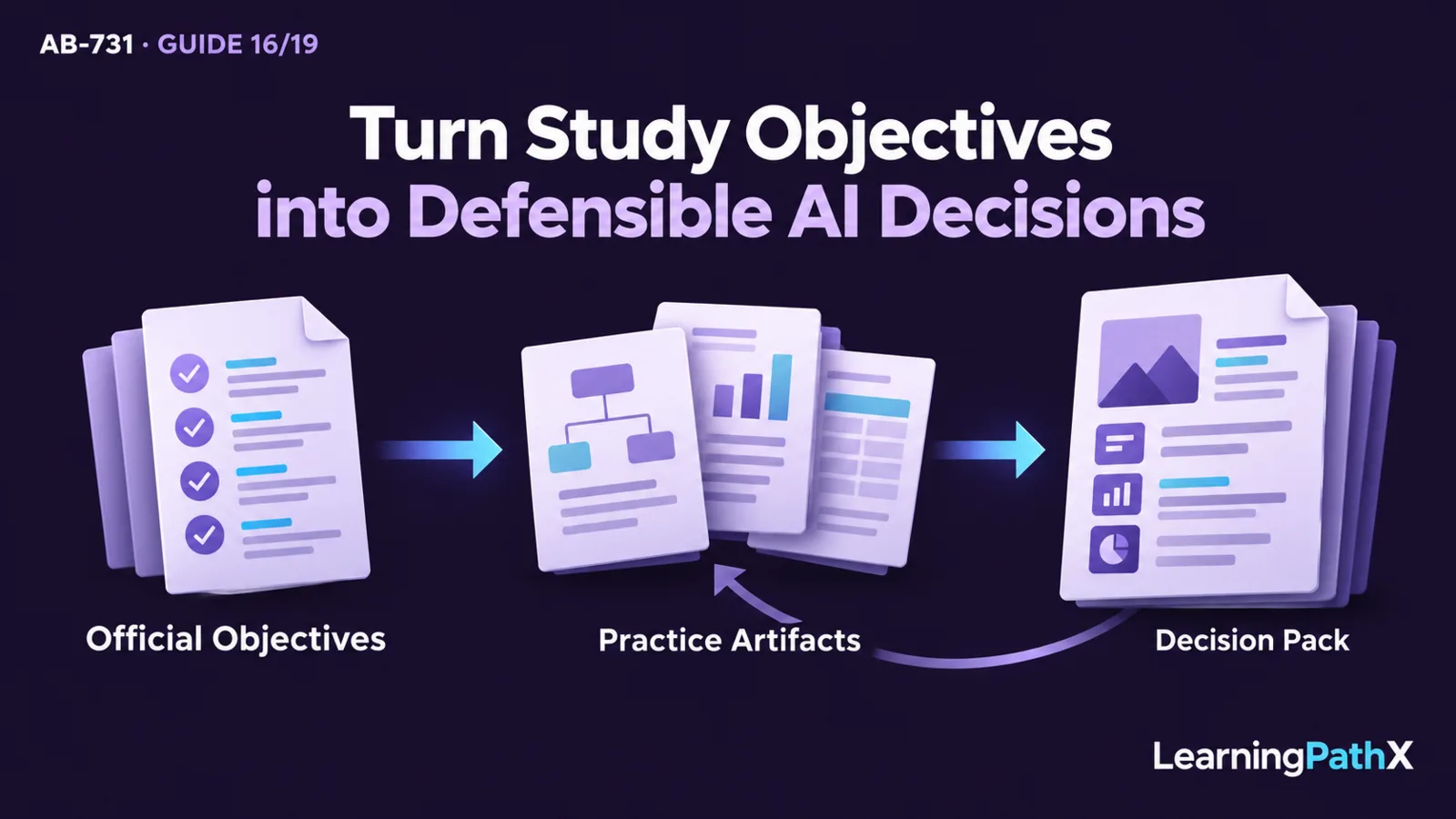
Treat preparation as an evidence loop rather than a stack of notes:
| Roadmap layer | Main activity | Observable output | Review question |
|---|---|---|---|
| Scope | Map the official skills measured | Objective coverage map | Can every objective be located and explained? |
| Concepts | Learn durable AI and business-value concepts | Terminology and value brief | Can the capability be explained without product slogans? |
| Selection | Match needs to Microsoft AI options | Solution decision record | Is the choice tied to requirements and constraints? |
| Controls | Add responsible AI, data, and security boundaries | Risk register and control checklist | Are risks assigned to owners and lifecycle gates? |
| Delivery | Design adoption, roles, licensing, and measurement | Adoption and commercial-readiness plan | Can the organization implement and sustain the choice? |
| Integration | Defend an end-to-end transformation proposal | Executive decision pack | Do value, technology, controls, people, and economics agree? |
Each output becomes input to the next layer. If a later exercise exposes an unsupported assumption, return to the relevant documentation and revise the earlier artifact. That feedback loop is closer to leadership work than memorizing isolated feature names.
Before You Begin
Open the current AB-731 study guide and record its skills-measured date. The scope used here is the version measured as of July 22, 2026 and verified October 16, 2026, but Microsoft can update objectives and product documentation. Recheck the study guide before scheduling or sitting the exam.
Create a coverage tracker with one row per official objective. Add columns for your confidence, authoritative source, practice artifact, review date, and unresolved question. Use three confidence states: explain, apply, and defend. “Explain” means you can define the concept; “apply” means you can use it in a business case; “defend” means you can compare alternatives and state the tradeoffs.
Choose one realistic but fictional business scenario to carry through the roadmap. For example, a regional services company might want to reduce time spent preparing account reviews while protecting sensitive customer information. Keep the scenario bounded enough to make decisions, but avoid importing confidential organizational data.
Stage 1: Map the Scope and Establish a Baseline
Start with the official domains and weights rather than a third-party topic list. AB-731 currently emphasizes two large areas—generative AI business value and Microsoft AI apps and services—followed by implementation and adoption strategy. Weighting helps allocate time, but every listed skill remains in scope.
Read the certification guide, study guide, and official AB-731 course page. Build a one-page map connecting each objective to a business decision. For example, “identify opportunities for generative AI” connects to use-case discovery; “identify an implementation and adoption strategy” connects to governance, roles, rollout, and measurement.
Then write a short baseline explanation for each domain without consulting notes. Mark vague phrases such as “use AI to improve efficiency.” Replace them with an actor, task, output, decision, and measure. The result is a gap map, not a score prediction.
Output: objective coverage map and baseline gap list.
Stage 2: Build Generative AI and Business-Value Foundations
Work through Microsoft's business-value learning path and its foundation material. Focus on relationships: models generate outputs from instructions and context; prompts shape a request; grounding supplies relevant evidence; retrieval-augmented generation retrieves external context at request time; fine-tuning changes model behavior through additional training; evaluation tests whether the solution meets defined quality and risk thresholds.
For the chosen scenario, create a value hypothesis with:
- The current process and measurable baseline.
- The user and decision being supported.
- The proposed generative output or interaction.
- The expected value driver, such as time saved, quality improved, or capacity released.
- Guardrails for accuracy, privacy, fairness, security, and human oversight.
- Evidence that would justify continuing, changing, or stopping the initiative.
Next, compare rules, predictive machine learning (ML), and generative AI. Rules fit explicit stable logic; predictive machine learning fits scores, categories, rankings, and forecasts learned from historical outcomes; generative AI fits content creation and interaction. This distinction prevents choosing a fashionable capability for the wrong output.
Output: terminology map, value hypothesis, and rules-versus-ML-versus-generative-AI decision note.
Stage 3: Practice Solution and Model Strategy Decisions
Turn the value hypothesis into a use-case scorecard. Rate business impact, feasibility, data readiness, risk, adoption effort, time to evidence, and operating cost. State the assumptions behind every rating. A score without rationale cannot support a leadership decision.
Then compare solution strategies. Ask whether an existing Microsoft AI application already supports the workflow, whether extension is sufficient, or whether a custom solution is justified. For model strategy, compare prompt engineering, grounding, retrieval-augmented generation, and fine-tuning by the problem they solve. Do not assume that more customization is automatically better.
Create a simple cost-driver model rather than memorizing prices. Include request volume, input and output tokens, model choice, retrieval and data services, evaluation, monitoring, integration, change management, licensing, and support. Keep prices in a dated assumptions log because commercial terms can change.
Output: prioritized use-case scorecard, model-strategy decision record, and cost-driver worksheet.
Stage 4: Map Business Work to Microsoft AI Capabilities
Now practice choosing among the Microsoft portfolio. Begin with the business process, user, data boundary, collaboration surface, required action, and governance need. Only then map the requirements to Microsoft Copilot, Microsoft Copilot Chat, Researcher, Analyst, Microsoft Copilot Studio, or Microsoft Foundry capabilities. The July 2026 exam guide still says Microsoft 365 Copilot, while current product documentation uses Microsoft Copilot; retain Microsoft 365 Copilot only when referring to the exam wording or an official transitional feature name.
Draw the high-level Microsoft Copilot flow: the user works through Microsoft Copilot Chat or a Microsoft 365 app; identity and permissions constrain accessible work data; Microsoft Graph can ground responses in authorized organizational context; orchestration combines instructions and context with a model; enterprise data protection and Microsoft 365 controls govern the service boundary. Keep permission-aware retrieval distinct from content accuracy: authorized context can still be incomplete or misunderstood.
For the same scenario, write three short selection records:
- Choose among Copilot Chat, Researcher, and Analyst for a defined knowledge-work task.
- Decide whether to buy, extend, or build the capability.
- Decide whether a custom need points to Microsoft Foundry models, model evaluation, content safety, document processing, language, speech, or vision tools.
Each record should state requirements, selected option, rejected alternatives, security boundary, licensing assumption, and the evidence needed for a pilot.
Output: capability map and three solution decision records.
Stage 5: Add Responsible AI, Data, and Security Controls
Study Microsoft's responsible AI principles together: fairness, reliability and safety, privacy and security, inclusiveness, transparency, and accountability. Then apply them across the lifecycle rather than treating them as a final compliance checklist.
Create a risk register for the scenario. Include fabrication, harmful or biased output, overreliance, inappropriate data access, prompt injection, sensitive-data disclosure, weak evaluation, and unclear accountability where relevant. For each risk, name the affected stakeholder, control, owner, evidence, release threshold, monitoring signal, and response action.
Use Microsoft's secure AI adoption guidance to review identity, devices, applications, data, infrastructure, networks, and visibility. Add data classification, least privilege, oversharing remediation, logging, evaluation, human review, and incident response to the design. Avoid the common mistake of treating enterprise data protection as proof that every underlying permission is appropriate.
Output: responsible AI risk register, data-boundary diagram, and security-readiness checklist.
Stage 6: Design the Operating Model and Adoption Strategy
Review the Microsoft 365 Copilot adoption essential guide and adoption hub. Convert adoption from a communications activity into an operating model.
Define the executive sponsor, AI council, business owner, center of excellence, security and compliance partners, technical service owner, adoption lead, champions, and users. Assign decision rights for use-case approval, data readiness, release, incident response, measurement, expansion, and retirement.
Create a staged rollout: discover and prioritize, prepare controls and users, pilot with a bounded group, measure outcomes and risks, revise the process, and expand only when the evidence supports it. Add a champions program with role expectations, enablement, feedback routes, recognition, and escalation. Measure business outcomes, responsible-use signals, user behavior, support demand, and quality—not activation alone.
Output: role map, adoption plan, champions charter, and measurement scorecard.
Stage 7: Validate Licensing and Commercial Readiness
Commercial readiness is part of solution fit. Review the current Microsoft Copilot licensing and extensibility documentation, then distinguish Microsoft Copilot Business from Microsoft Copilot, included access such as Microsoft 365 E7 from add-on paths, and fixed licensing from service-specific usage-based billing. Record assumptions for user experiences and application programming interfaces (APIs), including tenant eligibility, user licenses, Copilot Credits-managed services, separate Microsoft Copilot pay-as-you-go services, Microsoft Copilot Studio billing, agents, connectors, Microsoft Work IQ API, Microsoft 365 Copilot APIs, or capacity. For custom services, include Azure consumption and commitment-model assumptions where applicable.
Do not memorize a transient price as a durable architectural fact. Instead, practice identifying the billing unit, usage driver, owner, budget threshold, forecast range, and verification source. Pair those economics with data-residency, identity, compliance, network, support, and service-management requirements.
Create a pre-pilot gate with three possible decisions: proceed, revise, or stop. A “proceed” decision should require an approved use case, clear data boundary, named owners, risk controls, licensing path, measurable pilot design, and exit criteria.
Output: licensing assumptions log, total-cost model, and pre-pilot decision gate.
Stage 8: Integrate, Teach Back, and Close Gaps
Assemble the artifacts into a concise executive decision pack. It should tell one consistent story: business problem, chosen capability, rejected alternatives, architecture boundary, responsible AI controls, adoption model, economics, measures, and next decision. Contradictions are valuable signals. If the adoption plan assumes broad access while the security design requires a narrow pilot, reconcile them.
Use a teach-back review. Explain the proposal to a colleague or record yourself presenting it. Ask the reviewer to challenge the model strategy, Microsoft product choice, permissions, risk ownership, licensing assumptions, and success measures. Update the coverage tracker only when you can answer with an authoritative source or a reasoned decision artifact.
Finish with the official study guide. For every weak objective, return to Microsoft documentation, revise the relevant artifact, and repeat the explanation. Use official practice assessments if Microsoft provides them through the certification page, but do not seek or use dumps, recalled questions, or reconstructed answer keys.
Output: executive decision pack, teach-back findings, and final objective coverage map.
A Practical Review Loop
Advance when the stage's output can be explained, applied and defended, rather than following an invented personal calendar. If a decision artifact depends on an unresolved earlier concept, return to that prerequisite and revise the artifact before moving on. The required effort depends on baseline knowledge and the evidence still missing.
Use each session in four parts: review an objective, read an authoritative source, apply the concept to the scenario, and record evidence or uncertainty. Recheck product-sensitive facts such as availability, licensing, names and security boundaries at consequential checkpoints, including solution comparison, pilot approval and exam booking. Revisit durable concepts through spaced retrieval and teach-back; use current official evidence for living product details.
Common Mistakes
Reading without producing decisions
Recognition can feel like mastery. Require an observable artifact that shows how the concept changes a business choice.
Memorizing product labels without requirements
Product names can change, and overlapping capabilities can confuse selection. Start with the user, workflow, data, action, control, and economics.
Studying domains as isolated silos
Business value, technology, governance, adoption, and licensing constrain one another. Use one scenario and one integrated decision pack to expose conflicts.
Treating governance as a final approval
Responsible AI, security, and data controls affect discovery, design, evaluation, deployment, monitoring, and retirement. Add them from the first use-case screen.
Using outdated commercial facts
Licensing and availability are living guidance. Date every assumption and verify it in official Microsoft documentation near the decision point.
Practicing with exam dumps
Dumps do not establish leadership competence and can violate exam rules. Practice explaining, applying, comparing, and defending the official objectives instead.
Certification Relevance
AB-731 is designed for business leaders who drive AI transformation, not candidates expected to write implementation code. Preparation should therefore demonstrate decision quality: recognizing value, choosing appropriate Microsoft capabilities, identifying data and responsible AI constraints, defining operating roles, planning adoption, and connecting investment to measurable outcomes.
Begin with the AB-731: Certification Guide: AI Transformation Leader Skills and Scope for the official identity and boundaries. Revisit AB-731: When Machine Learning Adds Value and How Its Lifecycle Works when distinguishing predictive use cases. Complete the operating portions with AB-731: Building an AI Adoption Team, Champions Program, and Change Strategy and AB-731: Copilot and Foundry Licensing, Cost, Data, and Security Planning.
Conclusion
A strong AB-731 roadmap moves from scope to concepts, selection, controls, delivery, and integration. The sequence combines authoritative documentation with observable business artifacts so that preparation tests application, not just recall. One fictional scenario can connect the entire scope while keeping confidential data out of the exercise.
Maintain a dated coverage tracker, revisit product-sensitive facts, and close gaps through teach-back and artifact revision. The goal is to defend a coherent AI transformation decision whose business value, technology choice, governance, adoption model, security boundary, and economics reinforce one another.
Authoritative Sources
- Study guide for Exam AB-731
- Course AB-731T00-A: Drive AI transformation in your organization
- Explore the business value of generative AI solutions
- Adopt and secure AI and data
- Microsoft 365 Copilot adoption essential guide
- License options for Microsoft Copilot
- Data, privacy, and security for Microsoft Copilot
Related Reading
- Prerequisite: AB-731: Certification Guide: AI Transformation Leader Skills and Scope
- Related: AB-731: When Machine Learning Adds Value and How Its Lifecycle Works
- Prerequisite: AB-731: Building an AI Adoption Team, Champions Program, and Change Strategy
- Prerequisite: AB-731: Copilot and Foundry Licensing, Cost, Data, and Security Planning