
Introduction
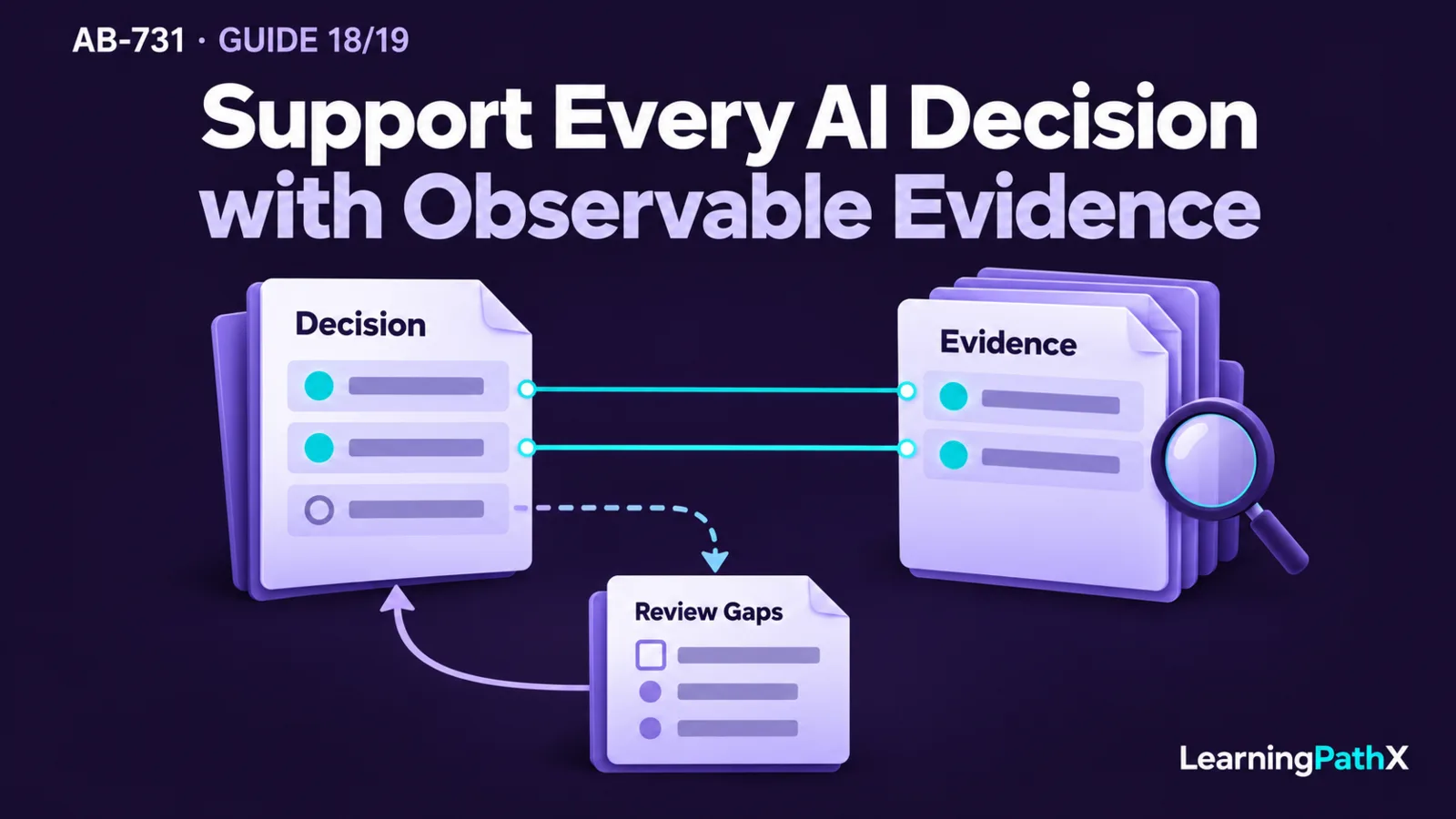
Before defending an AI transformation decision, check that you can distinguish the required business output from the technology, missing knowledge from a model-behavior problem, permission from factual accuracy, and product naming from actual entitlement. Then separate governance from adoption, gross benefits from benefits already reduced by operating effort, and license eligibility from usage charges. Each distinction should be supported by an observable decision record or check, rather than confidence in a familiar term.
Use this checklist after learning the foundations. For each item, identify what you can demonstrate, what remains uncertain, and which lesson or current official source will close the gap. It reviews leadership reasoning aligned with AB-731; it does not predict an exam score, establish complete coverage, or authorize a production release.
Prerequisite Knowledge and Review Method
You should already understand the model-choice framework in AB-731: Choosing Generative AI Solutions and Model Strategies, the prompting and retrieval-augmented generation (RAG) information flow in AB-731: Prompt Engineering, Grounding, and RAG for Business Solutions, the decision rights in AB-731: Responsible AI Governance and the AI Council, and the commercial boundaries in AB-731: Copilot and Foundry Licensing, Cost, Data, and Security Planning.
Choose one familiar business proposal and use its existing notes. Mark an item complete only when you can produce the stated evidence and explain its limits. An unsupported claim belongs on a return list even if you recognize every word. Record the missing evidence and next action; do not convert checked boxes into a readiness percentage.
AI Transformation Decision Review Checklist
Match the output to the capability
- State the required output and the business action it supports: a deterministic rule-based action, a prediction or ranking, or generated content.
- Give one reason for the selected approach and one reason a simpler alternative would be insufficient. A proposal that needs only a stable approval threshold should not acquire a model merely because AI is available.
- Identify the owner and measurable outcome. “More AI use” is activity, not evidence that the workflow improved.
If you cannot separate generation, prediction and rules, return to AB-731: Generative AI Foundations and Business Value for Leaders or AB-731: When Machine Learning Adds Value and How Its Lifecycle Works.
Separate missing context from a behavior gap
- Describe whether a poor response lacks instructions, lacks current or controlled information, or repeatedly fails a required behavior despite suitable instructions and context.
- Explain why prompting, grounding or fine-tuning addresses that diagnosed gap. Grounding supplies request-time information; fine-tuning changes model behavior through training. They can be combined when separate requirements justify them.
- Name the evaluation evidence that would show improvement over the baseline. Do not treat extra context or extra training as proof of better results.
Return to AB-731: Choosing Generative AI Solutions and Model Strategies for the intervention choice, or AB-731: Prompt Engineering, Grounding, and RAG for Business Solutions for retrieval and generation failure analysis. RAG does not guarantee factual correctness.
Check permission and answer quality separately
- Identify the user or service identity and the sources and actions it is allowed to access. Show how an unauthorized request is denied or excluded from the proposed flow.
- Separately identify how a permitted answer is checked for support, freshness and completeness. Authorized access can still return obsolete or incorrectly interpreted information.
- State who can review, correct or stop a consequential action. Permission to read a record is not permission to disclose or change it.
Return to AB-731: Data Quality, Reliability, Bias, and Security in Generative AI if access controls, quality evidence and human authority have become one vague “security” assurance.
Distinguish names, context and entitlement
- Recognize Microsoft 365 Copilot as the former enterprise product name now called Microsoft Copilot, while preserving exact exam wording and transitional feature names where applicable.
- Record the intended account, app or chat experience, and source of context. A product label alone does not establish which organizational information the user can access.
- Verify the applicable license and service conditions for that experience. Avoid assuming either that every Copilot user has broad work grounding or that every user without an add-on has no supported organizational context.
Return to AB-731: Microsoft 365 Copilot Architecture, Chat, Apps, and Microsoft Graph for context boundaries, and AB-731: Copilot and Foundry Licensing, Cost, Data, and Security Planning for entitlement. Recheck the relevant official documentation when the intended experience or decision date changes.
Separate governance authority from adoption execution
- Identify who approves the use case, sets its risk conditions and owns escalation. A council or policy document does not operate every solution control.
- Separately identify who helps the intended users change their workflow, obtain support and provide feedback. Naming an approval body does not establish an adoption team or champions program.
- Show both release conditions and evidence of useful, sustained behavior. Approval without enablement can leave a safe tool unused; active usage without oversight can leave risk unmanaged.
Return to AB-731: Responsible AI Governance and the AI Council for decision rights, or AB-731: Building an AI Adoption Team, Champions Program, and Change Strategy for execution and feedback.
Count labor once in the economic comparison
- Compare the same workload, population and period in baseline and assisted cases, including rejected attempts, correction and fallback effort.
- Label whether the calculation starts with gross baseline labor value and includes assisted labor on the cost side, or uses a net-time benefit that already deducts that labor. In the latter case, mark the same deducted review effort as already reflected before calculating incremental costs.
- Identify the denominator and nonlabor solution costs. Keep time returned, capacity and cash savings distinct, and do not add overlapping descriptions of the same benefit.
This is an accounting-consistency check, not a Microsoft formula or a claim of savings. Return to AB-731: Generative AI Cost Drivers, Tokens, and ROI if the benefit and cost boundaries cannot be reconciled.
Separate entitlement from consumption
- Record which license or qualifying plan permits the intended experience, then separately identify the selected service's usage unit and billing path.
- Identify who owns spending, monitoring and exceptions. Copilot Credits are a common currency for eligible services, not evidence that every service has identical access, administration or terms.
- Recheck the service-specific guidance before a purchase or expansion decision. An included capability does not establish that every connected service or operating cost is included.
Return to AB-731: Copilot and Foundry Licensing, Cost, Data, and Security Planning. Use the current licensing and consumption documents for the exact service; do not memorize an old eligibility list as a permanent rule.
Turn Gaps into Focused Review
For each incomplete item, write a short return record: the distinction you could not defend, the missing artifact or current fact, the named lesson or official source to revisit, and the evidence you will produce afterward. Recheck that item using a different business example so familiarity with one proposal does not conceal the gap.
Use AB-731: Study Roadmap for AI Transformation Leaders to place recurring gaps back into the learning sequence. The public exam scope remains skills measured as of July 22, 2026, with the source facts used here checked on October 16, 2026. Current product and commercial conditions still require verification for the actual decision.
Conclusion
A useful review ends with defensible distinctions and visible evidence. Keep unsupported assumptions on the return list, revisit the relevant lesson, and verify changing product facts before using the reasoning in a real approval.
Authoritative Sources
- Study guide for Exam AB-731
- Grounding data design for AI workloads
- RAG and generative AI in Azure AI Search
- Data, privacy, and security for Microsoft Copilot
- License options for Microsoft Copilot
- Apply responsible AI
- Understand usage-based billing and cost management for Copilot Credits
Related Reading
- Prerequisite: AB-731: Choosing Generative AI Solutions and Model Strategies
- Prerequisite: AB-731: Prompt Engineering, Grounding, and RAG for Business Solutions
- Prerequisite: AB-731: Responsible AI Governance and the AI Council
- Prerequisite: AB-731: Copilot and Foundry Licensing, Cost, Data, and Security Planning
- Related: AB-731: Study Roadmap for AI Transformation Leaders