
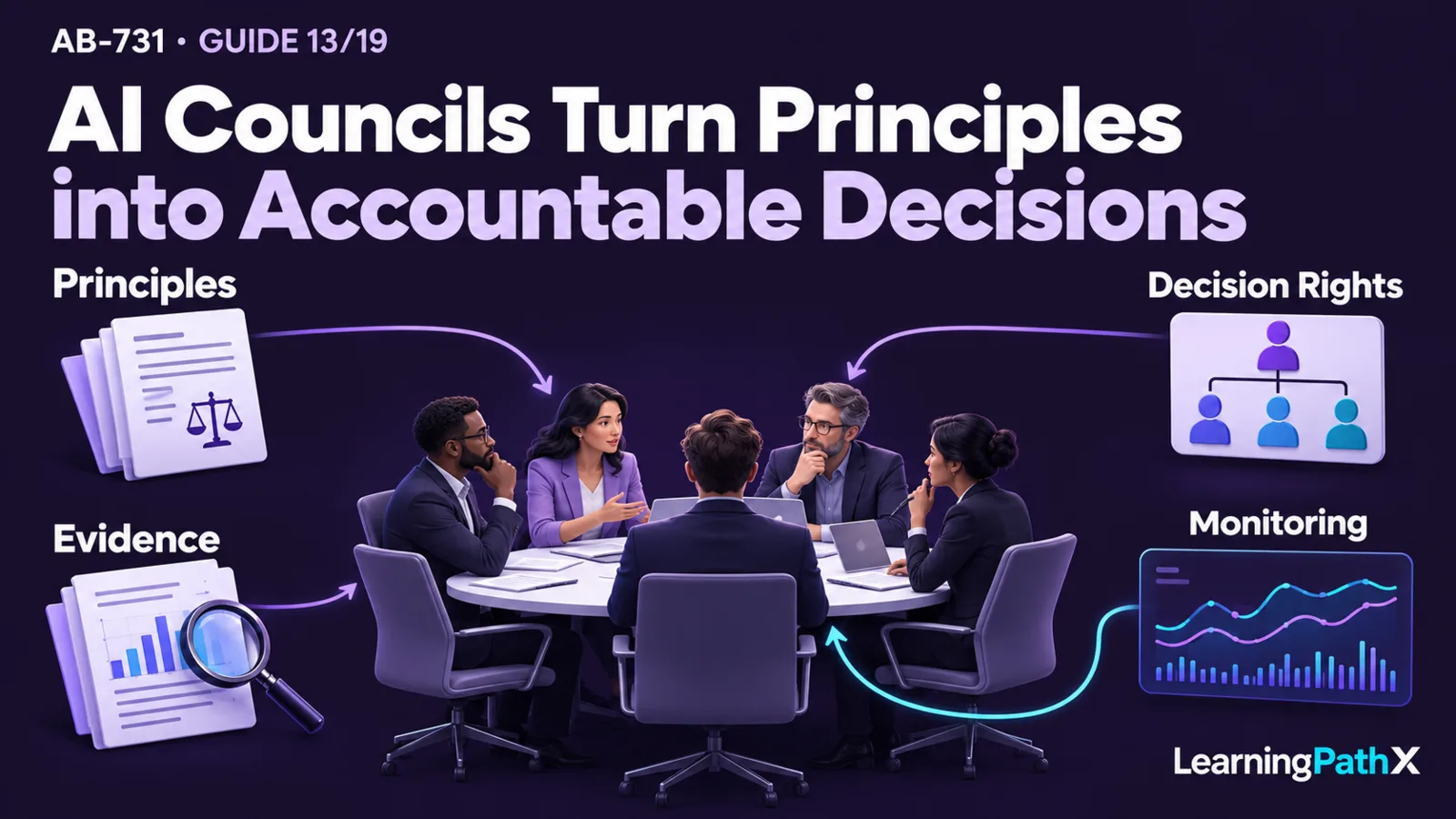
An AI council should turn Microsoft's responsible AI principles into a repeatable operating system for decisions. It does this by defining who owns each decision, grouping use cases by risk, requiring evidence at review gates, assigning human oversight, and monitoring approved solutions after release. The council is therefore not merely an advisory forum: it connects enterprise policy to portfolio priorities and solution-level accountability.
The architecture has four linked layers. Microsoft's six principles—fairness, reliability and safety, privacy and security, inclusiveness, transparency, and accountability—set the values; a council charter converts those values into authority; risk tiers determine the rigor of assessment and approval; and lifecycle evidence supports release, monitoring, escalation, and retirement decisions. This structure makes responsible AI governance consistent without forcing every low-risk productivity experiment through the same controls as a high-impact system.
Responsible AI Governance Architecture
Responsible AI governance operates across the enterprise portfolio and the lifecycle of each AI solution. At the portfolio level, leaders decide which opportunities align with strategy, risk appetite, legal obligations, and available oversight capacity. At the solution level, accountable owners demonstrate that a use case has appropriate data, safeguards, evaluation, human control, communication, and monitoring.
Microsoft's AI assurance guidance presents responsible AI as a shared responsibility and identifies the six principles that guide Microsoft's approach. Shared responsibility matters because purchasing a Microsoft service does not transfer an organization's duties for its own use case, data, configuration, user access, decisions, or operating context. The council must identify which responsibilities belong to the technology provider and which remain with the organization.
A useful governance design separates three functions:
- Policy defines the principles, prohibited uses, minimum controls, and escalation thresholds.
- Oversight tests whether evidence satisfies those requirements and records an accountable decision.
- Delivery teams design, operate, and improve the solution within the approved conditions.
Separating these functions reduces ambiguity. Delivery teams remain responsible for their solution, while the council provides consistent challenge and enterprise-level coordination rather than becoming the owner of every operational control.
Core Governance Components
Principles translated into testable requirements
Principles become operational only when teams can show how they affected design. The council should require each proposal to state the relevant risk, planned control, evidence, owner, and residual risk for all applicable principles.
| Responsible AI principle | Governance question | Example evidence |
|---|---|---|
| Fairness | Could outcomes differ unjustifiably across affected groups? | Impact analysis, representative evaluation data, and subgroup results |
| Reliability and safety | Does the solution behave within defined operating limits and fail safely? | Test results, fallback behavior, incident thresholds, and human-review rules |
| Privacy and security | Are data access, use, retention, and protection appropriate? | Data-flow record, access review, threat assessment, and approved controls |
| Inclusiveness | Can people with different abilities and contexts use the solution effectively? | Accessibility review and feedback from representative users |
| Transparency | Do users and affected parties understand that AI is involved, what it can do, and its limits? | User notices, system description, limitation statements, and escalation guidance |
| Accountability | Is a named role answerable for approval, operation, incidents, and retirement? | Decision record, ownership matrix, monitoring plan, and escalation path |
The table is a governance pattern, not a claim that one artifact proves compliance. Evidence must fit the use case, affected population, deployment environment, and consequences of error.
Council charter and decision rights
An AI council needs a written charter that defines its purpose, scope, membership, authority, meeting cadence, decision rules, escalation route, and recordkeeping expectations. The Microsoft Copilot adoption hub positions an AI council as part of organizational readiness and alignment. In practice, its membership should cover the perspectives needed to make defensible decisions, such as executive sponsorship, business ownership, technology, security, privacy, legal or compliance, risk, data, and adoption.
Decision rights should distinguish advice from approval. A practical assignment identifies:
- who proposes and funds the use case;
- who owns business outcomes and harms;
- who determines the risk tier;
- who reviews specialized control areas;
- who may approve, conditionally approve, pause, or reject a release;
- who accepts residual risk within authorized limits; and
- who responds when monitoring reveals a problem.
The council should delegate routine decisions within documented thresholds. It should retain direct review for exceptions, high-impact cases, unresolved conflicts, or risks that exceed delegated authority.
Risk tiers and proportionate controls
Risk tiering concentrates governance effort where failure would matter most. Microsoft's responsible AI guidance for an agentic Center of Excellence describes a risk-based approach that connects risk levels with review rigor, release gates, human oversight, and monitoring.
An organization can define its own tier criteria around factors such as the sensitivity of data, scale of use, autonomy, reversibility, affected population, legal or financial consequence, and potential safety impact. The important design choice is not the number or name of tiers; it is the documented link between a tier and mandatory controls.
For example, a low-impact drafting assistant used by a small internal group may qualify for a streamlined review if users verify its output. A solution that recommends decisions affecting employment, eligibility, safety, or material financial outcomes warrants deeper multidisciplinary review, explicit human authority, stronger testing, and closer monitoring. These examples are general governance illustrations; applicable law and organizational policy determine the actual requirements.
Lifecycle gates and evidence
Governance should follow the solution from idea to retirement. A practical sequence uses gates at intake, design, pre-release, operation, and material change:
- Intake records the intended outcome, users, affected parties, data, owner, and preliminary risk tier.
- Design review identifies foreseeable harms, control requirements, evaluation measures, human oversight, and communication needs.
- Pre-release review examines evidence, unresolved limitations, operational readiness, and the accountable approval decision.
- Operational review uses monitoring, incidents, complaints, adoption data, and control performance to confirm that approval conditions remain valid.
- Change review reassesses the solution when its model, data, tools, audience, autonomy, or business purpose changes materially.
Each gate should produce a durable decision record. The record should identify the evidence considered, decision maker, outcome, conditions, residual risks, review date, and trigger for reassessment. A checklist alone is insufficient if nobody is accountable for interpreting the evidence.
Human oversight and monitoring
Human oversight should be designed around a meaningful ability to intervene. The accountable team must know what people review, when they review it, what information they receive, and what authority they have to stop or correct an outcome. Simply placing a person near an automated process does not establish effective oversight.
Monitoring then tests whether the solution continues to operate within its approved conditions. Measures should reflect the use case and may include quality, groundedness, harmful-output indicators, access anomalies, user complaints, overrides, failed escalations, and changes in the population or data. Thresholds should lead to defined actions such as investigation, added controls, restricted use, rollback, or retirement.
How the Governance Components Work Together
The components form a decision loop rather than a one-time approval pipeline:
- Strategy and principles establish acceptable outcomes and non-negotiable constraints.
- The charter assigns authority and creates a route for cross-functional judgment.
- Intake and risk classification determine the evidence and reviewers required.
- Lifecycle gates compare that evidence with policy and record a decision.
- Delivery teams operate within the decision's conditions and collect monitoring evidence.
- Incidents, performance changes, and material modifications feed back into reassessment.
This loop also connects portfolio governance with solution governance. Portfolio signals can reveal repeated issues across teams, such as unclear ownership or weak evaluation practices. The council can respond by changing common policy, templates, enablement, or delegated authority while leaving solution owners accountable for implementation.
Design Considerations for an Effective AI Council
Start with decision inventory, not committee membership
Before selecting attendees, list the decisions the organization must make: use-case admission, risk classification, control exceptions, release approval, residual-risk acceptance, incident escalation, and retirement. Then assign authority and required expertise for each decision. This avoids a large council that discusses broadly but cannot act.
Use minimum evidence by risk tier
Define a baseline evidence set for every use case and additional requirements for higher tiers. Standard intake forms, impact assessments, evaluation summaries, system descriptions, approval records, and monitoring plans make comparisons easier across a portfolio. Permit justified alternatives when a standard artifact does not fit, but require the owner to explain how equivalent evidence is provided.
Preserve independent challenge
Business owners understand the intended value, while specialists understand particular risks. Neither view is sufficient alone. Reviews should allow security, privacy, legal, risk, data, accessibility, and adoption specialists to challenge assumptions within their remit. The final decision must still have one accountable owner rather than diffuse responsibility across the meeting.
Design for change
AI services and organizational uses evolve. Approval conditions should therefore name reassessment triggers, not rely only on a calendar. A change in intended users, sensitive data, connected actions, decision impact, model behavior, or deployment scope can alter risk even when the product name remains unchanged.
Measure governance performance
The council should monitor its own operating effectiveness. Useful measures can include review cycle time by risk tier, overdue conditions, incident recurrence, percentage of solutions with named owners, and whether monitoring actions close on time. These measures help identify process bottlenecks and accountability gaps; they should not reward rapid approval at the expense of evidence quality.
Common Governance Mistakes
- Treating the six principles as values statements without converting them into requirements, evidence, and owners.
- Making the council responsible for every control, which weakens the delivery team's accountability.
- Applying one review path to all use cases, causing either excessive friction for low-risk work or insufficient scrutiny for higher-risk work.
- Using product procurement or a vendor assurance statement as proof that the organization's use case is responsible.
- Approving a pilot without defining production release criteria, monitoring, incident response, or change triggers.
- Recording a group consensus without naming the person authorized and accountable for the decision.
- Treating human review as a label without verifying that reviewers have time, information, competence, and authority to intervene.
- Allowing adoption pressure or expected value to bypass unresolved risk evidence.
Relevance to AB-731 Leadership Decisions
The AB-731 study guide includes responsible AI, governance, accountability, and an AI council within the leadership scope. The important capability is to connect them: principles guide policy; the council defines and exercises decision rights; risk tiers scale the controls; review gates test evidence; human oversight and monitoring preserve accountability after deployment.
For preparation, practice producing leadership artifacts rather than memorizing principle names in isolation. A useful exercise is to take a hypothetical business use case and draft its intake summary, accountable owner, risk rationale, required reviewers, release evidence, human-oversight design, monitoring triggers, and escalation route. This stays within the certification's business-leader and no-code boundary while developing the judgment needed to evaluate an AI governance proposal.
Conclusion
Responsible AI governance works when the AI council converts principles into explicit decisions throughout the solution lifecycle. A charter gives the council authority, risk tiers make oversight proportionate, evidence-based gates make approvals defensible, and monitoring keeps accountability active after release. The resulting system supports useful experimentation while ensuring that business owners, specialists, and executives understand what they must decide and own.
Authoritative Sources
- Artificial Intelligence overview
- Microsoft Copilot adoption hub
- Apply responsible AI
- Define roles, responsibilities, and decision rights
- Study guide for Exam AB-731