
Introduction
Prompt engineering, grounding, and retrieval-augmented generation work as three connected layers in a business AI solution. Prompt engineering tells the large language model what task to perform, what constraints to follow, and how to structure the answer. Grounding supplies relevant business context. Retrieval-augmented generation (RAG) makes that context dynamic by finding appropriate content from an approved source before the model generates its response.
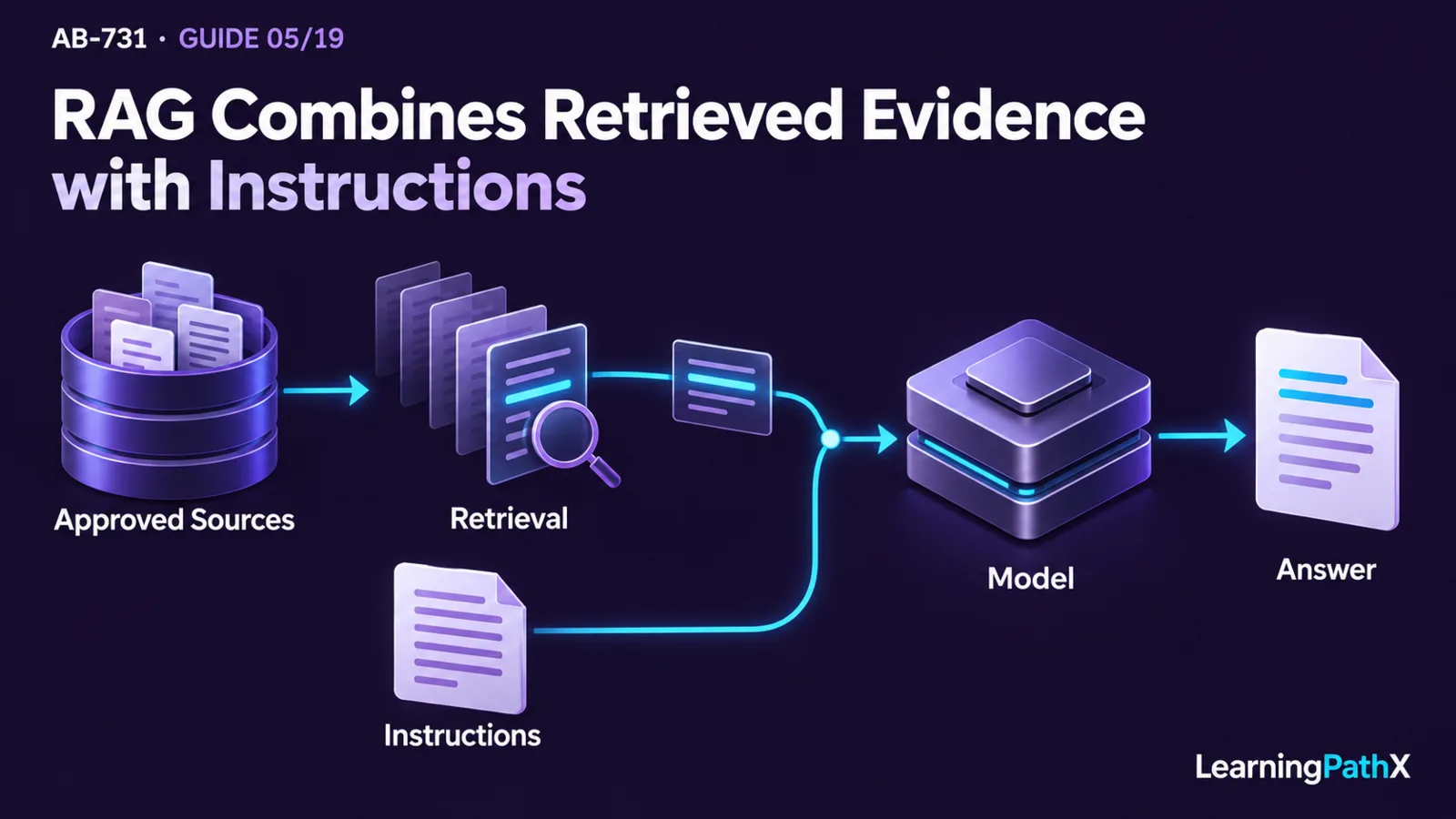
Together, these layers create a controlled information flow: make approved content retrievable, find evidence relevant to a user's request, assemble that evidence with clear instructions, generate an answer, and evaluate both retrieval and output quality. Content can be retrieved from a prepared index or a supported live source. This architecture can improve relevance and traceability, but it does not guarantee correctness. Leaders still need requirements for source authority, access control, context freshness, groundedness, human review, and ongoing evaluation.
Architecture Overview
A simple prompt sends instructions and user input directly to a model. That pattern can work for drafting, rewriting, classification, or other tasks that do not require private or frequently changing facts. It becomes insufficient when the answer must reflect an organization's policies, product records, case history, or other controlled knowledge.
Grounding adds context to the request so the model can answer from information supplied at generation time rather than relying only on patterns learned during model training. Microsoft's grounding data design guidance emphasizes that the quality, structure, indexing, and retrieval of grounding data affect solution quality.
RAG operationalizes this pattern. A retrieval system obtains content related to the current request. The application then combines selected content with instructions and the user's input, sends that assembled prompt to the model, and returns an answer. Azure AI Search documentation describes classic RAG as a pattern that retrieves from a search index and passes results to a generative model as grounding data.
The classic indexed architecture used for the walkthrough below has two paths:
- An indexing path prepares source content for retrieval before a user asks a question.
- A query path retrieves relevant content, constructs the model request, generates an answer, and captures evidence for evaluation.
Both paths matter. A carefully written prompt cannot compensate for missing or low-quality indexed content, and accurate retrieval can still be undermined by unclear instructions or weak output evaluation.
Indexing is not a requirement of every retrieval design. Azure AI Search also supports agentic retrieval through a knowledge base with one or more knowledge sources. Indexed sources use search indexes; supported remote sources are queried live without copying their content into a search index. The choice changes ingestion and query responsibilities, while source approval, authorization, evaluation, and operational ownership remain necessary.
Core Components
Prompt instructions and user input
Prompt engineering defines the model's task and operating constraints. A well-structured prompt can establish the role or task, identify the permitted context, specify the expected format, state how to handle missing evidence, and separate instructions from retrieved content. Microsoft's RAG prompt engineering guidance also highlights the need to manage context limits, evaluate prompts, and address security risks.
The user's input supplies the immediate request, but it should not silently override system or application rules. For a business solution, prompt design is an application control, not merely a writing technique. Owners should version important prompts, test changes, and define what the solution must do when a request is ambiguous or outside scope.
Grounding sources and content preparation
Grounding begins with source selection. Owners need to identify which repositories are authoritative, who maintains them, how current they must be, and which users are permitted to access them. Source authority is a business decision; the retrieval service cannot determine that every indexed document is correct or approved.
Content is commonly divided into smaller units so the retrieval system can return focused passages rather than entire documents. The appropriate unit depends on document structure and question type. Sections, headings, tables, metadata, and relationships between records can all affect retrieval usefulness. Content preparation should preserve enough surrounding meaning for a retrieved passage to remain understandable.
Retrieval index and knowledge sources
In the indexed design, a retrieval index stores a searchable representation of prepared content and relevant metadata. Metadata can support filtering by attributes such as department, document type, region, status, or effective date. Filters also need to align with the solution's authorization design; relevance alone must not expose content a user is not allowed to see.
Azure AI Search supports text, vector, hybrid, and multimodal queries through its classic search and agentic retrieval modes. Current product documentation identifies classic search as generally available and agentic retrieval as generally available with some capabilities in preview. Verify the needed source type, feature, region, and permission behavior before selecting a path. The choice should follow content, query patterns, quality evidence, scale, security, and operating requirements rather than a preference for a particular search technique.
Retrieval and ranking
In a classic query path, the application submits the user's request and required authorization constraints to the retrieval system, which retrieves candidates and ranks the results. The objective is not to retrieve the largest possible amount of text. It is to supply the most relevant, authorized, current, and useful evidence that fits within the available model context.
Retrieval can fail in several distinct ways: the required content may be missing from the index or unavailable through the selected source, a query may not express the user's intent well, filters may exclude useful content, ranking may place weak evidence above strong evidence, or the selected passages may lack necessary context. These failure modes require retrieval diagnostics; changing the final answer prompt alone may not fix them.
Prompt assembly and the large language model
Prompt assembly combines application instructions, conversation state when appropriate, retrieved passages, source identifiers, and the current user request. The model then generates an answer from that assembled input. Clear delimiters and explicit instructions help distinguish source content from commands, but applications must still treat retrieved content as untrusted input and apply appropriate security controls.
Context capacity is limited, so the application must prioritize useful evidence. Adding more passages can increase cost, dilute relevance, or crowd out important instructions. The design goal is sufficient high-quality context, not maximum context.
Output, source traceability, and evaluation
The output layer presents the generated response and, where useful, links or references to the retrieved sources. Source traceability helps a user verify evidence, but a citation does not prove that the model interpreted the source correctly.
Evaluation should examine the system by layer. Retrieval evaluation asks whether the right evidence was found. Generation evaluation asks whether the response follows instructions, uses that evidence correctly, avoids unsupported claims, and meets the business outcome. End-to-end evaluation asks whether the complete experience is useful, safe, timely, and supportable for representative users.
How the Components Work Together
Consider a policy-assistance example using classic indexed RAG. This is an illustrative architecture, not a product configuration procedure:
- Policy owners identify approved documents, ownership, effective dates, and access rules.
- The solution extracts and divides the content into retrieval units while retaining useful metadata and source references.
- The retrieval service indexes those units using the selected search approach.
- A user submits a question through the application.
- The application authenticates the user, applies authorization-aware filters, and retrieves relevant passages.
- Prompt assembly places the passages alongside instructions that define the task, response format, and missing-evidence behavior.
- The large language model generates a response based on the assembled context.
- The application presents the answer with appropriate source references and captures evaluation or feedback signals.
- Owners investigate poor results at the correct layer and update content, retrieval, prompts, controls, or evaluation as evidence requires.
This sequence clarifies the responsibility of each component. The model generates language; it does not curate the source repository, grant access, determine document authority, or prove that retrieval was complete.
Design Considerations
Define the answer contract first
Before selecting retrieval technology, specify which questions the solution should answer, what sources it may use, what evidence it must show, what output format users need, and when it should decline or escalate. These requirements turn a demonstration into a testable business capability.
Govern indexing and remote source access
Assign owners for source approval, ingestion, deletion, freshness, metadata, and access changes. Establish how quickly an updated or withdrawn document must be reflected in the index. A RAG solution built on unmanaged content can return fluent but obsolete or contradictory guidance.
For a supported remote source, define how live access, availability, authorization, and source changes are handled instead. Removing a copied search index from that path does not remove the need to test whether current, permitted evidence reaches the model.
Evaluate retrieval and generation separately
Use a representative set of business requests and expected source evidence. When an answer is poor, first determine whether the necessary passage was retrieved. If not, investigate content coverage, chunking, metadata, filters, query construction, and ranking. If the evidence was retrieved but the response is weak, investigate prompt instructions, context assembly, model behavior, and output checks.
Protect the entire information flow
Security requirements apply to source systems, ingestion, any index, retrieval, prompt construction, model access, logs, and displayed results. Enforce identity and authorization at the relevant layers, minimize sensitive content, and ensure that logging does not create an unintended copy of protected data. Treat user input and retrieved content as potentially hostile rather than assuming that trusted storage makes every embedded instruction safe.
Plan for context, latency, and cost tradeoffs
More retrieval steps, larger context, and more complex evaluation can improve some results while increasing latency and consumption. Leaders should define acceptable response time, quality thresholds, usage patterns, and escalation behavior, then test the complete system under realistic conditions. Exact service limits and prices are living facts and should be checked in current documentation before implementation.
Keep people in the decision loop where consequences require it
Grounding can make an answer more relevant, but it does not remove uncertainty. Require human verification when outputs could materially affect customers, employees, finances, safety, compliance, or access. The form of review should match the consequence and give the reviewer enough evidence and authority to intervene.
Common Mistakes
- Treating prompt engineering as a one-time wording exercise instead of a versioned application component.
- Assuming grounding guarantees factual correctness or eliminates the need for evaluation.
- Indexing every available document without defining authority, freshness, duplication, or access rules.
- Optimizing the final prompt when the real defect is missing content or poor retrieval.
- Filling the context with many low-relevance passages rather than selecting sufficient high-quality evidence.
- Showing source links without testing whether the response is actually supported by those sources.
- Measuring only user satisfaction while ignoring retrieval coverage, unsupported claims, security behavior, and operational failure modes.
- Moving a successful prototype into wider use without ownership, monitoring, feedback, and change controls.
Certification Relevance
The AB-731 study guide includes prompt engineering, grounding, and RAG within the business value of generative AI solutions. Leaders do not need to write the retrieval code to evaluate a proposal, but they should be able to explain the end-to-end flow and ask where source authority, indexing or live source access, retrieval, prompt assembly, access control, evaluation, and human oversight are handled.
A useful preparation exercise is to diagram a business question from source system to answer. For each stage, identify its input, output, owner, quality check, and likely failure mode. This develops architecture judgment while staying within the certification's business-leader and no-code scope.
Conclusion
Prompt engineering, grounding, and RAG improve a business AI solution when they operate as a measured system. Prompt instructions define the task, grounding provides relevant evidence, retrieval selects that evidence at request time, and evaluation shows whether the complete flow meets the intended outcome. Reliable results depend on the connections among these layers, not on any one layer in isolation.
For leaders, the essential skill is to ask for an end-to-end architecture with clear source ownership, authorization, retrieval evidence, prompt controls, evaluation, and human accountability. That framework makes solution quality explainable and gives teams a practical way to locate and correct failures.
Authoritative Sources
- Grounding data design for AI workloads
- RAG prompt engineering
- RAG and generative AI in Azure AI Search
- What is Azure AI Search?
- Study guide for Exam AB-731