
Introduction
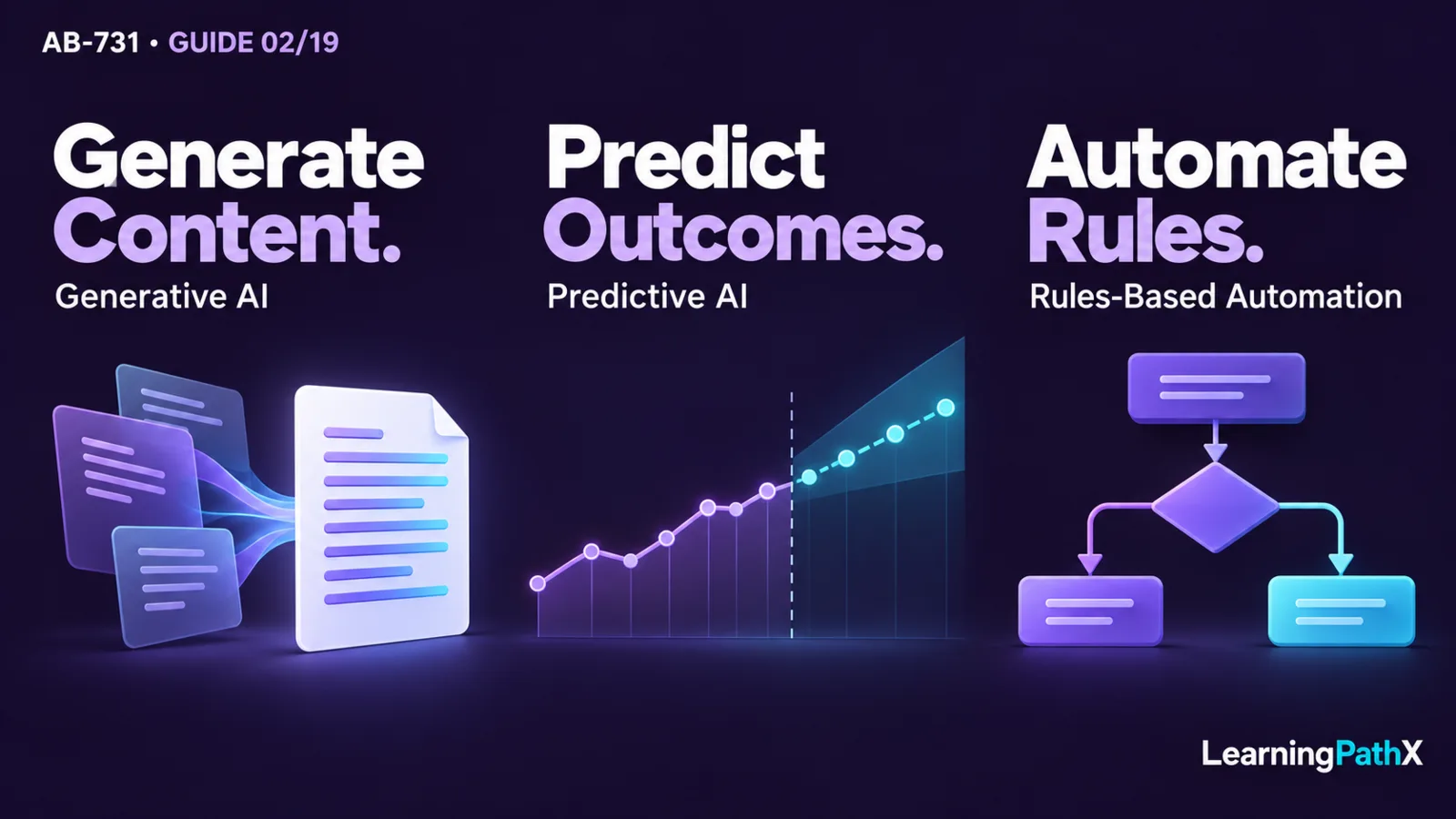
Generative artificial intelligence (AI) creates new content—such as text, summaries, images, or software code—from instructions and learned patterns. Other AI systems may instead classify records, forecast demand, detect anomalies, or recommend an action. The practical distinction for a leader is the output: generative AI produces a new artifact or conversational response, while predictive and analytical AI typically estimate, categorize, or optimize based on existing data.
Generative AI creates business value when content-heavy or knowledge-heavy work can be assisted repeatedly across many employees, customers, or transactions. Its strongest opportunities combine automation and scale with a clear outcome: less time spent drafting or finding information, faster service, more consistent first-pass content, or greater capacity without proportional manual effort. Value is not automatic, however; it depends on suitable data, process design, human oversight, security, and a way to measure whether the assisted work actually improves.
What Generative AI Is
Generative AI models learn patterns from large collections of data and use those patterns to produce a response to an input, commonly called a prompt. The response is generated rather than retrieved as a fixed, prewritten answer. This enables flexible interaction, but it also means the output can vary and may be incomplete or incorrect.
The category sits within the broader field of AI. A useful business-level distinction is:
| Capability | Typical output | Example business question |
|---|---|---|
| Generative AI | Newly composed text, image, summary, or conversational response | “Can we produce a useful first draft from these approved inputs?” |
| Predictive AI or machine learning | A score, forecast, classification, or probability | “Which orders are most likely to arrive late?” |
| Rules-based automation | A deterministic action based on defined conditions | “If an invoice exceeds the limit, route it for approval.” |
These capabilities can complement one another. A process might use a predictive model to identify a high-risk case, a rules engine to determine the required escalation, and generative AI to draft a case summary for an employee. The distinction matters because each capability solves a different part of the problem and requires different controls.
Why Generative AI Matters to Business Leaders
Generative AI expands the range of work that software can assist because many business processes depend on language, images, and unstructured information rather than only structured fields. Microsoft's business-leader foundation module frames the topic around business opportunities, model considerations, costs, and responsible adoption rather than treating generation as an isolated technical feature.
Leaders should look beyond impressive demonstrations and ask whether the capability changes a meaningful operating constraint. A credible opportunity usually improves one or more of the following:
- Cycle time: Employees reach a usable first draft, summary, or response sooner.
- Capacity: A team can handle more requests without increasing repetitive effort at the same rate.
- Consistency: Approved context, templates, and review criteria help standardize the first pass.
- Access to knowledge: Users can interact with relevant organizational information through natural-language experiences when access and grounding are appropriately designed.
- Service experience: Customers or employees receive faster, more contextual assistance, with escalation when the system should not act alone.
The benefit should be tied to an observable workflow measure. “Use AI for customer service” is too broad. “Reduce the time agents spend summarizing resolved cases while maintaining quality and privacy controls” defines a process, an expected result, and constraints that can be evaluated.
Core Concepts for Recognizing Business Value
Content generation is an assistive capability
Common uses include drafting messages, summarizing documents, transforming content for a different audience, extracting themes, and creating an initial structure for a report. The most defensible starting points treat the output as a draft or recommendation when errors would matter. A qualified person remains responsible for judgment, approval, and exceptions.
This assistive framing also clarifies process design. The question is not merely whether a model can create content. It is where generated content enters the workflow, which inputs it may use, who reviews it, and what happens when confidence or quality is insufficient.
Automation can cover a task without owning the decision
Automation does not have to mean end-to-end autonomous execution. Generative AI can automate a bounded step—such as preparing a meeting summary or drafting a response—while a person retains control of the decision or external action. This pattern can deliver value sooner because it preserves accountability and creates a practical feedback loop.
The degree of automation should reflect consequence. Low-impact internal drafting may tolerate broad assistance with review. Financial, legal, employment, safety, or customer-commitment decisions need stronger validation, access controls, traceability, and human authority.
Scale multiplies both benefits and weaknesses
A reusable AI-assisted workflow can support many people and transactions, so even a modest time saving per task may become material. The same multiplier applies to defects. An inaccurate instruction, unsuitable source, excessive permission, or biased pattern can be repeated quickly across the organization.
For that reason, scalability is not just a performance characteristic. It is an operating-model concern. Leaders need ownership for approved use, data access, evaluation, monitoring, user feedback, incident response, and improvement. Microsoft's AI assurance guidance describes responsible AI through the principles of fairness, reliability and safety, privacy and security, inclusiveness, transparency, and accountability. These principles provide a useful lens for evaluating value and risk together.
Grounding improves relevance but does not guarantee truth
Grounding supplies relevant context to a model so its response can be more specific to a task or organization. For example, an assistant might receive approved policy documents or product information as context before drafting an answer. Good grounding can improve relevance and make an experience more useful, but it does not eliminate the need to evaluate outputs. Microsoft's grounding data design guidance emphasizes the importance of data quality, retrieval, freshness, security, and evaluation.
At the opportunity-identification stage, leaders do not need to choose a grounding architecture. They do need to recognize whether a proposed use case depends on current organizational facts. If it does, generic model knowledge alone is unlikely to be sufficient.
A Practical Business-Value Test
Before moving an opportunity into solution selection, leaders can test it with six questions:
- What work product is being created? Name the draft, summary, answer, image, or other output.
- Who uses or approves it? Identify the person accountable for the business outcome.
- What constraint improves? Specify time, capacity, quality, consistency, access, or experience.
- Can the improvement be measured? Establish a baseline and a small set of outcome and quality measures.
- What information does the task require? Identify whether inputs are public, organizational, personal, confidential, regulated, or time-sensitive.
- What happens when the output is wrong? Define review, escalation, correction, and fallback before scaling.
A good candidate has a frequent or costly content task, accessible and appropriate inputs, a reviewable output, and a measurable benefit. A poor candidate has an undefined owner, severe consequences with no effective verification, unavailable or untrustworthy inputs, or a benefit stated only as novelty.
Target Audience
This foundation is useful for executives, functional leaders, transformation leaders, and business owners who sponsor or prioritize AI-enabled change. Their role is not necessarily to build a model. It is to frame the business problem, identify accountable owners, establish acceptable outcomes and risks, and decide whether an opportunity deserves deeper evaluation.
Technical, security, legal, compliance, data, and adoption specialists remain essential partners. Business leadership supplies the outcome and operating context; cross-functional teams determine whether the capability can be implemented and governed responsibly.
Business and Technical Value
Understanding generative AI foundations helps leaders avoid two common category errors. The first is using content generation for a problem that primarily requires forecasting, classification, optimization, or deterministic rules. The second is assuming that a fluent response proves accuracy, readiness, or business value.
The foundation also creates a better handoff to product and model decisions. Once a leader has defined the workflow, required information, consequence of error, and success measure, a delivery team can evaluate whether a packaged solution, a more configurable experience, or another form of AI is appropriate. Without that framing, solution selection tends to become technology-first.
Common Learning and Adoption Challenges
Treating all AI as interchangeable
Generative AI is one capability category, not a synonym for every analytical or automated system. Leaders should begin with the required output and decision, then match the technology to that need. For a deeper comparison with prediction-focused systems, see AB-731: When Machine Learning Adds Value and How Its Lifecycle Works.
Measuring activity instead of outcomes
Prompt counts, user counts, and generated documents describe activity. They do not by themselves show value. Pair adoption measures with workflow outcomes such as turnaround time, rework, quality, resolution rate, or employee capacity, and include guardrails such as error, escalation, privacy, and user-feedback measures.
Assuming scale will fix a weak use case
Scale amplifies the underlying process. A vague task, poor source data, or missing review step will not become sound because more people use it. Validate the workflow with representative users and cases before broad deployment, then monitor whether results hold as usage grows.
Ignoring change and accountability
Even a technically capable solution can fail when people do not trust it, do not know when to use it, or cannot report a problem. Assign a business owner, communicate the intended use and limits, train users to review outputs, and provide a clear path for feedback and escalation.
Conclusion
Generative AI differs from predictive AI and rules-based automation because it creates new content and conversational responses rather than primarily estimating an outcome or executing fixed logic. Its business value comes from applying that capability to repeatable, content-intensive work where automation can improve cycle time, capacity, consistency, knowledge access, or service experience at scale.
The leadership task is to connect the capability to a measurable workflow while preserving accountability for data, quality, security, and decisions. With that foundation in place, the next step is to evaluate the most suitable solution and model strategy rather than choosing technology before the business need is clear.
Authoritative Sources
- Understand the foundations of generative AI for business leaders
- Artificial Intelligence overview
- Grounding data design for AI workloads