
Introduction
Leaders should estimate generative AI cost and return on investment (ROI) with a scenario-based total cost of ownership model, not a token-price calculation. Start with the number and shape of completed business tasks, estimate the input and output tokens each task consumes, then inventory model deployment, retrieval and data services, evaluation, security, operations, human review, and adoption. Compare cost and value under an explicit accounting boundary that counts each labor activity once. Distinguish time returned, additional capacity, faster cycle time, avoided rework, and improved service outcomes rather than adding overlapping benefits.
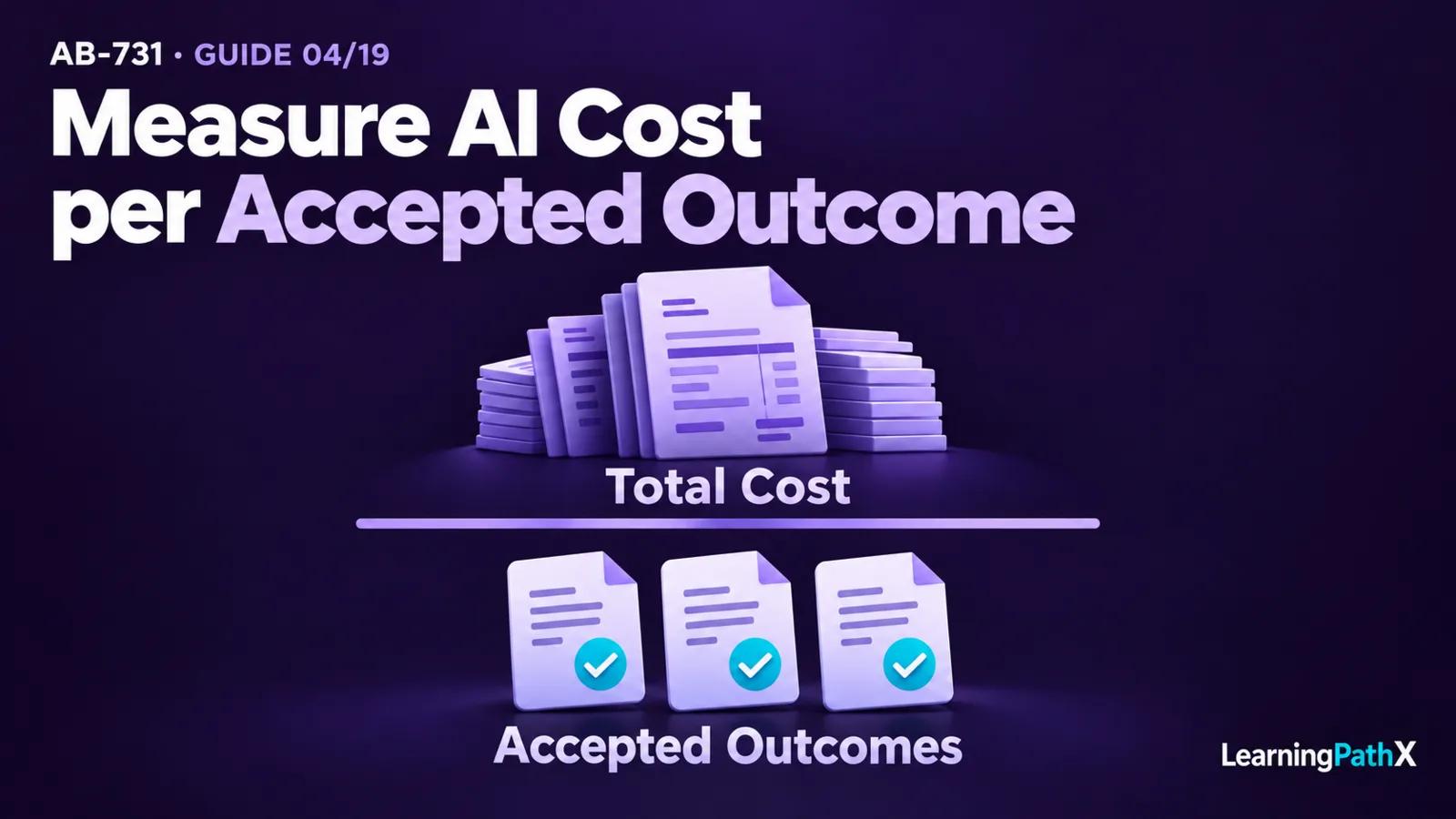
The decision should be based on cost and value per accepted business outcome under expected, low, and high usage scenarios. Token consumption is an important variable, but adoption, response length, retries, model choice, quality thresholds, review effort, and fixed operating costs can change the business case more than a nominal token rate. A pilot supplies the evidence needed to replace early assumptions and test whether benefits persist after quality and risk controls are included.
What a Generative AI Cost and ROI Model Is
A generative AI cost and ROI model connects technical consumption to an economic unit that a business owner understands. The technical unit may be a token, model call, search query, or processed document. The economic unit should be a completed and accepted outcome, such as a resolved support case, an approved proposal draft, or a reviewed research summary.
A token is a metered unit used by language and multimodal models to process inputs and outputs. Input tokens can include instructions, conversation history, retrieved context, and the current user request. Output tokens represent the model's generated response. Microsoft's agent optimizer cost and token usage overview describes token-cost estimation and also identifies exclusions that must be considered separately. Exact rates depend on current service, model, region, and deployment choices, so this article uses variables rather than transient prices.
ROI then compares the value attributed to the initiative with the cost required to deliver and sustain it. A common planning expression is:
ROI = (measured benefits - total costs) / total costs
The formula is simple; defensible inputs are not. State the accounting boundary before supplying values. For a full labor-cost comparison, use the gross baseline labor value for the same workload as the labor-related benefit, then include assisted handling, review, correction, fallback and nonlabor solution costs on the cost side. Do not substitute a benefit that already deducts those labor activities and subtract their cost again. The net-time metric below is a separate operational view unless the cost boundary is adjusted explicitly.
Why Token Price Is Not the Business Case
Token price answers a narrow procurement question: what does a unit of model input or output cost under a particular configuration? It does not answer how many attempts a task needs, whether retrieval adds context, whether a larger model is necessary, how much human review remains, or whether people adopt the experience.
A low-cost response that is routinely rejected has poor unit economics. A more expensive response can create better value if it reliably completes a high-value task with less rework. Conversely, a technically accurate solution can still have weak ROI when few eligible users adopt it or when fixed governance and operational work is spread across too little useful volume.
For this reason, leaders should evaluate cost per accepted outcome and benefit per eligible user or transaction. Those measures expose quality, adoption, and scale effects that raw token counts hide.
Core Cost Drivers
Workload volume and token shape
Estimate demand from the business process rather than from an arbitrary token allowance. For each workload, record:
- eligible users or transactions;
- expected tasks per user or transaction;
- average input and output size;
- context carried across turns;
- retrieval content added to the prompt;
- retries, revisions, and failed attempts;
- seasonal peaks and likely growth;
- the proportion of outputs that pass the acceptance criteria.
This produces a workload equation:
Estimated token demand = task volume × attempts per task × tokens per attempt
Separate input and output tokens when the selected service meters or prices them differently. Use ranges rather than a single average when prompts, attached content, or response length vary substantially.
Model and deployment choice
Model choice affects quality, latency, capability, and cost. The least expensive model is not automatically the most economical if it increases retries or review effort; the most capable model is not automatically justified for a routine task. Microsoft Foundry supports model discovery and evaluation, and its model-selection training guidance frames selection across quality, safety, cost, and performance.
Evaluate candidate models against the same representative task set. Record acceptance rate, response time, token use, failure modes, and human correction effort. This turns model selection into a measurable contribution to unit economics rather than a preference.
Data, retrieval, and integration
Many business solutions require more than a model deployment. Retrieval-augmented generation (RAG) may add content preparation, indexing, search, retrieval, and evaluation. Integrations may add connectors, application services, data movement, identity controls, and monitoring. These components may have their own consumption or capacity costs.
Grounding and retrieval can improve relevance, but they also change token volume and operational responsibility. Count the work needed to prepare, secure, refresh, and evaluate the knowledge source. Do not assume that sending more context always improves quality; irrelevant context can add cost without improving the accepted outcome.
Evaluation, safety, and human review
Evaluation is part of the delivered solution, not an optional project expense. Include the effort and tooling used to create test cases, assess quality and safety, investigate failures, and verify changes. Higher-consequence uses may also require more human review, audit evidence, escalation, or approval.
Human review belongs in both the process design and the cost model. Measure the minutes spent reviewing and correcting each output, not merely whether a review step exists. If AI saves drafting time but shifts nearly the same effort into verification, the gross productivity claim will overstate the net benefit.
Operations and organizational enablement
Total cost of ownership includes the work required to keep the solution useful. Depending on the workload, this can include:
- service administration and support;
- security, privacy, and compliance activities;
- monitoring, incident response, and change control;
- data and prompt maintenance;
- model or configuration evaluation after changes;
- training, communications, and user support;
- product ownership and benefits measurement.
Separate one-time costs from recurring costs. Also distinguish fixed costs, which remain similar across a range of usage, from variable costs that rise with transactions or consumption. This distinction helps leaders understand whether scale improves or worsens unit economics.
A Decision Framework for Generative AI Economics
1. Define the business outcome and baseline
Choose a bounded workflow and record its current performance before introducing AI. Useful baselines include labor time per completed task, cycle time, rework rate, throughput, escalation rate, quality score, or service-level attainment. Name the accountable owner and the population eligible to use the solution.
Avoid converting all benefits immediately into currency. Operational measures are easier to validate first. A finance partner can later determine which measured changes qualify as recognized savings, avoided cost, capacity, or revenue contribution under the organization's policies.
2. Build an end-to-end cost inventory
Estimate the complete solution across four layers:
| Cost layer | Include | Useful allocation basis |
|---|---|---|
| Consumption | Input tokens, output tokens, model calls, retrieval queries, and other metered capabilities | Per attempted and accepted task |
| Platform and integration | Deployment, storage, search, application, network, identity, and connector components | Per workload or transaction |
| Delivery and control | Design, testing, evaluation, security review, data preparation, and implementation | One-time plus planned refresh |
| Operations and adoption | Monitoring, support, human review, training, product ownership, and change management | Per period, user, or accepted task |
Document each exclusion. For example, Microsoft's token-cost guidance may estimate model token use while excluding other resources used by the broader solution. An exclusion is not necessarily a flaw, but it must not disappear from the business case.
3. Estimate benefits after adoption and quality
Track attempts and acceptance separately before translating an improvement into value:
Attempted volume = eligible volume × adoption rate
Accepted volume = attempted volume × successful-use rate
Net time returned = baseline labor for the attempted workload - assisted handling, review, correction, and fallback labor for that same workload
Failed attempts still consume time and service resources. Include their review, retry and fallback effort even when they produce no accepted AI output. Compare the same completed workload, population and time horizon in the baseline and assisted cases; otherwise a high acceptance rate can hide work moved to another team.
These equations are planning tools, not vendor formulas. If net time returned is monetized as a benefit, exclude the same already-deducted handling and review labor from incremental costs in that calculation. Retain it in the operational cost inventory for staffing and budget visibility, marked as already reflected. Alternatively, use the full labor-cost comparison above with gross baseline value and all assisted labor costs. Label the chosen cost boundary and ROI denominator; ratios with different denominators are not directly comparable.
Use each underlying benefit only once: time returned, avoided labor cost, and additional capacity can describe the same improvement. Time returned is not automatically a cash saving; the organization's approved valuation and financial treatment still apply.
Include quality and risk guardrails beside the benefit measure. A shorter cycle time is not a gain if error, escalation, privacy, or customer-impact measures deteriorate beyond the accepted threshold.
4. Compare scenarios and sensitivities
Create at least low, expected, and high cases. Vary the assumptions most likely to change the decision:
- adoption and task frequency;
- input context and output length;
- retries and acceptance rate;
- model choice;
- review effort;
- fixed support and governance cost;
- measured time or quality improvement.
The purpose is not to predict one precise total. It is to find the break-even conditions and identify which assumptions require pilot evidence. If the expected case works only with near-perfect adoption or no review effort, the business case is fragile.
5. Measure the pilot and update the decision
During a pilot, capture consumption and business outcomes for the same completed tasks. Compare the assisted process with the baseline, investigate unsuccessful cases, and update the model with observed token use, acceptance, review time, and support effort.
Use a decision gate before scaling. Proceed when the observed outcome meets quality and risk thresholds, the total cost per accepted outcome is supportable, and the benefit remains credible under a conservative scenario. Redesign or stop when the solution moves effort rather than reducing it, adoption is persistently weak, or controls erase the expected value.
Target Audience
This framework is intended for business decision-makers, transformation leaders, product owners, finance partners, and technical leaders who jointly approve AI investments. Business owners define the outcome and baseline; technical teams measure consumption and solution dependencies; security and governance teams identify required controls; finance validates how operational improvements are valued.
No one discipline owns the complete business case. Cross-functional agreement on assumptions is more valuable than a highly detailed model built from unverified inputs.
Business and Technical Value
A complete cost and ROI model improves portfolio decisions in three ways. It makes technical choices economically visible, separates usage from realized value, and exposes the assumptions that a pilot must test. It can also reveal when a smaller model, shorter response, better retrieval, improved workflow, or narrower use case produces better economics than simply reducing the nominal token rate.
The resulting model supports comparison across initiatives because each proposal can report total cost per accepted outcome, measurable operational benefit, adoption, quality, and risk. It does not replace finance or procurement review, but it gives those reviews traceable technical and operational inputs.
Common Cost and ROI Mistakes
Counting tokens but omitting the solution
Model consumption may be visible first, while data preparation, retrieval, integration, evaluation, support, and human review remain distributed across teams. Maintain one end-to-end cost inventory and assign an owner to every material assumption.
Treating time saved as cash saved
Time returned may create capacity, faster service, or better employee experience without reducing expenditure. State which form of value is expected and use the organization's approved financial treatment rather than automatically recording labor time as savings.
Using generated outputs instead of accepted outcomes
An output that requires extensive correction has not delivered the same value as an accepted result. Track completion, acceptance, rework, and escalation together with consumption.
Ignoring adoption in the denominator
Fixed delivery and governance costs are spread across actual useful usage, not the population named in a rollout plan. Base unit economics on observed or conservatively estimated adoption.
Presenting a point estimate as certainty
Model behavior, usage, cloud services, and operating needs can change. Preserve low, expected, and high scenarios, record the verification date, and recheck current commercial terms before an investment or procurement decision.
Conclusion
A defensible generative AI business case starts with the completed business outcome and works backward to every cost required to deliver it. Tokens connect workload behavior to model consumption, but total cost of ownership also includes data, retrieval, integration, evaluation, controls, human review, operations, and adoption.
Leaders should compare costs and benefits for the same cohort and period with consistent labor treatment, test sensitive assumptions in a pilot, and make scaling decisions using cost per accepted outcome. This keeps token pricing in its proper role: one technical input to ROI, not the business case itself.
Authoritative Sources
- Understand the foundations of generative AI for business leaders
- Select, deploy, and evaluate Microsoft Foundry models
- Agent optimizer cost and token usage overview
- Grounding data design for AI workloads
- RAG and generative AI in Azure AI Search