
Introduction
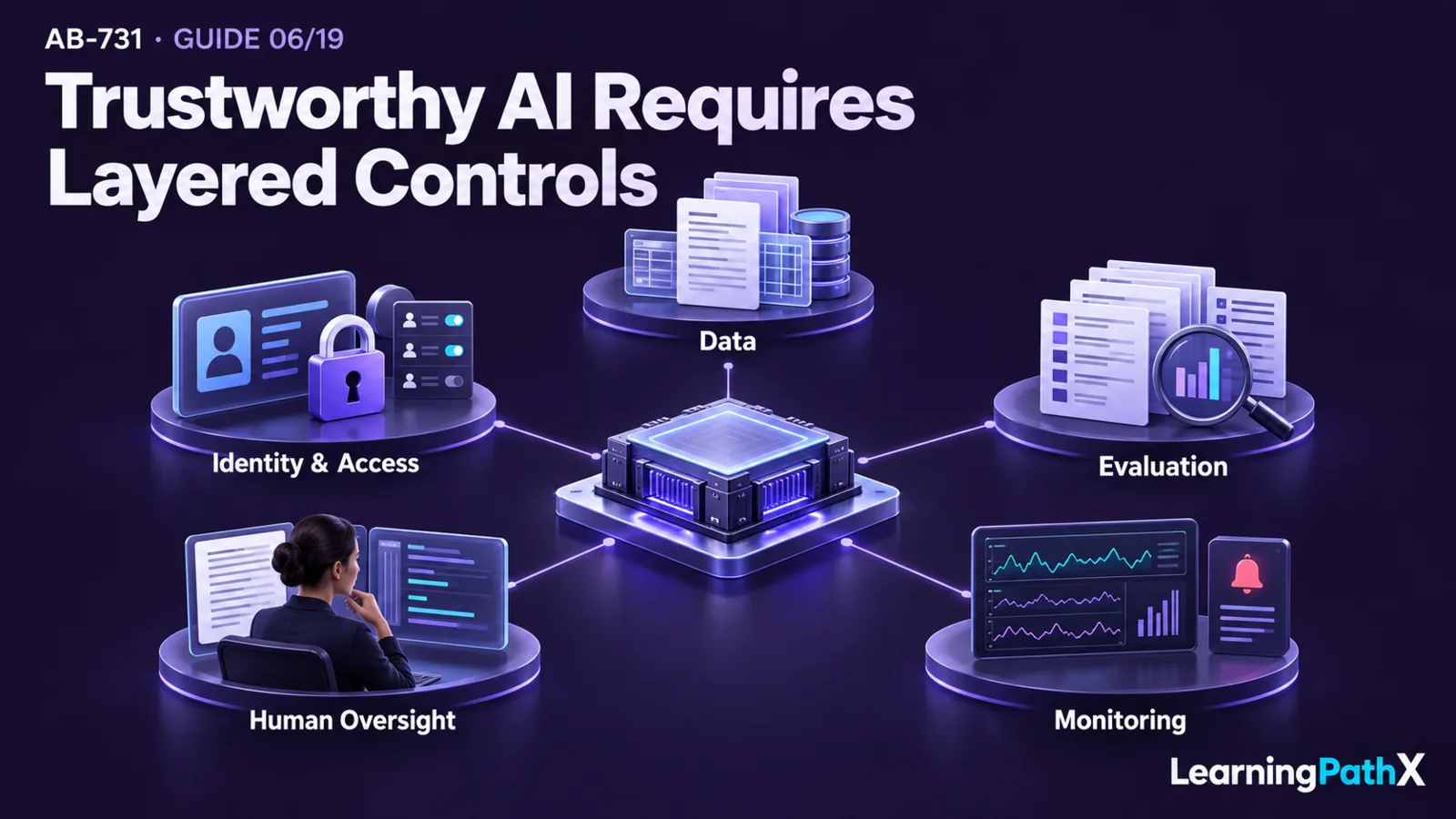
Leaders should require a layered control architecture for trustworthy generative AI: authoritative and representative data; permission-aware retrieval; explicit identity and application boundaries; systematic quality, safety, and bias evaluation; human authority for consequential decisions; and monitoring that can trigger correction, restriction, or shutdown. No single control eliminates fabrication, reliability, bias, or security risk because each risk can enter through a different part of the system.
The practical goal is not to promise error-free AI. It is to define acceptable behavior, expose failure modes, reduce the likelihood and impact of failure, and assign accountable owners throughout the lifecycle. Microsoft's Artificial Intelligence overview treats AI risk as a shared responsibility: Microsoft operates and protects its services within the documented model, while customers remain responsible for their use cases, data, access, configuration, policies, user training, and appropriate review of outputs.
Trustworthy Generative AI Is a System Property
A fluent model response can still be wrong, incomplete, biased, out of date, or based on information the user should not have received. Conversely, a capable model can produce poor results when the retrieval system returns weak context, an application supplies ambiguous instructions, permissions are overbroad, or users apply the output outside its intended purpose.
Trustworthiness therefore depends on the complete path from source data to business decision:
- Source systems create and maintain information.
- Data preparation selects, cleans, labels, chunks, or indexes information for the solution.
- Identity and access controls determine which people, services, and agents may retrieve it.
- The application constructs prompts and context, calls a model, and applies safety controls.
- The model generates a response that the application presents or uses.
- A person or automated workflow interprets the response and may take an action.
- Evaluation, logging, feedback, and incident processes reveal whether the system remains within its approved boundary.
A control at one stage cannot compensate fully for neglect at another. Strong authentication does not correct stale data. High-quality data does not prevent an application from exposing it to the wrong identity. Content filters do not prove factual accuracy. Human review is weak if reviewers lack time, evidence, or authority to intervene.
Core Risk Categories
Fabrication and reliability
A fabrication is generated information presented without adequate support from the relevant evidence. It can arise because a model fills a gap from learned patterns, retrieval returns irrelevant or incomplete context, instructions encourage unsupported completion, or the application does not handle uncertainty appropriately.
Reliability is broader. It asks whether the system performs as intended across expected conditions, variations, failures, and changes. A response may be factually plausible yet unreliable because similar inputs produce materially inconsistent outcomes, latency breaks the workflow, a dependency fails without a safe fallback, or quality degrades after source data changes.
Mitigations include grounding in authorized sources, instructions that define how to handle missing or conflicting evidence, representative evaluation, citations when useful, fallback behavior, user disclosures, monitoring, and human verification for decisions where error has material consequences. Grounding can improve relevance, but it does not guarantee truth.
Bias and unrepresentative data
Bias risk appears when data, labels, prompts, evaluation sets, model behavior, or workflow design systematically disadvantages people or produces unsuitable outcomes for part of the intended population. A dataset can be accurate for the cases it contains and still be unrepresentative of the people, language, situations, or operating conditions the solution will encounter.
Leaders should ask who is represented, who is absent, which outcomes matter to different groups, and whether aggregate performance hides subgroup differences. Evaluation should use realistic cases across the approved population and inspect differences that are relevant to the use case. When a system influences employment, financial, health, safety, legal, or eligibility decisions, general examples are not a substitute for qualified legal, risk, fairness, and domain review.
Security and privacy
Generative AI systems create familiar security risks and AI-specific attack paths. Risks include excessive permissions, stolen identities, unintended data exposure, insecure application interfaces, prompt injection, poisoned retrieval content, unsafe tool actions, sensitive information in logs, and misuse of generated output. Privacy adds questions about purpose, notice, collection, access, retention, residency, disclosure, and individual rights.
Microsoft's secure AI adoption guidance recommends applying Zero Trust principles to AI identities, access, and data flows, classifying and protecting sensitive data, and extending security monitoring to AI workloads and agents. These controls should be designed into the solution rather than added after users already rely on it.
The Data Control Layer
Identify data types and authority
Generative AI solutions may use structured records, semi-structured formats such as JavaScript Object Notation (JSON), unstructured documents, images, audio, user prompts, system instructions, tool results, and model outputs. Document the purpose and authoritative owner for each type. A source that is convenient to index is not necessarily approved, current, complete, or authoritative.
For every source, record:
- the business owner and system of record;
- the approved purpose and users;
- sensitivity, regulatory, or contractual classification;
- expected freshness and update process;
- quality and completeness criteria;
- retention and deletion requirements;
- access and audit controls;
- the fallback when the source is unavailable or contradictory.
This inventory makes data readiness visible before a pilot. It also supports later incident analysis because the team can trace which data entered the response path.
Prepare data for the actual questions
Data quality is contextual. A document may be correct yet unsuitable for retrieval because it lacks titles, effective dates, ownership, or clear section boundaries. A dataset may be complete for reporting yet unsuitable for model evaluation because it omits edge cases or underrepresents an affected group.
Microsoft's grounding data design guidance describes source data and grounding data as distinct concepts and emphasizes iterative preparation, indexing, querying, and evaluation. Leaders do not need to choose a chunking algorithm, but they should require evidence that the prepared data retrieves the right information for representative user questions.
Enforce permission-aware access
Retrieval must preserve authorization boundaries. Authenticate the person or service, authorize each requested source and operation, and avoid copying protected information into a broadly accessible index or cache. Use least privilege for application identities, tools, and administrators. Separate development and evaluation data from production data when appropriate, and prevent sensitive test cases from appearing in unprotected logs or prompt histories.
Authorization must continue through the workflow. A user who may read a record is not automatically permitted to update it, disclose it externally, or instruct an agent to take a consequential action.
The Application and Identity Control Layer
Treat every input as untrusted
User prompts, files, webpages, retrieved passages, tool output, and agent messages are data that may be incorrect or malicious. The application should separate trusted system instructions from untrusted content, constrain tool access, validate inputs and outputs, and avoid letting retrieved text silently redefine the system's authority.
Prompt engineering can reduce ambiguity, but it is not an access-control system. A model instruction such as “do not reveal confidential information” cannot replace authentication, authorization, data classification, network protection, and tested application logic.
Use distinct identities and least privilege
People, applications, services, and agents need clearly defined identities and permissions. Avoid shared credentials and overly broad application access. Require strong authentication, short-lived credentials where supported, secure secret handling, role-based authorization, and review of privileged access. When a tool can change a record or trigger an external effect, scope its permissions to the approved action and require confirmation or approval when consequences justify it.
Design safe failure paths
The solution should not improvise when a dependency fails or evidence is missing. Define whether it should state that information is unavailable, request clarification, provide a limited response, route to a person, retry safely, or stop. Record which failures must alert an operator and which can be handled within the user experience.
The Evaluation and Human-Control Layer
Define acceptance criteria before testing
Evaluation needs an explicit target. Criteria can include groundedness, factual accuracy, completeness, relevance, refusal behavior, harmful content, bias indicators, privacy leakage, security resilience, response time, action correctness, and business outcome measures. The required measures depend on the use case; a low-impact drafting assistant and a system used in a consequential workflow should not share identical evidence requirements.
Use representative test cases drawn from normal work, edge conditions, conflicting sources, missing data, ambiguous instructions, unauthorized requests, adversarial inputs, and known failure patterns. Separate a baseline from the proposed system so leaders can determine whether AI improves the process rather than merely producing activity.
Make human oversight meaningful
Human oversight requires more than displaying a review button. Specify who reviews, what evidence they see, which decisions remain human, how they correct an output, when they must escalate, and whether they can stop the process. Reviewers need training in the intended use, limitations, protected data, and signs of an unreliable result.
Automation bias is a practical concern: people may accept a confident response because it appears polished or because reviewing it takes effort. Design the workflow so accountability remains visible and the reviewer has enough source context and time to exercise judgment.
Monitor the deployed system
Models, data, user behavior, connected services, threats, and business requirements change. Monitor quality and safety signals, access anomalies, source failures, user complaints, escalations, override rates, cost, and business outcomes. Define thresholds and response actions in advance.
Monitoring should feed an operational loop:
- Detect a signal or incident.
- Assess affected users, data, decisions, and time period.
- Contain risk by restricting access, disabling a capability, rolling back, or requiring added review.
- Correct data, instructions, configuration, controls, or workflow design.
- Re-evaluate the affected behavior before restoring or expanding use.
- Update governance records, training, and monitoring based on the finding.
A Leadership Control Matrix
| Risk | Preventive controls | Detection evidence | Response owner |
|---|---|---|---|
| Unsupported or fabricated response | Authorized grounding, missing-evidence behavior, bounded instructions | Groundedness and accuracy evaluation, citations, user feedback | Product owner with domain owner |
| Unreliable behavior | Representative tests, safe fallbacks, dependency design | Regression tests, failure rates, latency, incident signals | Service owner |
| Bias or unrepresentative results | Representative data, subgroup analysis, inclusive design | Outcome comparisons, complaints, expert review | Business owner with responsible AI specialists |
| Unauthorized data exposure | Strong identity, least privilege, permission-aware retrieval, data protection | Access logs, data-loss alerts, security testing | Security and data owners |
| Unsafe action | Scoped tools, validation, approvals, reversible design | Action logs, failed approval checks, exception reports | Process owner and service owner |
| Misuse or prompt attack | Untrusted-input handling, tool constraints, content and application safeguards | Security telemetry, adversarial testing, incident reports | Security operations and application owner |
The matrix is a planning pattern, not proof of compliance. Each organization must adapt controls and accountable roles to its architecture, risk appetite, policies, and legal obligations.
Common Mistakes
- Treating a powerful model as a substitute for authoritative, current, and representative data.
- Assuming retrieval-augmented generation (RAG) guarantees truth instead of evaluating both retrieval and generated responses.
- Using prompt instructions as the primary defense against unauthorized access or tool misuse.
- Measuring only average quality and missing harmful subgroup or edge-case performance.
- Granting an agent the broad permissions of its maker instead of a bounded operational identity.
- Storing prompts, retrieved content, or output in logs without applying data protection and retention rules.
- Calling a workflow “human in the loop” when reviewers lack evidence, training, time, or authority.
- Monitoring usage while ignoring quality, security, complaints, overrides, and business outcomes.
- Scaling a pilot before assigning owners for incidents, data maintenance, evaluation, and retirement.
Relevance to AB-731 Leadership Decisions
The AB-731 scope connects data quality and representative datasets with fabrication, reliability, bias, secure AI, application security, data security, and authentication. These are not separate vocabulary items. They form a chain of leadership decisions about what information the solution may use, who or what may access it, how behavior is evaluated, which decisions remain human, and how the organization responds when evidence changes.
For preparation, take a proposed generative AI use case and draw its data and action flow. Identify authoritative sources, identities, permissions, model and application boundaries, evaluation measures, human decisions, monitoring signals, and response owners. The exercise stays within the no-code business-leader scope while revealing whether a proposal has a trustworthy operating design.
Conclusion
Trustworthy generative AI requires layered controls across data, retrieval, identity, application behavior, evaluation, human decisions, and operations. Leaders should define acceptable outcomes and failure behavior, require representative evidence, preserve authorization boundaries, and ensure that monitoring leads to accountable action.
Technical controls are necessary but not sufficient. Continue with AB-731: Responsible AI Governance and the AI Council to place these solution controls inside enterprise decision rights and oversight. Use AB-731: Copilot and Foundry Licensing, Cost, Data, and Security Planning to connect control requirements with commercial and organizational readiness.
Authoritative Sources
- Artificial Intelligence overview
- Grounding data design for AI workloads
- Adopt and secure AI and data
- Apply responsible AI