
Introduction
AB-731 is the public exam associated with Microsoft Certified: AI Transformation Leader. It validates whether a business decision-maker can recognize valuable AI opportunities, choose appropriate Microsoft AI capabilities, establish responsible governance, and lead implementation and adoption. The credential is aimed at leaders who guide transformation across teams and functions; it does not require candidates to write code. The official certification page identifies the credential as beginner level and describes its business-leader audience.
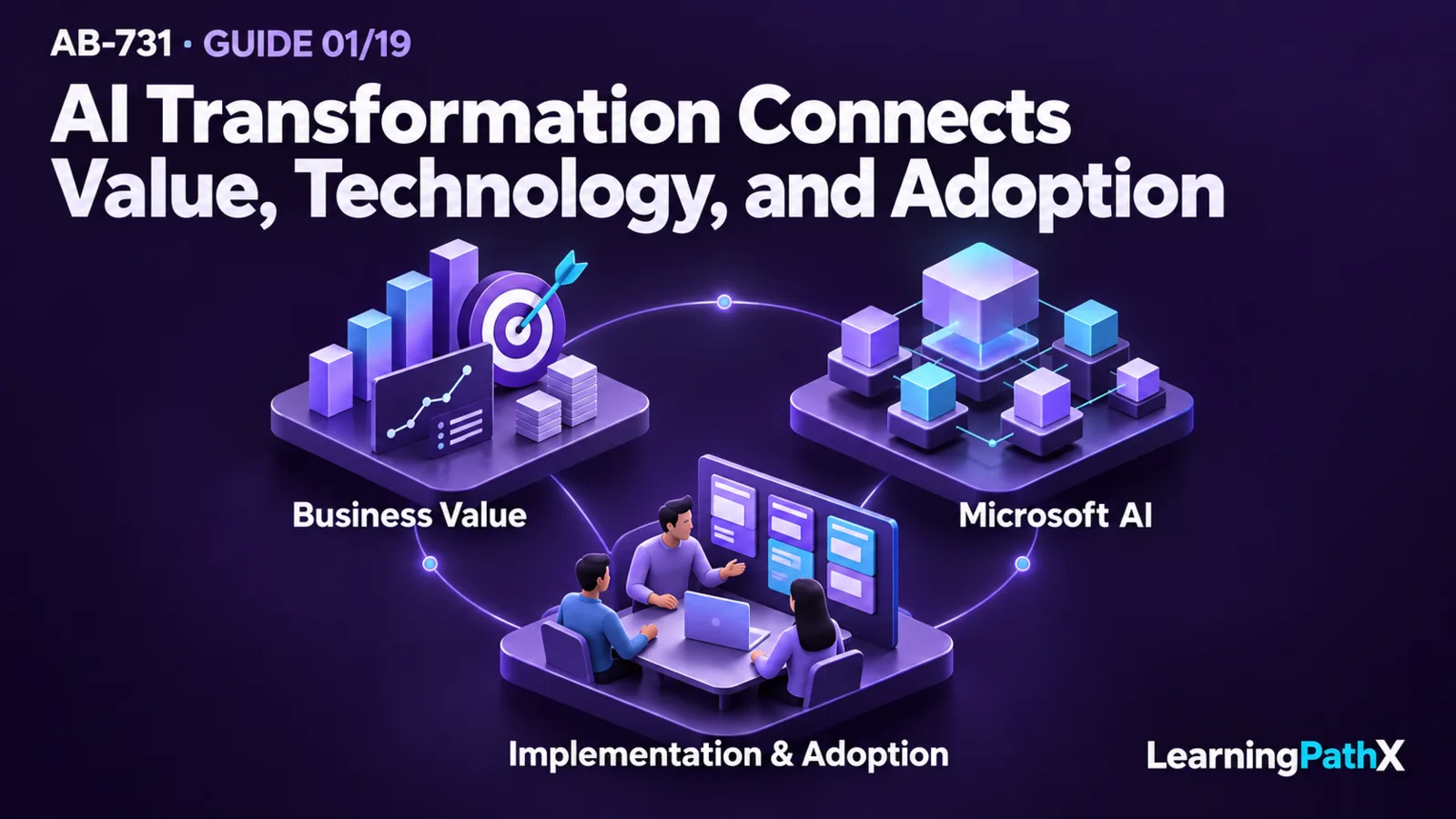
The three measured domains form one leadership system. Identifying the business value of generative AI solutions represents 35–40% of the published scope, identifying benefits and opportunities for Microsoft's AI apps and services represents another 35–40%, and identifying an implementation and adoption strategy represents 20–25%. A capable AI transformation leader therefore connects value, technology choice, governance, and behavior change instead of treating them as separate initiatives. The AB-731 study guide is the authoritative public source for the skills measured as of July 22, 2026.
What the AB-731 Certification Validates
AB-731 evaluates strategic fluency rather than implementation syntax. A leader should be able to explain what generative AI can and cannot do, identify where AI might improve a business process, and recognize the economic and operational implications of a proposed solution. That includes model and data choices, prompt engineering, grounding, retrieval-augmented generation (RAG), cost drivers, reliability, bias, and security.
The credential also expects familiarity with Microsoft's current AI portfolio. The productivity solution formerly called Microsoft 365 Copilot is now named Microsoft Copilot, while the July 2026 AB-731 guide and some transitional feature names retain the earlier wording. These names do not establish two different current product choices. The portfolio includes Microsoft Copilot experiences, low-code agents and workflows through Microsoft Copilot Studio, and model, agent, and tool capabilities in Microsoft Foundry and Foundry Tools. Familiarity means matching a need to the right capability and asking sound questions about data, permissions, scale, security, cost, and ownership; it does not mean mastering every administrative or developer procedure.
Finally, the credential covers the organizational system around technology. Responsible AI principles, an AI council, an adoption team, champions, governance, licensing, data readiness, and measurement all matter because a technically capable tool delivers little value if people cannot use it safely or if no one owns the outcome.
Why the Three Domains Belong Together
The domain weights show emphasis, but the strongest preparation follows a decision sequence:
- Define the business problem, affected users, desired outcome, and evidence of value.
- Decide whether generative AI, predictive machine learning, automation, or a non-AI approach best fits the problem.
- Select the least complex Microsoft capability that can satisfy the requirement within the organization's control boundary.
- Establish governance, security, privacy, cost, and human-oversight requirements before scaling access.
- Prepare people, processes, measurement, and feedback loops so adoption produces a repeatable business result.
This sequence also reveals why an attractive demonstration is not an AI strategy. A demonstration proves that a capability can produce an output under selected conditions. Transformation requires evidence that the capability solves a worthwhile problem, works with representative data, remains within acceptable risk, fits the operating model, and changes day-to-day behavior.
Core Skills in the AB-731 Scope
Identify the business value of generative AI
The first domain begins with foundational distinctions. Generative AI creates content from learned patterns, while other AI and machine learning approaches may classify, predict, detect, or optimize. Leaders should be able to identify where generation, summarization, interaction, automation, or scale creates value and where a deterministic process or predictive model is more appropriate.
The domain then moves from opportunity to solution quality. The public scope includes pretrained and fine-tuned models, token-based cost drivers, return on investment (ROI), prompt engineering, grounding, RAG, data quality, representative datasets, secure AI, fabrication, reliability, bias, and the machine learning lifecycle. Microsoft's business-value learning path groups these subjects around a practical leadership outcome: identify high-value opportunities and evaluate whether an AI solution can deliver them responsibly.
Preparation should focus on relationships among these ideas. For example, RAG can supply current or private context to a model, but retrieval quality and permissions affect the answer. Fine-tuning can specialize model behavior, but it introduces data, evaluation, operational, and cost commitments. A lower token price can reduce inference cost, but it does not establish ROI if the solution has weak adoption or poor output quality.
Identify Microsoft AI apps, services, and opportunities
The second domain asks leaders to map business processes to Microsoft's AI portfolio. Microsoft distinguishes ready-to-use generative AI systems, such as Copilot experiences, from development platforms used to build custom solutions. Its Artificial Intelligence overview explains that the customer's responsibilities change with the deployment model even when Microsoft operates the underlying service.
Within Microsoft 365, candidates should understand differences among Copilot experiences, the role of Copilot Chat, capabilities embedded in Microsoft 365 apps, and how Microsoft Graph supplies organizational context subject to a user's permissions. They should also recognize where Microsoft Copilot Studio enables agents and workflows, when Researcher or Analyst fits a task, and when an organization should buy, extend, or build.
For custom AI needs, the scope includes Microsoft Foundry, Microsoft Foundry Models, Azure AI Search, and Azure Vision in Foundry Tools. The useful leadership question is not “Which service is most advanced?” It is “Which combination meets the process, data, modality, control, scale, and differentiation requirements with justified complexity?” Current product documentation must be rechecked because names, availability, licensing, preview state, and deprecation schedules can change.
Identify an implementation and adoption strategy
The third domain turns responsible intent into an operating model. Microsoft's responsible AI framework centers on fairness, reliability and safety, privacy and security, inclusiveness, transparency, and accountability. Leaders should be able to translate those principles into governance, risk classification, decision rights, review gates, human oversight, monitoring, and clear ownership rather than repeating them as abstract values.
An AI council provides cross-functional alignment for strategy and oversight, but it should not become a substitute for delivery ownership. Business owners remain accountable for value, security and privacy specialists define control requirements, technology teams operate platforms, and adoption leaders help people change workflows. The Microsoft Copilot adoption hub recommends connecting strategy, readiness, an AI council, champions, launch activities, and impact measurement.
Adoption is therefore a managed capability. A launch needs executive sponsorship, relevant use cases, early adopters, training, community support, feedback, and evidence that the new behavior improves an outcome. Licensing, pay-as-you-go consumption, data exposure, privacy, security, and cost must be planned for the intended user segments and workloads rather than addressed after a pilot succeeds.
Who Should Pursue AB-731
The credential is a strong fit for business leaders who sponsor, approve, prioritize, govern, or scale AI initiatives. Examples include leaders in operations, sales, marketing, finance, human resources, strategy, risk, and transformation. It can also help technology leaders who need a business-oriented framework for discussing AI investments with executives and process owners.
Candidates should bring experience leading adoption or change in a business context and basic familiarity with Microsoft 365 services, Microsoft Foundry, and general AI capabilities. Deep coding knowledge is outside the stated audience. However, “no code required” does not mean “no technical reasoning required.” Leaders still need to understand architecture at the level necessary to question claims, recognize dependencies, allocate accountability, and compare risk.
The credential is less suitable as a first and only goal for someone seeking detailed implementation skills in model development, Azure administration, or Copilot Studio engineering. Those outcomes require hands-on role-based learning beyond this business-leader scope.
A Practical Learning Progression
Begin with the official study guide and the Microsoft training course, then create decision artifacts instead of collecting isolated definitions. Useful artifacts include:
- A process-to-AI opportunity map that states users, pain points, desired outcomes, and success measures.
- A solution-choice record comparing packaged Copilot, extension, and custom Foundry approaches.
- A cost-and-value hypothesis that includes adoption, quality, operations, and risk rather than only model consumption.
- A responsible AI governance outline with owners, principles, risk tiers, review gates, and escalation paths.
- An adoption plan covering sponsors, team roles, champions, training, feedback, and scale criteria.
These artifacts reinforce the decision-making behavior the credential describes. They also expose weak assumptions early. If a proposed use case has no measurable outcome, representative data, accountable owner, or safe operating boundary, learning more product features will not fix the business case.
Common Preparation Mistakes
Treating the scope as a product-feature checklist
Product recognition is necessary, but the credential is about matching capabilities to business needs and leading responsible adoption. Study how value, data, architecture, controls, people, and cost interact.
Assuming generative AI is the answer to every AI problem
Some problems are better solved with rules, workflow automation, traditional analytics, or predictive machine learning. Be ready to explain the outcome, data, uncertainty, and decision pattern that make a particular approach suitable.
Memorizing transient licensing or feature details
Licenses, prices, availability, and product names can change. Learn the decision categories—entitlement versus consumption, web versus work grounding, packaged versus extended versus custom—and verify current facts in official documentation before acting.
Ignoring adoption and governance until after a pilot
A technically impressive pilot can fail when permissions are excessive, ownership is unclear, users are not enabled, or costs are not measured. Treat governance and adoption as design inputs from the start.
Using unofficial exam material
Prepare from the public study guide, official documentation, training, and original business exercises. Real or reconstructed exam questions are unnecessary and may violate exam rules. The aim is durable leadership judgment, not recall of confidential content.
Conclusion
AB-731 validates a leader's ability to connect generative AI value, Microsoft technology choice, responsible governance, and organizational adoption. The best preparation follows the same connection: understand the business problem, choose an appropriate solution pattern, establish trustworthy controls and economics, then create the operating conditions for sustained use.
Continue with AB-731: Generative AI Foundations and Business Value for Leaders to build the conceptual foundation for solution and investment decisions. Use the AB-731: Study Roadmap for AI Transformation Leaders when you are ready to turn the complete scope into a staged preparation plan.
Authoritative Sources
- Microsoft Certified: AI Transformation Leader
- Study guide for Exam AB-731
- Course AB-731T00-A: Drive AI transformation in your organization
- Explore the business value of generative AI solutions
- Artificial Intelligence overview
- Microsoft Copilot adoption hub
- Data, privacy, and security for Microsoft Copilot