
Introduction
An organization should move from AI pilots to sustained use through a staged change program: assign an executive sponsor and accountable business owners, form a cross-functional adoption team, choose a small set of measurable use cases, prepare technology and controls, recruit representative early adopters, develop champions and a community of practice, measure outcomes and friction, then scale only what remains valuable and supportable. Adoption is the deliberate change in how people perform work, not the distribution of licenses.
The operating model needs both central enablement and local ownership. A Center of Excellence (CoE) or equivalent central team can provide governance, platforms, reusable guidance, measurement, and support, while functional business owners and champions adapt practices to real work. Microsoft's Copilot adoption hub presents planning, implementation, adoption, management, and improvement; its essential guide offers a simplified route through the rollout. The same cycle can guide a broader enterprise AI program when roles, decision rights, and risk controls are made explicit.
The AI Adoption Operating Model
AI adoption spans strategy, technology, risk, learning, operations, and business process change. A single project team rarely owns all of those capabilities. The operating model should make their relationships visible:
- The executive sponsor connects the program to strategy, secures authority and resources, resolves cross-functional blockers, and models the expected behavior.
- Business owners choose outcomes, provide process context, accept accountability for value, and decide whether a use case should scale, change, or stop.
- The adoption lead coordinates communications, training, feedback, community, and behavior-change activities.
- Technology and service owners prepare platforms, identity, data, support, reliability, and operational escalation.
- Security, privacy, legal, compliance, risk, data, and responsible AI specialists define and review the applicable controls.
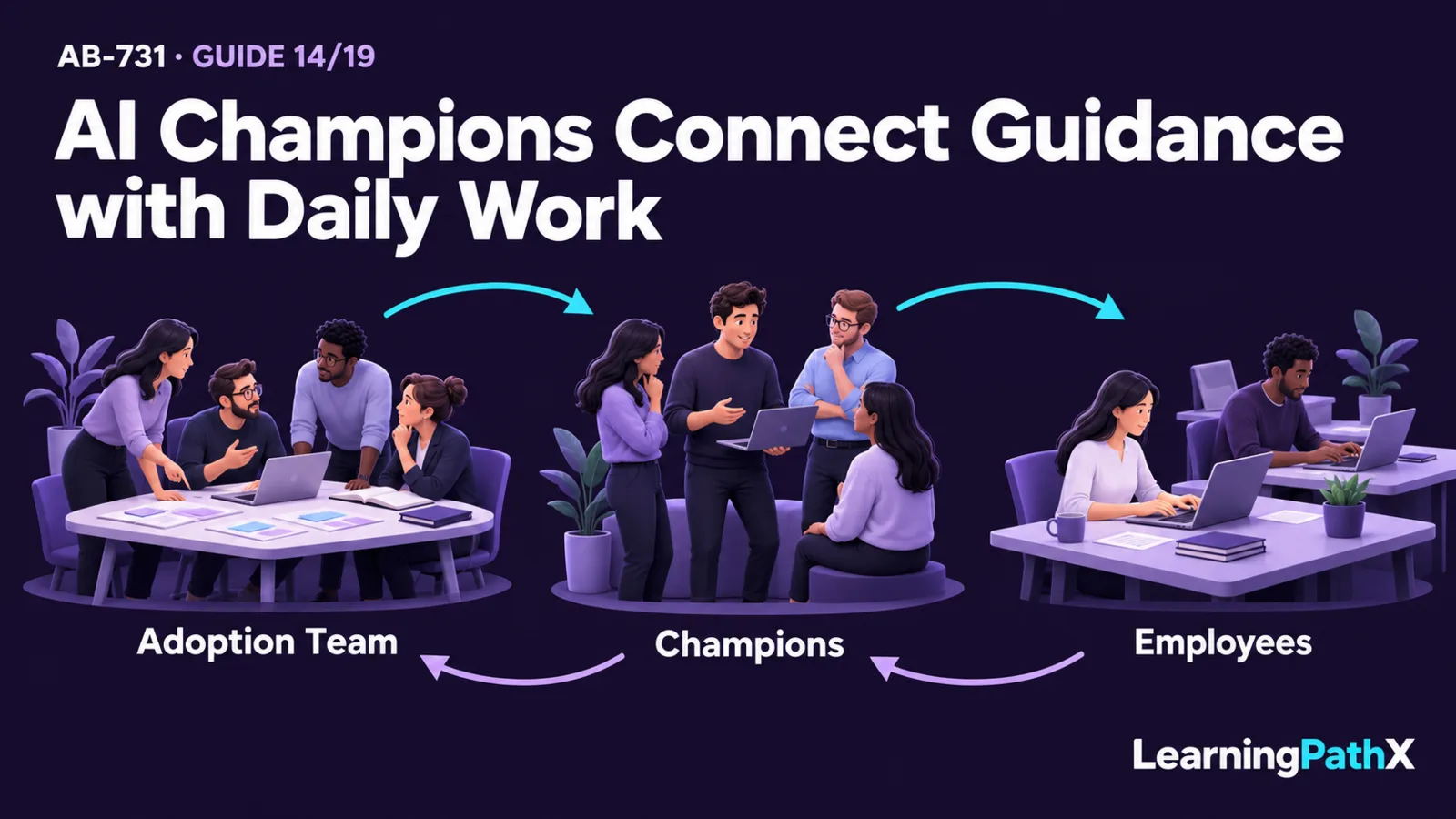
- Champions provide peer support, examples, local feedback, and a connection between central guidance and daily work.
- End users decide through their behavior whether the capability becomes part of the process.
Microsoft's roles and decision-rights guidance distinguishes leadership, business ownership, build and knowledge roles, adoption, service ownership, and end users. An organization may combine roles at first, but it should not leave the responsibilities unnamed.
Build the Adoption Team
Establish sponsorship and outcome ownership
Choose a sponsor with enough authority to connect the effort across affected functions. Sponsorship is more than approval of a budget. The sponsor must communicate why work should change, remove barriers, require accountable measurement, and demonstrate responsible use.
Assign a business owner to every priority use case. The owner defines the process baseline, affected users, desired outcome, acceptable risk, success criteria, and scale decision. A central AI team can facilitate the work, but it cannot own the value of every functional process.
Create a small cross-functional core
The core adoption team should be large enough to cover the decision but small enough to act. Typical representation includes business operations, adoption or change management, IT, security, data, privacy or compliance, service support, and learning. Add specialists when a use case requires their judgment instead of making every stakeholder attend every meeting.
Define decision rights in writing. The team should know:
- who admits and prioritizes use cases;
- who classifies risk and identifies mandatory reviewers;
- who approves technical and data readiness;
- who assigns users or licenses;
- who approves training and communication;
- who owns support and incidents;
- who judges business value and scale readiness;
- who may pause or retire a use case.
Clear decision rights prevent a common failure: a large steering group supports the idea, yet nobody is accountable for the result.
Connect governance and enablement
Governance and adoption should share one operating rhythm. Governance defines permitted use, data boundaries, review conditions, monitoring, and escalation. Enablement teaches people how to work within those boundaries and surfaces evidence that the policy is unclear or impractical.
A CoE can coordinate the shared system. Microsoft's agentic CoE guidance describes four connected functions: govern, enable, optimize, and scale. The CoE should make the safe path easier through templates, training, golden paths, and support rather than becoming a gatekeeper that users work around.
Select and Prepare the First Use Cases
Start with measurable work, not broad access
Select a few processes with visible friction, an accountable owner, available data, a reviewable output, and a measurable baseline. A good starting case is frequent enough to generate evidence but bounded enough to control. Avoid choosing only a visually impressive demonstration or a high-consequence process with no reliable verification path.
For each case, document:
- users and affected stakeholders;
- present workflow and baseline;
- intended AI-assisted behavior;
- authoritative data and access needs;
- human decisions and review points;
- risk and control requirements;
- success, quality, adoption, and guardrail measures;
- support, incident, and change owners.
This record connects the adoption effort to the approved business and governance boundary.
Prepare technology, data, and policy together
Technical readiness includes identity, access, licenses or consumption setup, application availability, data quality, permissions, supported devices and work surfaces, service management, and monitoring. Policy readiness includes acceptable use, protected information, required review, prohibited actions, reporting, and escalation.
Do not teach users to rely on data the solution cannot access reliably, and do not enable work-grounded AI before reviewing excessive or stale permissions. Conversely, do not expect a policy document to create correct behavior without examples, training, and in-work support.
Recruit Early Adopters and Champions
Distinguish early adopters from champions
Early adopters test the use case and supply evidence before scale. Champions take on an additional peer role: they explain the intended practice, share credible examples, answer local questions, and feed recurring friction back to the adoption team.
Not every enthusiastic user should become a champion. Select people who are trusted by peers, understand the local process, communicate well, respect governance boundaries, and have manager-supported time for the role. Include different functions, locations, work styles, and accessibility needs so the network does not represent only the easiest users.
Define the champion role as real work
Give champions a written role, time allocation, training, support channel, recognition, and escalation route. Expected activities can include:
- demonstrating approved use cases in the flow of work;
- hosting office hours or local learning sessions;
- helping peers improve task framing and output review;
- correcting misconceptions about capability and data access;
- collecting examples, barriers, and user feedback;
- escalating safety, privacy, quality, or support issues;
- participating in pilot and change reviews.
Microsoft's enablement and community guidance emphasizes that champions advocate, support peers, and return frontline insight to the CoE. Champions are not informal administrators, security approvers, or substitutes for a staffed service desk.
Build a community of practice
A community of practice gives early adopters and champions a shared place to learn, compare approaches, ask questions, and make good work visible. It can use an existing collaboration environment rather than a new platform. The important elements are an accountable community lead, regular useful content, office hours, a searchable record of approved guidance, routes to specialist help, and a visible feedback loop.
The community should separate endorsed practices from experiments. Encourage learning, but label examples with their use case, data boundary, reviewer expectations, and product context so an approach is not copied into an unsuitable process.
Address Common Adoption Barriers
Unclear relevance
Generic AI announcements do not tell people how their work should change. Use role- and process-specific examples that show the starting task, approved data, expected output, review responsibility, and measurable benefit. Let users compare the assisted process with the prior workflow.
Low trust or excessive trust
Some users avoid AI because they expect error or data exposure; others overtrust fluent output. Address both with transparent explanations, source-aware examples, verification practices, limitations, and reporting routes. Trust should follow evidence and accountable controls, not promotional language.
Weak manager support
People rarely sustain a new practice when managers do not allocate learning time, update expectations, or model the behavior. Train managers on the use cases, measures, and boundaries, and give them a role in reviewing team feedback and outcomes.
Skills and workflow friction
One introductory course does not create fluency. Use scenario-based learning, guided practice with real but approved tasks, prompt or workflow examples, peer support, and reinforcement in the work surface. Remove unnecessary steps and fix broken guidance quickly.
Data, access, or product mismatch
An adoption problem may actually be a readiness problem. Users cannot succeed when the solution lacks the required content, permissions are wrong, a capability is unavailable for their license or environment, or the process requires an action the tool cannot perform. Route these findings to the appropriate owner instead of adding more training.
Fear and role uncertainty
People may worry about job impact, monitoring, accountability, or how performance will be judged. Explain the intended work change, which decisions remain human, how usage data is handled, what good review looks like, and how roles may evolve. Avoid guarantees that leadership cannot support.
Run a Pilot-to-Scale Cycle
Plan
Define the use case, baseline, users, owner, risks, controls, measures, and pilot period. Recruit early adopters and champions before launch so training and support reflect the actual workflow.
Implement
Configure access and controls, validate data readiness, prepare support, test the end-to-end process, and train users on both capability and responsibility. Record which product facts and licensing assumptions were verified for the launch date.
Adopt
Use manager reinforcement, champion-led examples, community activity, office hours, guided practice, and regular communications. Collect feedback in forms that can be assigned to an owner: product defect, data problem, access issue, unclear guidance, skill gap, policy question, or use-case mismatch.
Manage
Review outcome, adoption, quality, readiness, security, support, and cost signals together. Investigate differences across roles or locations rather than relying only on an organization-wide average. Act on incidents and control failures promptly.
Improve and scale
Correct the process, data, training, controls, or support based on evidence. Scale when the use case meets its value and guardrail thresholds, ownership is durable, and the program can support the additional users. Stop or redesign when the benefit is weak, friction remains high, or risk cannot be controlled acceptably.
Measure What Changed
Use a balanced scorecard rather than one adoption number:
| Dimension | Example measures | Decision supported |
|---|---|---|
| Business outcome | Cycle time, throughput, rework, service result, quality | Is the use case valuable? |
| Adoption behavior | Eligible users, active use, repeat use, workflow completion | Are people incorporating it into work? |
| Quality and trust | Acceptance, correction, escalation, user confidence, source verification | Is the output usable and responsibly reviewed? |
| Readiness and support | Access failures, data issues, training completion, support demand | Can the operating model sustain use? |
| Risk and governance | Incidents, policy exceptions, overdue conditions, harmful or unauthorized behavior | Does use remain inside the approved boundary? |
| Cost and capacity | Consumption, support effort, review time, cost per accepted outcome | Is scale economically supportable? |
Measures should lead to decisions. A dashboard that reports activity without an owner, threshold, and response is observation rather than management.
Common Mistakes
- Equating assigned licenses with adoption or business value.
- Creating a central AI team without functional business owners.
- Naming champions without giving them time, training, recognition, or escalation support.
- Launching organization-wide before testing representative users, data, and support paths.
- Treating every barrier as a training problem when data, permission, product, or policy readiness is weak.
- Measuring prompt volume or active users without quality, outcome, risk, and cost measures.
- Publishing generic examples that do not state the approved data and human-review boundary.
- Keeping a pilot alive because it is popular even when measurable benefit is absent.
- Scaling faster than the organization can provide governance, support, and incident response.
Relevance to AB-731 Leadership Decisions
AB-731 expects leaders to establish an adoption team, identify barriers, establish an AI champions program, and understand impacts to data, security, privacy, and cost. These responsibilities belong to one adoption operating model. Team structure creates accountability, champions connect change to daily work, measurement reveals what should scale, and governance keeps the change inside an approved boundary.
For preparation, choose a representative business process and create a one-page adoption plan. Include sponsor, business owner, core team, early-adopter criteria, champion role, community route, baseline, outcome and guardrail measures, known barriers, training approach, support owner, and scale gate. This produces leadership evidence without requiring code or reconstructed exam questions.
Conclusion
Sustained AI adoption comes from accountable ownership and repeated behavior change. Establish sponsorship and business ownership, form a cross-functional adoption team, prepare technology and controls, test bounded use cases with representative users, develop champions and community support, then measure outcomes, quality, risk, readiness, and cost before scaling.
The adoption system should make safe, valuable use easier and feed frontline evidence back into governance and product decisions. Continue with AB-731: Copilot and Foundry Licensing, Cost, Data, and Security Planning to align user segments and workloads with current commercial and readiness choices. Use the AB-731: Study Roadmap for AI Transformation Leaders to practice the full sequence through leadership artifacts.
Authoritative Sources
- Microsoft 365 Copilot adoption essential guide
- Microsoft Copilot adoption hub
- Build an agentic Center of Excellence
- Define roles, responsibilities, and decision rights
- Enable makers and grow the community