
Introduction
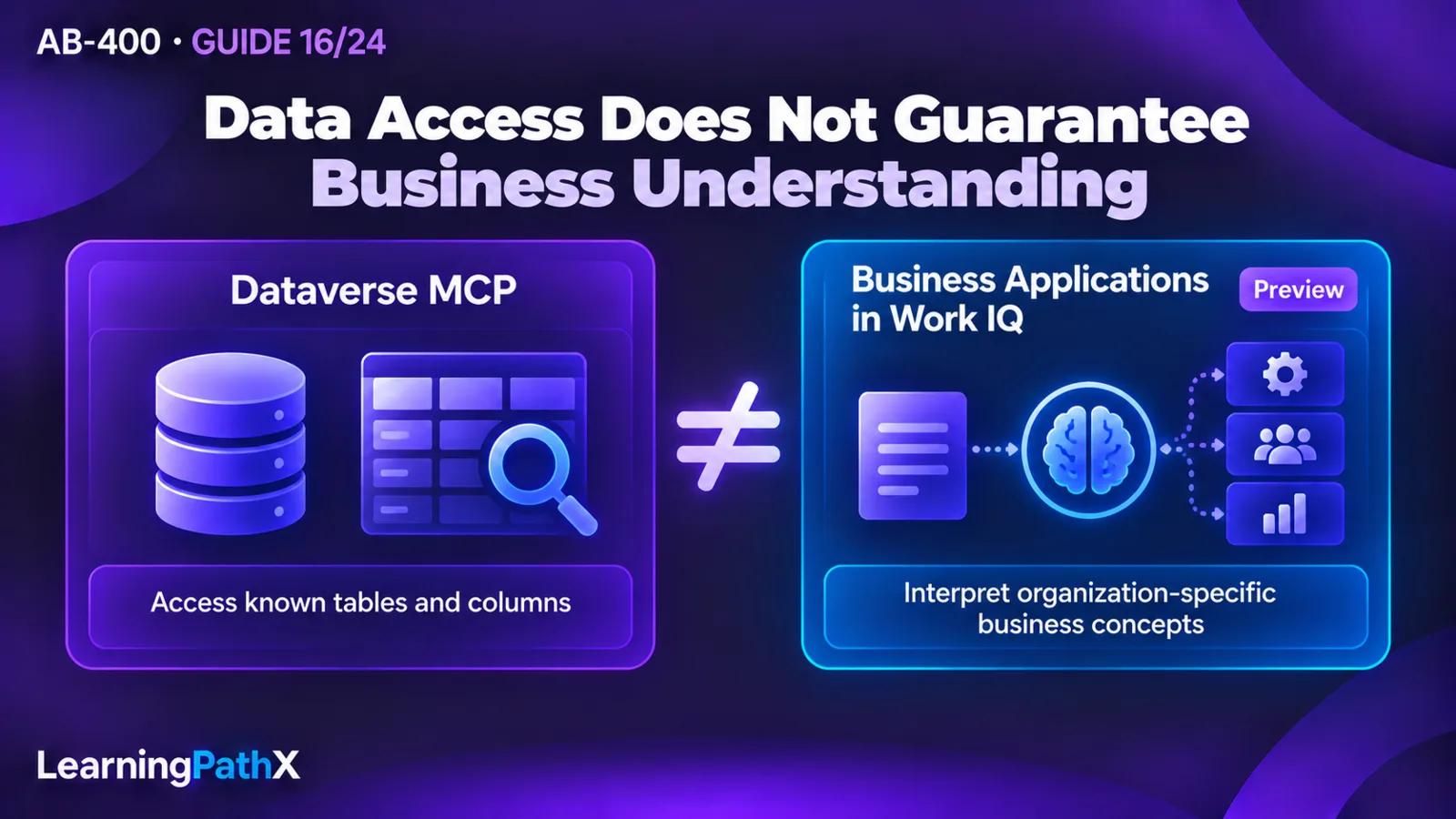
Choose Dataverse Model Context Protocol (MCP) access when an agent needs a discoverable interface to a particular Microsoft Dataverse environment's data and operations. Consider Business Applications in Work IQ when the missing capability is business meaning: interpreting application data through semantic models and reusable business skills. Business Applications in Work IQ is preview; Microsoft states preview features are not intended for production use. A production design must respect that restriction rather than treating semantic enrichment as a prerequisite for every agent.
For either path, decide whose permissions the request must preserve before choosing authentication. Enable the required environment and client access, discover the actual tools, and demonstrate both permitted and forbidden requests under the intended identity. A working connection is only one checkpoint. The outcome is an access contract that states which environment, identity, operations and data the agent may use, with evidence that a prohibited request remains prohibited.
This guide uses the frozen October 15, 2026 AB-400 scope, with the cited product documentation rechecked on October 16. As of that frozen certification baseline, exam availability was announced for October 16; this guide does not establish live exam availability. No verified AB-400 Registry record was available for the series.
Architecture Overview: Dataverse MCP and Work IQ Access for Agents
MCP separates a client that requests capabilities from a server that exposes tools. Dataverse can serve as that server. Business Applications in Work IQ adds application-specific business context to the broader Work IQ experience; each application scope retains its own model, execution behavior, permissions and governance. It is not a synonym for every Microsoft 365 Work IQ capability.
Use the following decision framework before selecting a connection:
| Reader's requirement | Initial choice | Evidence needed before accepting the design |
|---|---|---|
| A developer agent must understand a selected environment's tables before proposing an extension | Evaluate Dataverse MCP metadata capabilities | The discovered tools describe the intended schema without granting unnecessary data or write access |
| A service agent must retrieve permitted request records | Evaluate Dataverse MCP data capabilities | Returned records match the caller's effective access and the request's bounded purpose |
| An agent must interpret an organization-specific concept such as an actionable renewal | Evaluate Business Applications in Work IQ in an approved preview evaluation | A domain owner validates the meaning, and access tests still hold for each participating application scope |
| A task must obey each employee's own data boundary | Require a supported individual authentication path | Two employees with different permissions produce different permitted results |
| An unattended task intentionally acts as one service identity | Evaluate a supported shared identity path | The service identity's permissions, accountable owner and permitted audience are explicitly approved |
| The required tenant feature, client support or entitlement cannot be established | Defer that path | Resolve the prerequisite or use a separately approved integration design |
These are design recommendations, not a universal product support matrix. For example, a tool that can read records might still lack the business interpretation a question needs. Conversely, a semantic model is unnecessary when the task is simply to inspect a known table's columns. Separate missing meaning from missing access before adding infrastructure.
Core Components and Their Contracts
Environment, endpoint and client
The Dataverse documentation requires enabling and configuring the MCP server and allowed clients for the Power Platform environment. Connect the selected supported client to that environment's remote MCP endpoint. Record the environment identity separately from the agent's display name so a connection to the wrong organization cannot pass review merely because authentication succeeds.
As an implementation practice, keep an environment-specific connection record containing the owner, client, endpoint reference, authentication mode, approved operations and latest discovery evidence. Store credentials through the supported connection mechanism; keep secrets out of prompts and test reports. A copied development configuration needs fresh environment and permission verification before reuse elsewhere.
Tool discovery and metadata versus data
Inspect the tool descriptions and input contracts returned by the connected server. The documentation checked for this guide distinguishes current search, for metadata and business skills, from search_data, for structured and unstructured data. It also documents removed or replaced tools. These are dated examples to recognize during discovery, not a promise that every environment exposes an identical inventory.
Metadata discovery answers questions such as which table represents a service request or which column stores its status. Data retrieval answers which particular requests satisfy a condition. Confusing the two can produce an apparently plausible answer built from schema descriptions rather than records. Require the agent's execution evidence to identify which operation actually supplied the answer.
Review any client allowlist or denylist after a tool-surface change. As a design rule, inspect semantics and schemas before admitting a new name; do not broaden permissions merely to make an old example work. Restrict the agent's selectable tools to the approved task where the client supports it, and retain server-side authorization as the data boundary. Tool selection policy and Dataverse permissions solve different parts of the problem.
Authentication identity and authorization
Microsoft Foundry distinguishes shared authentication from individual authentication. Its OAuth identity passthrough preserves user context; key-based and supported Microsoft Entra identity methods use shared identities. This Foundry guidance describes available patterns across compatible MCP servers. It does not prove that every pattern is supported by the selected Dataverse or Work IQ endpoint.
For a per-user requirement, verify a supported end-to-end user flow rather than substituting a broad shared credential. Foundry's passthrough documentation requires same-tenant users and an appropriate project role, recommending Foundry Agent Consumer for consumers. A shared identity can be appropriate for a deliberately bounded service task, but it cannot demonstrate that the requesting employee's own Dataverse permissions were applied.
Dataverse permissions are cumulative across roles and team memberships; a narrower role does not cancel a broader grant. Record access also involves ownership, business units and sharing. Column security is a further boundary and does not itself grant record access. Authentication establishes the principal; the effective permissions of that principal determine what access tests should expect.
Business meaning through Work IQ
Business Applications in Work IQ documents semantic models for business-aware understanding and business skills for reusable process context. Its prerequisites include administrator enablement and the relevant plugin and coding-agent access configuration for MCP-server use. Verify the exact entry point's prerequisites and licensing in the intended tenant; the presence of another Work IQ experience does not establish this feature's availability.
For an illustrative renewal assistant, define whether “actionable” means a contract nearing expiry, an account requiring approval, or a customer with an unresolved service issue. A domain owner should review that definition and examples before the agent uses it to select records. Semantic correctness and access correctness need separate acceptance criteria: a well-interpreted record can still be outside the caller's permitted scope.
How Components Work Together
Consider an original design example: a regional support assistant summarizes open requests for its signed-in employee. It may read authorized request identifiers, status and priority. It may not read another region's private requests, expose a secured internal note, change records or modify schema. This example describes an expected access design; no tenant connection or test execution is claimed.
Start with Dataverse MCP if the task's terms map directly to known tables and columns. Add a Business Applications in Work IQ preview evaluation only if a real ambiguity remains, such as a business definition of “needs intervention.” Keep that evaluation separate from production acceptance while the capability remains preview.
Implement and verify the access contract in this order:
- Establish an isolated nonproduction environment with synthetic records, the necessary licensed users, approved client access and an administrator who can configure the feature. For Foundry, also establish the project and permission to configure its connection. Confirm current tenant availability, entitlement and cost ownership before sending requests.
- Define the identity requirement as employee-specific access. Configure a documented user-preserving authentication path supported by the selected client and endpoint. If that path cannot be established, stop this design rather than silently changing it to a shared identity.
- Have an administrator configure the environment's MCP server and allowed client. Set the connection to the intended environment. For a Work IQ evaluation, independently satisfy its feature-specific prerequisites.
- Discover tools under the actual test identity. Record the relevant descriptions, accepted parameters and enabled operations. Admit only the required metadata and read capabilities to this assistant where the client offers selection controls.
- Use metadata to resolve the request table and relevant columns. Then make the bounded record-data request. Compare tool results with independently established expected permissions before judging the generated summary.
- Repeat with a differently authorized employee and the negative tests below. Approve the design only when both retrieval and the final answer meet the contract.
This order prevents an attractive natural-language response from hiding a wrong environment, wrong identity or wrong operation. It also yields a reproducible decision record without coupling the design to a static tool list.
Design Considerations and Acceptance Evidence
Test the boundary with contrasting identities
Prepare two synthetic regional request sets in a user-or-team-owned table. Give employee A read access to the first set and employee B read access to the second, with no cross-region sharing. Grant neither employee write, create, delete or schema-customization privileges for the test's operations. Create a secured internal-note column and leave both employees without its read permission. Independently verify their effective grants, including teams and any broad inherited roles, before testing the agent.
The following observations are acceptance targets, not executed results. The precise denial payload or empty-result representation depends on the selected tool and client.
| Test | Expected observation | What a failure means |
|---|---|---|
| A requests a summary of A's open requests | Authorized identifiers and fields appear; the summary agrees with the synthetic fixture | A data query, interpretation or answer-generation defect remains |
| B submits the same natural-language request in a fresh B session | B's permitted records appear; A's private records do not | Reused credentials, wrong effective permissions or cross-user state may be leaking data |
| A explicitly requests a known B-only record | No protected record content appears in tool output or answer | Inspect identity, sharing and broad grants before changing the prompt |
| A requests the secured internal note on an otherwise readable record | The note remains undisclosed | Record access and column security were not tested independently |
| A asks to update priority or create a table | No change occurs; the assistant explains the task's read-only boundary | Tool admission and server permissions need correction |
| The intended user has not completed required consent | No protected-data answer is fabricated; authorization is completed through the supported flow | The client may be masking an authentication failure |
For each run, retain the test identity reference, environment, requested operation, sanitized tool result and final answer. Do not retain access tokens or sensitive fixture substitutes. A persuasive answer alone is insufficient evidence: inspect retrieval because a model could omit improperly retrieved data from the visible answer.
Distinguish the assistant's refusal from the service's enforcement. If a write capability is exposed in a separate controlled test connection, attempt a change to a disposable fixture under the restricted employee and verify that authorization prevents it. If no supported write tool is exposed, record that server-side write denial was not exercised through MCP; the assistant's read-only tool selection alone does not prove it.
Make semantic and operating conditions explicit
For a Work IQ evaluation, add positive and negative examples of the business definition. If two authorized requests differ only in whether an approval is outstanding, the assistant should explain why only one meets the approved “needs intervention” criterion. This checks meaning without granting more access. Treat instructions embedded in retrieved business text as untrusted content; the assistant's access contract should remain unchanged.
Check entitlement and charging separately from authorization. Dataverse MCP documentation describes charges for some external-agent access and qualifying exceptions; do not infer that a Power Apps license, a Copilot experience or successful sign-in makes every tool call free. This guide deliberately supplies no universal license bundle or rate. Confirm the current terms for the selected service, identity and access path.
After evaluation, remove temporary client connections and test grants, delete synthetic records according to the environment's retention policy, and remove test-only semantic context. Restore only settings changed for this evaluation after checking other consumers; disabling a shared feature could interrupt unrelated agents.
Common Mistakes and Failure Analysis
A missing tool is first a discovery or enablement question. Compare the connected environment, allowed client and current tool descriptions with the intended capability. Do not invent a replacement method or assume that an old tool name still exists.
An empty result needs evidence before interpretation. It might represent no matching authorized records, an unsuitable operation, or a permission problem surfaced by the client. Compare the controlled fixture with a direct authorized view and inspect the tool response. Never turn “nothing returned” into a confident assertion that the organization has no such records.
Unexpected access is a release blocker for this contract. Confirm the runtime principal, then inspect cumulative roles, team memberships and sharing. Changing natural-language instructions cannot repair an overprivileged shared identity.
A factually retrieved but misleading answer requires a different investigation. Check column mapping, query criteria and any business definition before adjusting model wording. Repeating the request with broader access can conceal the actual interpretation defect.
Certification Relevance
The selected AB-400 scope includes integrating agents with Power Platform through MCP and Business Applications in Work IQ. The practical skill is to connect a capability to an explicit access requirement and verify its behavior. AB-400: Designing Security and Dataverse Data Boundaries and AB-400: Dataverse API Clients and OAuth Authentication provide the prerequisite security and identity reasoning; this guide applies them to agent tool access.
Conclusion
Choose the access path from the required data operation and business meaning, then prove the identity boundary with contrasting permitted and denied requests. Preserve dynamic discovery, preview restrictions and tenant-specific prerequisites in the design record. An acceptable agent integration can explain both why it retrieved a record and why it could not retrieve another.
Authoritative Sources
- Ownership-based security in Microsoft Dataverse
- Connect to Dataverse with Model Context Protocol
- Set up MCP server authentication in Microsoft Foundry
- Business Applications in Work IQ
- AB-400 study guide