
Introduction
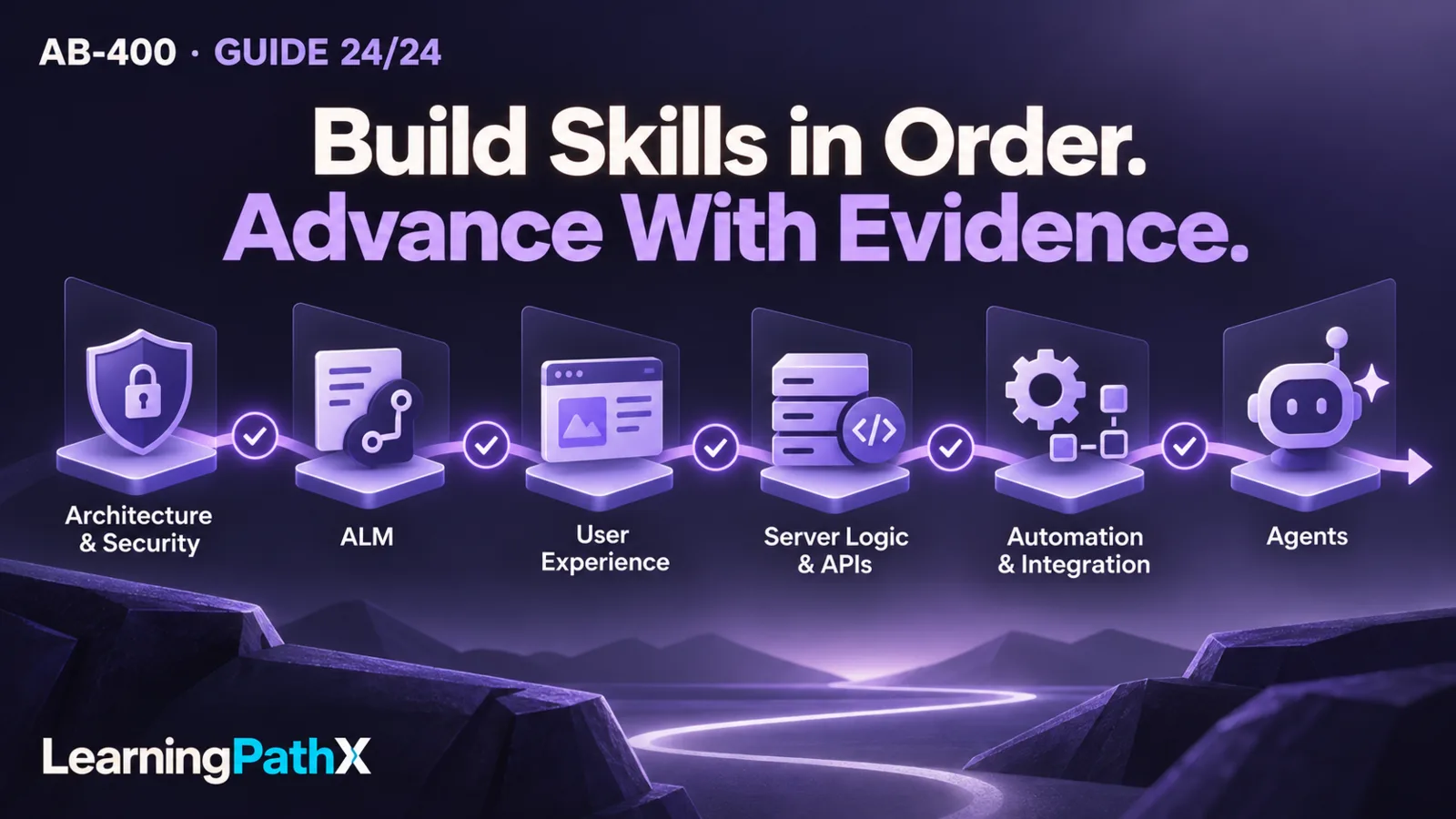
Build a skills roadmap for Power Platform developers in this order: architecture and security, application lifecycle management (ALM), user experience, server logic and API reliability, automation and integration, then agents and governed tool access. Advance when you can explain a design choice and demonstrate its intended behavior and a meaningful failure case. Finish with a constrained integration lab and revisit the earliest failed prerequisite, rather than restarting the entire series whenever a later component fails.
This is a recommended learning procedure for AB-400 preparation, not a Microsoft-mandated sequence or personal timetable. Use a small evidence record for each stage: the requirement, your decision, an artifact, expected and actual observations, and any unresolved gap. Experienced developers can demonstrate an existing skill and concentrate on missing evidence; reading completion alone does not establish that the skill is usable.
Understand the roadmap's scope
The selected baseline is the AB-400 skills measured effective October 16, 2026, verified for this series on October 15. It uses the study-guide exam name Extending Microsoft Power Platform Solutions with Code and AI for Microsoft Certified: Power Platform Developer Associate. The exam page displays Power Platform Developer Associate. As of that baseline, Microsoft announced availability beginning October 16; this roadmap does not assert a live launch. Its official source checks were repeated on October 16, 2026.
Use the four official areas as a coverage inventory, in their published order: Build Microsoft Power Platform solutions; Extend the user experience; Extend Microsoft Power Platform; Develop integrations. They describe scope, not four equal learning blocks. For example, understanding authentication before studying replay behavior makes a failed API call diagnosable; moving directly to a larger integration can hide the missing foundation behind several errors.
The stages below are editorial learning recommendations. Their outcomes deliberately combine explanation with small original demonstrations; they are not assessment questions or a prediction of exam tasks.
Establish your starting point and evidence rules
This roadmap suits developers extending Microsoft Power Platform who already understand basic Dataverse tables and applications. Before a stage, check whether you can read the language and configuration used by its example and explain the relevant data model. Address a missing language or platform foundation before treating an implementation failure as a product defect. Familiarity with C# does not establish TypeScript or browser debugging skills, and successful app making does not by itself demonstrate server-side development.
Use an isolated development environment, synthetic data and identities with explicit test permissions. Confirm licensing, feature enablement, organizational policy and potential Azure charges before provisioning. Keep secrets out of source artifacts and observations. A diagram or mocked response can support design practice when tenant access is unavailable, but mark the execution outcome as unverified. Do not silently substitute a design exercise for an integration you claim to have tested.
For each learning task, record a concrete claim such as “this caller may read its own request but cannot read another user's request.” Describe how you will observe it before building. Store redacted evidence alongside the version or configuration that produced it. Keep expected and actual results separate, including failures; a later correction should not erase why the first attempt was inconclusive.
Follow the prerequisite stages
1. Place logic and define access boundaries
Begin with one original service-request requirement: an employee submits a request, business validation decides whether it can proceed, and an external service acknowledges processing. Draw the application, Dataverse and external boundaries. Identify where the decision belongs, which identity crosses each boundary, what data it needs, and which operation must be deterministic. Explain why your chosen extension is preferable to an available platform capability for this requirement.
Your stage outcome is a compact design record, not a list of product definitions. It should identify an allowed operation, a denied operation, the owner of each validation rule and a reason for every proposed service. If you cannot say which principal performs an operation, resolve that uncertainty before adding code. AB-400: Choosing Power Platform Extension Architectures and AB-400: Designing Security and Dataverse Data Boundaries provide the prerequisite reasoning used by later implementation guides.
2. Make the smallest change repeatable
Learn ALM before accumulating extensions. Microsoft documents solutions as the mechanism for distributing solution components across environments and source control as the source of truth for collaboration. Use AB-400: Managing Solutions, Pipelines and Build Tools to learn the component, dependency and configuration boundaries before interpreting a pipeline run as a complete release.
For practice, choose one harmless solution change. Record its source, required dependencies, environment-specific bindings and intended target. Demonstrate a controlled move to a separate test environment when available; otherwise retain a clearly labeled release design with execution pending. Inspect the resulting behavior and configuration rather than accepting only an import message. Record how you would recover the previous behavior without assuming every component supports the same rollback method.
The exit evidence is a reproducible change record that another developer can inspect. Include what travels in the solution and what must be configured or provisioned separately. This stage comes early because a working component tied to one maker's connections is difficult to reproduce, diagnose or compare with a later revision.
3. Build an interface against an explicit contract
Study client scripting, hosted code components and Power Apps code apps as different user-experience tasks. Learn an event handler's role before composing an application that also depends on data, automation and agents. Follow the approved prerequisite progression into AB-400: Building Code Apps with Dataverse and Automation; use the component-specific lessons for the implementation details.
Choose one request operation for the interface exercise. Write down its input, success result, validation failure and unavailable-service behavior before connecting it. Power Apps code apps bring platform capabilities into custom web apps; ordinary frontend skill still needs a clear platform boundary.
The stage outcome is a small interface demonstration accompanied by a contract and redacted observations. Show that the user can distinguish a pending operation, confirmed success and a failed attempt. Explain which checks improve the user experience and which must be enforced by a trusted service. A visually complete screen that assumes every service call succeeds is incomplete learning evidence. Keep agent invocation for the later agent stage so an interface defect can be isolated first.
4. Prove server behavior and API reliability
Now connect the architecture to server-side execution. Use AB-400: Dataverse Plug-ins and the Event Execution Pipeline to reason about when event-bound code executes, and AB-400: Dataverse API Clients and OAuth Authentication to establish the client identity. The Dataverse event framework provides extension points around data operations; OAuth access to Dataverse uses Microsoft Entra ID. Learn those boundaries before adding retries, concurrent requests or bulk processing.
Split your evidence into two small demonstrations. For business logic, predict whether a rejected operation changes data and compare that prediction with the observation. For an API client, demonstrate one allowed operation and one deliberately denied operation under a different effective permission set. Record the identity and configuration used, not tokens or credentials.
Then use AB-400: Reliable Dataverse Bulk and Background Operations to investigate completion, retries and uncertainty. Your outcome is an explanation of what is known after a successful response, a denial and an interrupted response, plus evidence for the cases you actually exercised. Do not treat repeated submission as safe until you have a reason the business effect will not duplicate. If authentication is still unclear, return to the client demonstration rather than increasing concurrency to compensate for failures.
5. Add automation and integration one boundary at a time
Learn orchestration after a basic operation and its identity are understood. Follow AB-400: Reliable Cloud Flows and Copilot Studio Workflows for success, failure and response handling. Microsoft's flow guidance uses scopes and Run after configuration to handle failures; the learning task is to demonstrate the resulting behavior, including what the caller receives when a downstream step fails.
Continue through Azure-hosted processing before custom connector adaptation, and through event delivery before synchronization. This preserves the distinction between hosting work, describing an API contract, notifying a consumer and reconciling stored state. In particular, study AB-400: Publishing Dataverse Events to External Services before AB-400: Synchronizing Dataverse with Change Tracking and Upsert. Change tracking supplies changes for synchronization; it does not remove the need to reason about identity and recovery.
Use a separate small fixture for each unfamiliar boundary. For a connector, retain the request/response definition and one inspected error mapping. For event consumption, retain the event identity and the consumer's interpretation of a repeated delivery. For synchronization, retain a checkpoint and a comparison showing how you detect a missing or repeated change. These are recommended evidence artifacts, not assertions that one transport or platform configuration automatically provides those behaviors.
The exit condition is an end-to-end explanation backed by observations: what starts the work, who performs it, what confirms completion, and how an uncertain outcome is investigated. AB-400: Custom Connectors with OpenAPI, Policies and Code belongs here after its API and Azure Functions prerequisites. Avoid placing all these components into one fixture merely to make the exercise look comprehensive.
6. Introduce agents after tools and authorization are understandable
An agent adds another source of behavioral variability. First define the deterministic operation it may request and how its result is validated. Then use AB-400: Integrating Foundry and Copilot Studio Agents and AB-400: Dataverse MCP and Work IQ Access for Agents to study orchestration and governed access as distinct tasks.
Model Context Protocol (MCP) connects model applications with external tools and data. The Dataverse MCP server requires environment configuration and allowed clients; do not assume a connection proves unrestricted data access. Connecting Copilot Studio to a Microsoft Foundry agent is documented as preview. Verify its current prerequisites before an exercise and retain that preview boundary in your evidence.
Your outcome is an agent interaction record that identifies the caller, selected operation, authorized data, observed result and what happens when access is denied or a tool fails. Compare the proposed operation with the actual backend effect. If the tenant cannot support the feature, keep a design exercise with its availability gap visible. A fluent response alone is insufficient evidence that the intended operation occurred under the intended permissions.
Use the lab to combine evidence without expanding the fixture
After the automation, Azure Functions and connector foundations, work through AB-400: Lab: A Governed Service Request Integration. Preserve its constrained operator model, synthetic records and sequential execution. Its mock receipt is an instructional substitute for an external business effect. Do not add agents, queues or extra applications simply to make the lab represent every stage.
Use its acceptance matrix to connect earlier learning: distinguish a stable business identity from an attempt identifier, inspect which identity performs each operation, compare a denied call with a valid call, and examine replay after uncertainty. Record the request state and receipt evidence together. The lab's observations are expected results until you perform and record the tests in your own environment.
For the roadmap record, select one successful path and one failure/recovery path and explain them without reading the procedure aloud. Keep the full lab acceptance evidence separately. If a receipt exists but the request state remains unresolved, identify the boundary that failed and return to that stage's smaller exercise. After retaining redacted observations, follow the lab's cleanup and confirm the dedicated resources and credentials have been removed. The lab validates this constrained integration; separate interface, plug-in and agent artifacts remain necessary for those learning outcomes.
Revisit weak areas through a focused loop
Use failed observations to select the next learning task. “I need to study integrations” is too broad to act on; “I cannot explain which connection supplied the identity for this denied operation” identifies a repairable gap.
- State the failed claim and retain the actual observation. Distinguish lack of conceptual understanding from an implementation error, unavailable tenant capability or missing permission.
- Trace the earliest unresolved prerequisite. If a flow cannot read a row, establish the connection and effective access before revising retry logic. If a replay creates another effect, examine business identity and completion evidence before changing the interface.
- Return to the relevant component lesson and current official documentation for that specific claim. Change one cause at a time in the smallest disposable fixture that can expose it.
- Predict a successful case and a failure case, then execute them when permitted. Compare actual behavior with the prediction; unexplained success remains a gap.
- Retest the original integration path after the isolated correction. Add one variation, such as another permitted identity or a different synthetic record, to check that the explanation transfers beyond the first fixture.
- Update the evidence record with the correction, remaining limitations and cleanup. Mark unavailable execution as pending rather than repeatedly rereading material to create a false completion signal.
For example, a readable request under an administrator session does not close a denied-access gap. Repeat the observation under the intended test principal and inspect effective grants. Conversely, repeatedly failing to enable a tenant-restricted feature does not establish a language weakness. Escalate the access prerequisite through the environment's normal process and continue an independent stage whose prerequisites are satisfied.
Review readiness by evidence and remaining uncertainty
Before treating the roadmap as complete, assemble the design decision, release record, interface contract, server/API observations, integration recovery evidence and agent access record. Map each artifact to the relevant official area and identify skills that have only reading evidence. This is a personal learning inventory; it cannot establish confidential assessment coverage or guarantee a pass.
Ask another developer to inspect one artifact and explain the main boundary and failure outcome back to you. Where their explanation differs, improve the evidence or revisit the decision. The practical value is being able to build, release and investigate a bounded extension with a defensible explanation of its behavior. More screenshots or more services do not necessarily improve that explanation.
Conclusion
Use prerequisites to decide what to learn next and observable outcomes to decide when to move on. Establish trust and release foundations before composition, prove API behavior before orchestration, and add agents only after their tools and permissions are understandable. Let the constrained lab reveal integration gaps, then repair and retest the smallest failed prerequisite while preserving an honest record of what remains unverified.
Authoritative Sources
- AB-400 study guide
- AB-400 exam page
- Overview of application lifecycle management with Microsoft Power Platform
- Power Apps code apps overview
- Event framework in Microsoft Dataverse
- Use OAuth authentication with Microsoft Dataverse
- Employ robust error handling in cloud flows
- Use change tracking to synchronize data with external systems
- Create a custom connector from an OpenAPI definition
- Connect to Dataverse with Model Context Protocol
- Connect to a Microsoft Foundry agent (preview)
Related Reading
- AB-400: Managing Solutions, Pipelines and Build Tools
- AB-400: Building Code Apps with Dataverse and Automation
- AB-400: Dataverse Plug-ins and the Event Execution Pipeline
- AB-400: Dataverse API Clients and OAuth Authentication
- AB-400: Reliable Cloud Flows and Copilot Studio Workflows
- AB-400: Integrating Foundry and Copilot Studio Agents
- AB-400: Dataverse MCP and Work IQ Access for Agents
- AB-400: Publishing Dataverse Events to External Services
- AB-400: Synchronizing Dataverse with Change Tracking and Upsert
- AB-400: Custom Connectors with OpenAPI, Policies and Code
- AB-400: Lab: A Governed Service Request Integration