
AB-400 assesses developers who extend Microsoft Power Platform through custom user experiences, server logic, automation, integrations and agentic AI. It is associated with Microsoft Certified: Power Platform Developer Associate. For preparation, treat the refreshed scope as a developer role spanning design, construction, testing and troubleshooting. Existing PL-400 experience is useful evidence to reassess against that scope, rather than a reason to start every topic again.
The PL-400 transition requires a separate scheduling decision. Verified on October 15, 2026, Microsoft announces AB-400 availability beginning October 16, 2026; registration is already available. Qualifying PL-400 registrations can still lead to appointments through October 30, 2026. Choose the exam route from your actual registration and appointment eligibility, then align preparation with that exam's guide. This certification guide uses the AB-400 skills scope effective October 16, 2026.
Understand the credential and exam names
Microsoft Certified: Power Platform Developer Associate is the credential name. AB-400 is an exam code. The study guide calls the exam Extending Microsoft Power Platform Solutions with Code and AI, while the exam page displays Power Platform Developer Associate. These are source-specific labels for AB-400, not two different exams or credentials.
That distinction is useful when organizing study notes. Record the exam code and scope date alongside a resource's title; a title alone is a weak version identifier during a transition. Also distinguish an exam booking from a credential already recorded in your profile. A registration notice should not be read as an instruction to retake a credential you already hold. Resolve an individual credential or appointment issue through your Microsoft Learn profile and the official support route rather than inferring its outcome from a change of code.
What the AB-400 skills scope means for a developer
The selected study guide has four official areas, in this order:
| Official area | Weight |
|---|---|
| Build Microsoft Power Platform solutions | 15–20% |
| Extend the user experience | 25–30% |
| Extend Microsoft Power Platform | 35–40% |
| Develop integrations | 10–15% |
Across those areas, the guide covers architecture and application lifecycle management (ALM); client scripting, reusable controls and code apps; Dataverse extensions, APIs, automation and agents; and events, synchronization and custom connectors. Its change log identifies code-app construction and management, plus Microsoft Foundry agent integration, as new groups. It also moves existing material and revises several groups. A renamed heading alone does not tell you whether prior preparation remains sufficient.
Use the weights as a relative emphasis signal, not a prediction of specific questions or a personal study-time formula. For example, strong server-side experience may make your largest gap a smaller area. Conversely, being able to create an app screen says little about your ability to reason through a failed integration.
For an original readiness example, imagine a service team requesting a custom request interface and an automated downstream handoff. Before implementing anything, write down four kinds of evidence: the reason for the component placement, the interface's expected behavior, the server operation's success and failure conditions, and the external system's completion contract. This exercise connects the scope without requiring one large demonstration project. It also exposes a common blind spot: a working demonstration can hide missing reasoning about failure, access or release.
Who the exam is for and what to bring
Microsoft's audience profile expects applied platform, security and ALM knowledge, developer tooling, and experience with JavaScript, JSON, TypeScript, Power Fx, C#, Python, HTML, YAML, RESTful web APIs, Microsoft Azure, Microsoft Foundry and Microsoft Copilot Studio. These are experience expectations, not a list of additional certifications to collect. The role goes beyond app configuration to designing, developing, testing and troubleshooting extensions.
As a practical recommendation, check your starting point through evidence rather than job title. Can you read a small code change and explain its inputs and outputs? Can you separate an identity failure from a business-rule rejection? Can you describe how an environment-specific setting should be handled when moving a solution? If the explanation depends entirely on remembering clicks from a tutorial, strengthen that foundation before combining several extension surfaces.
Use an isolated development environment for practical learning, with permission to create and remove your learning assets. Check licensing, feature enablement and any paid Azure resources before provisioning them. This is a preparation recommendation; it does not assert a universal tenant entitlement or a mandatory paid lab. Keep production data and production connections out of disposable exercises.
Handle the PL-400 transition as two decisions
Microsoft states that PL-400 registration closes on October 16, 2026, when registration becomes exclusive to AB-400. Learners registered for PL-400 on or before that date can continue to schedule and take it through October 30, 2026. The announcement does not justify inventing a local cutoff time or assuming that a particular appointment is available.
First, confirm the administrative route that actually applies to you. If you already have a PL-400 registration, inspect its appointment options before changing it. If you are preparing for AB-400, use its dated scope and current booking information. Neither route should be selected solely because a course folder has an older code on its cover.
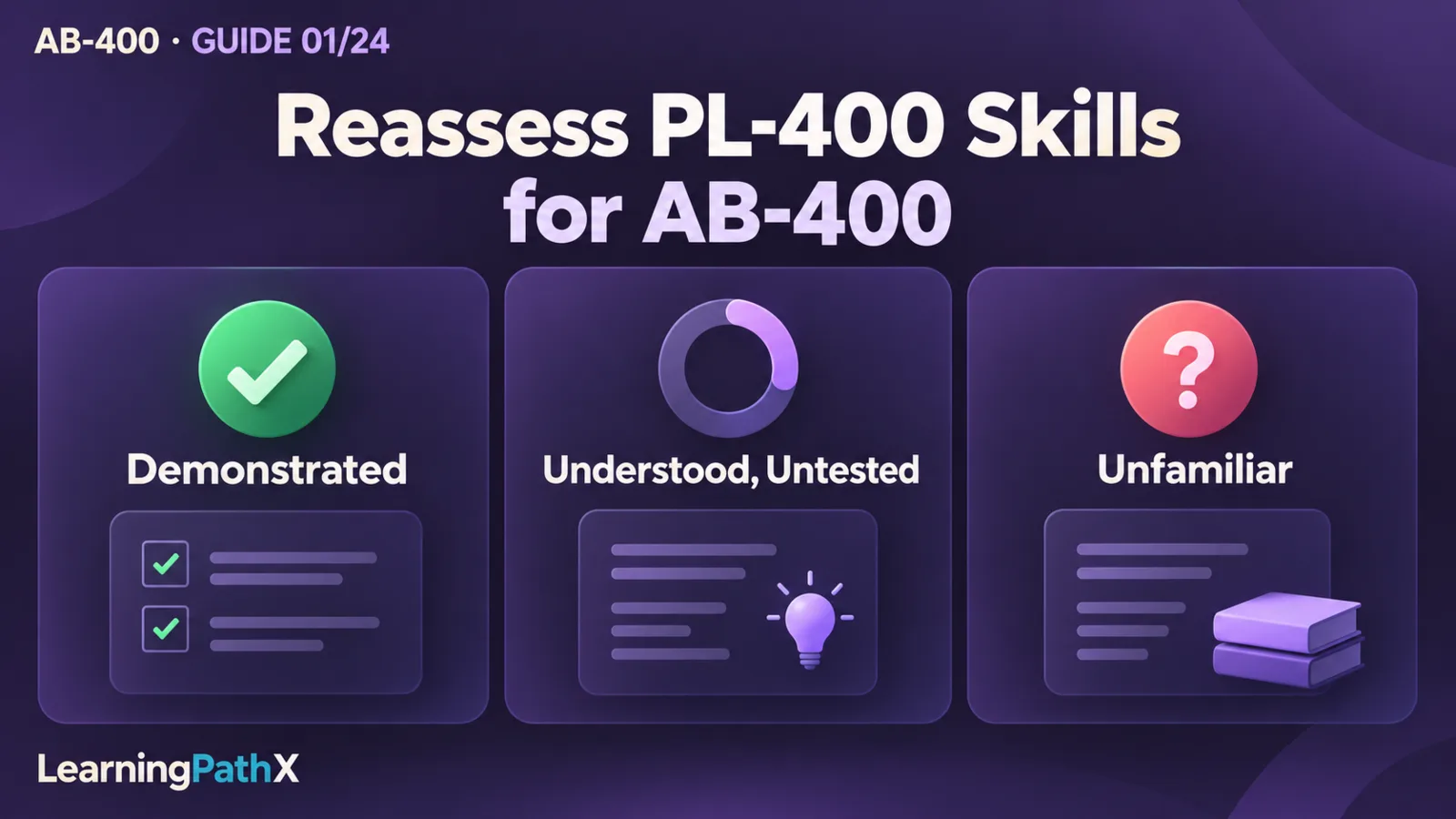
Second, audit the content you already know. For each relevant task, mark the evidence as demonstrated, understood but untested, or unfamiliar. Retain sound explanations, code-reading skills and diagnostic habits. Recheck version-sensitive instructions and fill the specific gaps. This recommendation avoids both repeating familiar foundations without purpose and assuming that all older material remains current.
Common preparation mistakes
The certification landing page still contains an older scope summary. Use the matching AB-400 study guide and exam page for the selected scope, while using the certification page to understand the credential and transition. Mixing these source purposes can produce an apparently complete checklist for the wrong version.
Another mistake is turning every scope item into a definition to memorize. A more useful note states what decision the concept supports, what evidence would show correct behavior, and what failure would change the design. Keep that note short enough to reveal missing reasoning. Detailed implementation belongs in the component guides; this guide establishes which role and version you are preparing for.
Finally, distinguish an objective's inclusion from a feature's deployment readiness. Check current product documentation before a lab, especially where a feature is labeled preview. An exam scope is not a substitute for product prerequisites or production acceptance criteria.
Conclusion
Use the verified registration dates to settle the exam route, and the matching skills guide to settle the preparation scope. Then evaluate prior PL-400 learning through demonstrable developer tasks. The useful outcome is a clear account of your current capability and remaining gaps, with the credential name, exam code and scope date recorded separately.