
Introduction
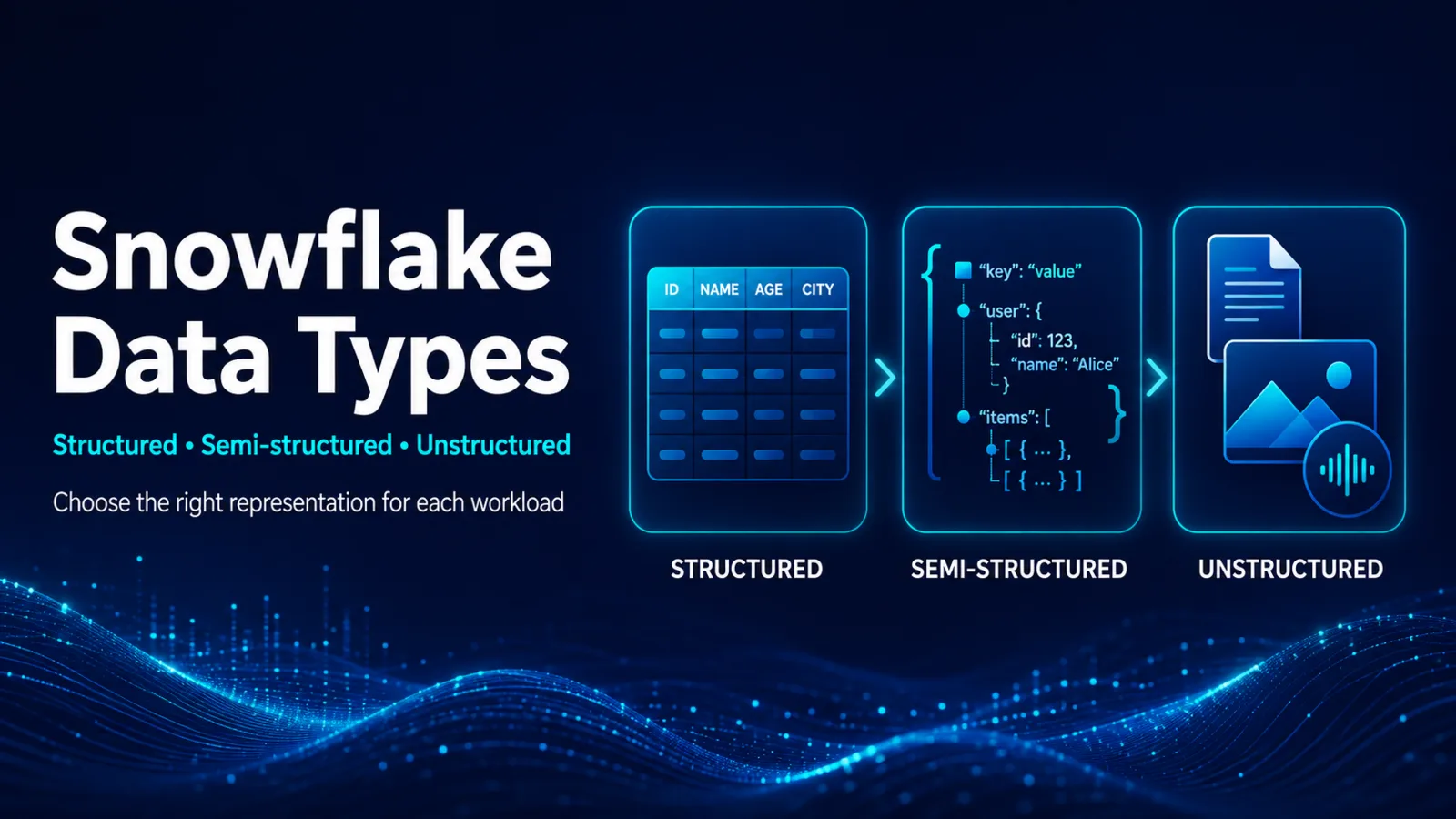
Snowflake supports structured, semi-structured, and unstructured data, but each category has a different representation and access pattern. Selecting the correct model affects type safety, query design, pruning, governance, and downstream tooling. The goal is not to force every input into relational columns or to place every irregular record into VARIANT; it is to match representation to stable access requirements.
Structured Data
Structured data follows a defined tabular schema. Columns have declared data types, making validation, joins, aggregation, and business rules predictable. CSV input may look tabular, but a CSV file is still staged text until file-format rules parse it and values are converted into target column types.
Relational columns are usually the clearest choice when attributes are stable, frequently filtered or joined, and governed individually. Correct types also avoid repeated runtime conversion of timestamps, numbers, or booleans stored as strings.
Semi-structured Data
Semi-structured formats such as JSON, Avro, ORC, Parquet, and XML can contain nested or evolving attributes. Snowflake provides VARIANT, OBJECT, and ARRAY data types for hierarchical values.
VARIANT can hold values of other supported types, including nested objects and arrays. Path notation accesses known elements, while FLATTEN produces a lateral row set from nested arrays or objects.
A representative lab query is:
SELECT
event_payload:customer:id::NUMBER AS customer_id,
item.value:sku::STRING AS sku,
item.value:quantity::NUMBER AS quantity
FROM analytics.raw.events,
LATERAL FLATTEN(INPUT => event_payload:items) AS item;
This example assumes the referenced paths and conversions match the source data. Missing or inconsistent types require explicit quality handling.
VARIANT versus relational columns
Keeping evolving input in VARIANT can accelerate ingestion and preserve source fidelity. Extracting stable, high-value attributes into typed relational columns can improve clarity, pruning, and repeated analytical use. Snowflake recommends testing representative data rather than applying one model universally.
Non-native values such as dates stored as JSON strings may consume more space or perform less efficiently than corresponding relational types. Arrays that are repeatedly flattened can also justify curated relational structures.
Unstructured Data
Unstructured data includes documents, images, and audio that do not expose an inherent relational schema. Snowflake documentation places unstructured files in internal or external stages before access and processing. Directory tables can expose file metadata, scoped URLs can provide governed access, and supported functions or services can process file content.
The FILE data type can reference files for supported use cases. It should not be treated as though the binary content automatically becomes a set of relational columns. Security must cover the stage, file access URL, role, and any processing service.
Choosing a Representation
Use these questions:
- Is the schema stable and enforced by consuming systems?
- Which fields drive joins, filters, policies, and aggregations?
- Must the original payload be retained for audit or replay?
- How often do nested arrays require expansion?
- Are files processed as whole objects or interpreted into records?
- What retention, privacy, and access controls apply to raw and curated copies?
A common pattern is to preserve raw payloads, validate and transform them, and publish typed curated tables. This is an architectural example, not a requirement for every workload.
Common Mistakes
- Treating file format as the same concept as Snowflake data type.
- Storing stable numeric or timestamp fields permanently as strings without a reason.
- Casting nested values without handling missing or malformed attributes.
- Using FLATTEN without understanding how it multiplies rows.
- Assuming VARIANT removes the need for data-quality rules.
- Treating a staged document as though it were automatically loaded into a table.
- Granting broad stage access when users need only governed file references.
Certification Relevance
COF-C03 explicitly includes structured, semi-structured, and unstructured data. Practical readiness means explaining their storage and query boundaries, choosing suitable types, and predicting how modeling choices affect transformations and evidence.
Authoritative Sources
- Semi-structured data types
- Introduction to loading semi-structured data
- Considerations for semi-structured data stored in VARIANT
- Unstructured data types
Conclusion
Structured columns provide strong relational semantics, semi-structured types preserve evolving hierarchies, and staged files support unstructured content. Use workload evidence and governance requirements to decide what remains raw, what becomes typed, and how each representation is accessed safely.