
Introduction
The SnowPro® Core Certification exam COF-C03 validates practical familiarity with the Snowflake AI Data Cloud. Snowflake launched the English COF-C03 exam on February 16, 2026 as the replacement for COF-C02. The certification page recommends at least six months of experience using Snowflake, which matters because the published scope connects architecture concepts to routine administrative, data, and operational decisions.
This overview explains what the certification covers, how the platform's major responsibilities fit together, and how to build useful Snowflake skills without relying on reconstructed exam content.
What COF-C03 Covers
Snowflake publishes seven top-level abilities for COF-C03:
- Use the Snowflake AI Data Cloud architecture.
- Manage Snowflake accounts and virtual warehouses.
- Perform data loading, unloading, and transformation.
- Use structured, semi-structured, and unstructured data.
- Monitor and optimize performance.
- Enable data collaboration and protection.
- Establish Snowflake connectivity.
These are capability statements, not isolated memorization topics. A loading workflow, for example, depends on a stage, a file format, sufficient privileges, compute selection, and load-history evidence. Performance work similarly depends on distinguishing warehouse queuing from inefficient scanning or a restrictive network path.
The Snowflake AI Data Cloud at a Glance
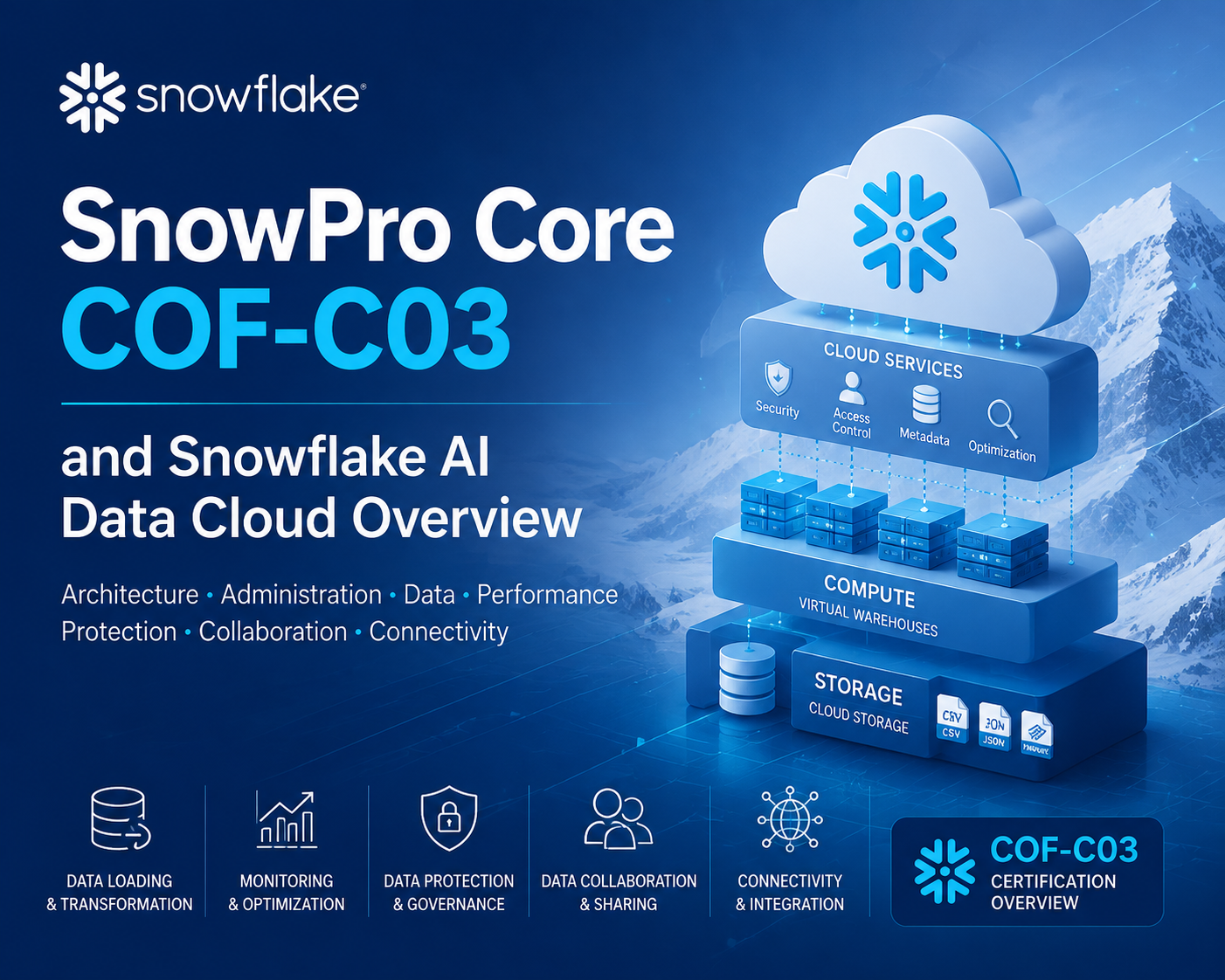
Snowflake separates persistent storage, compute, and coordinating cloud services. Data in Snowflake tables is stored in an optimized columnar format in cloud storage. Virtual warehouses provide independent compute clusters for SQL and other supported workloads. The cloud services layer coordinates authentication, access control, metadata management, query parsing, and optimization.
This separation creates an important operational rule: a team can change compute capacity without moving the persisted table data. It also means that a slow request should not automatically be treated as a storage problem. The cause might be queueing at the warehouse, excessive scanning caused by weak pruning, an authentication policy, or a client-side connectivity issue.
Snowflake also integrates data engineering, analytics, artificial intelligence and machine learning, application development, and collaboration capabilities. COF-C03 is a core certification, so the useful learning goal is to understand the responsibility and selection logic of these capabilities rather than to become a specialist in every advanced feature.
Who Should Build These Skills
The scope is relevant to several technical roles:
- Data engineers need to select loading patterns, transform data, operate pipelines, and validate freshness.
- Analysts need to understand warehouses, data types, query behavior, and governed access.
- Administrators need to manage accounts, roles, authentication, network access, cost, and monitoring.
- Application developers need to choose supported drivers or connectors and separate authentication from authorization failures.
- Architects need to connect workload requirements to account, compute, protection, and collaboration boundaries.
Candidates who know SQL but have limited Snowflake experience should first practice object creation, warehouse use, staged loading, role switching, query-history review, and Time Travel in a non-production account.
A Practical Learning Sequence
Build the architecture model first
Start with storage, compute, and cloud services. Be able to trace a request from sign-in through authorization, parsing, optimization, warehouse execution, and retrieval of persisted data. This model prevents layer confusion later.
Add administration and data movement
Learn how organizations contain accounts, how roles receive privileges, and why object ownership matters. Then practice inbound loading with stages, file formats, COPY INTO <table>, and Snowpipe. Reverse the direction with COPY INTO <location> to understand unloading.
Work across data representations
Compare relational columns with VARIANT, OBJECT, and ARRAY. Practice path traversal and FLATTEN, and understand that unstructured files normally begin in a stage rather than a relational column.
Use evidence before optimization
Review Query History, warehouse activity, and Query Profile before changing compute or storage design. A larger warehouse may help a compute-bound query but is not a universal remedy for blocked access, poor pruning, or excessive concurrency.
Separate protection from collaboration
Time Travel, Fail-safe, and cloning address history, recovery, and environment creation. Secure Data Sharing and listings provide governed provider-consumer access. A clone is not a share, and Fail-safe is not a customer-operated backup.
Common Preparation Mistakes
- Memorizing feature names without tracing dependencies and evidence.
- Treating a virtual warehouse as the location where table data is permanently stored.
- Using ACCOUNTADMIN for routine work instead of designing a role hierarchy.
- Confusing COPY INTO <table> with COPY INTO <location>.
- Changing warehouse size before checking queueing, scan volume, spill, and pruning evidence.
- Treating authentication, authorization, and network policy as the same control.
- Assuming all features and retention periods are available in every Snowflake edition.
Authoritative Sources
- SnowPro Core Certification (COF-C03)
- Snowflake key concepts and architecture
- Get started with Snowflake
Conclusion
COF-C03 is best approached as a connected platform-skills assessment. Build a layer-aware architecture model, practice routine Snowflake operations, and use documented evidence to explain why a configuration or troubleshooting decision is appropriate. That method supports both certification preparation and safer day-to-day Snowflake work.